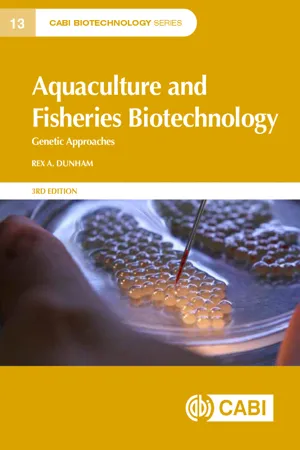
The genetic improvement of fish for aquaculture and related fisheries has seen huge advances over recent years. Building upon the previous two editions of Aquaculture and Fisheries Biotechnology: Genetic Approaches, this 3rd edition offers a presentation of traditional selective breeding, modern genetic biotechnology, genomics, gene transfer and gene editing, and the latest developments in genetic biotechnology such as epigenetics, xenogenesis and genome-wide association study coupled with commercial application, the impact of government regulation and expectations for the future. It provides a firm grounding in relevant aspects of classical genetics, before focusing on particular aspects such as sex reversal and breeding as applied in aquaculture and fisheries. It also explores how more recent molecular genetics, genomics and biotechnology techniques can be used and combined in improvement programmes for fish and aquaculture species. A glossary explains the latest terminology used in biotechnology and genetics.This book will be useful for research scientists and students in marine biotechnology, aquaculture biotechnology, and fish genetics and breeding.
- 648 pages
- English
- ePUB (mobile friendly)
- Available on iOS & Android
eBook - ePub
About this book
Information
Table of contents
- Cover
- Title page
- Copyright
- Contents
- Foreword
- Preface
- Acknowledgments
- 1 History of Biotechnology, Genetics, and Selective Breeding in Aquaculture and Fisheries
- 2 Phenotypic Variation and Environmental Effects
- 3 Basic Genetics, Qualitative Traits, and Selection for Qualitative Traits
- 4 Strain Evaluation, Domestication, and Strain Selection
- 5 Population Size, Inbreeding, Random Genetic Drift, and Maintenance of Genetic Quality
- 6 Gynogenesis, Androgenesis, Cloned Populations, and Nuclear Transplantation
- 7 Intraspecific Crossbreeding
- 8 Interspecific Hybridization
- 9 Selection and Correlated Responses to Selection
- 10 Polyploidy
- 11 Xenogenesis
- 12 Sex Determination
- 13 Sex Reversal and Breeding, Monosex Populations, and Sterility
- 14 Biochemical and Molecular Markers
- 15 Population Genetics and Interactions of Hatchery and Wild Fish
- 16 Genomics, Gene Mapping, Quantitative Trait Locus Mapping, Marker-Assisted Selection, Genome-Wide Association Studies, and Genomic Selection
- 17 Gene Expression
- 18 Gene-Transfer Technology
- 19 Reverse Genetics, Gene Knockdown, Gene/Genome Editing, and Induced Mutations
- 20 Combining Genetic Enhancement Programs
- 21 Genotype–Environment Interactions
- 22 Commercial Application of Fish Biotechnology
- 23 Environmental Risk of Aquatic Organisms from Genetic Biotechnology
- 24 Genetic Sterilization to Reduce Environmental Risk of Genetically Altered Aquatic Organisms and Control Invasive Species
- 25 Food Safety and Consumer Acceptance of Transgenic Aquatic Organisms
- 26 A Case Example: Safety of Consumption of Transgenic Salmon Potentially Containing Elevated Levels of Growth Hormone and Insulin-like Growth Factor
- 27 Government Regulation of Transgenic and Gene-Edited Fish and Biotechnology Products
- 28 Strategies for Genetic Conservation and Gene Banking
- 29 Ethics
- 30 Constraints and Limitations of Genetic Biotechnology
- Glossary
- References and Further Reading
- Index
- Back Cover
Trusted by 375,005 students
Access to over 1.5 million titles for a fair monthly price.
Study more efficiently using our study tools.
Frequently asked questions
Yes, you can cancel anytime from the Subscription tab in your account settings on the Perlego website. Your subscription will stay active until the end of your current billing period. Learn how to cancel your subscription
No, books cannot be downloaded as external files, such as PDFs, for use outside of Perlego. However, you can download books within the Perlego app for offline reading on mobile or tablet. Learn how to download books offline
Perlego offers two plans: Essential and Complete
- Essential is ideal for learners and professionals who enjoy exploring a wide range of subjects. Access the Essential Library with 800,000+ trusted titles and best-sellers across business, personal growth, and the humanities. Includes unlimited reading time and Standard Read Aloud voice.
- Complete: Perfect for advanced learners and researchers needing full, unrestricted access. Unlock 1.5M+ books across hundreds of subjects, including academic and specialized titles. The Complete Plan also includes advanced features like Premium Read Aloud and Research Assistant.
We are an online textbook subscription service, where you can get access to an entire online library for less than the price of a single book per month. With over 1.5 million books across 990+ topics, we’ve got you covered! Learn about our mission
Look out for the read-aloud symbol on your next book to see if you can listen to it. The read-aloud tool reads text aloud for you, highlighting the text as it is being read. You can pause it, speed it up and slow it down. Learn more about Read Aloud
Yes! You can use the Perlego app on both iOS and Android devices to read anytime, anywhere — even offline. Perfect for commutes or when you’re on the go.
Please note we cannot support devices running on iOS 13 and Android 7 or earlier. Learn more about using the app
Please note we cannot support devices running on iOS 13 and Android 7 or earlier. Learn more about using the app
Yes, you can access Aquaculture and Fisheries Biotechnology by Rex A Dunham in PDF and/or ePUB format, as well as other popular books in Technology & Engineering & Fisheries & Aquaculture. We have over 1.5 million books available in our catalogue for you to explore.