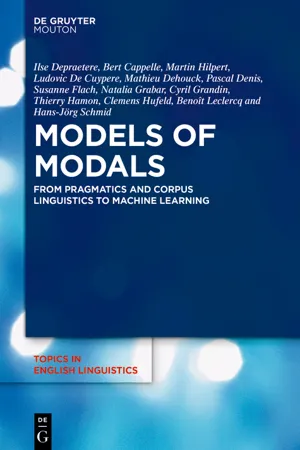
eBook - ePub
Models of Modals
From Pragmatics and Corpus Linguistics to Machine Learning
- 280 pages
- English
- ePUB (mobile friendly)
- Available on iOS & Android
eBook - ePub
Models of Modals
From Pragmatics and Corpus Linguistics to Machine Learning
About this book
No detailed description available for "Models of Modals".
Information
Publisher
De Gruyter MoutonYear
2023Print ISBN
9783111620725
9783110738612
Edition
1eBook ISBN
9783110734256
Table of contents
- Title Page
- Copyright
- Contents
- Introduction
- 1 English modals: An outline of their forms, meanings and uses
- 2 Modality revisited: Combining insights from Construction Grammar and Relevance Theory
- 3 Possibility modals: Which conditions make them possible?
- 4 Necessity modals and the role of source as a predictive factor
- 5 You must/have to choose: Experimenting with choices between near-synonymous modals
- 6 Does the intersubjectivity of modal verbs boost inter-individual differences?
- 7 Modals as a predictive factor for L2 proficiency level
- 8 Revisiting modal sense classification with contextual word embeddings
- 9 Modals in the network model of Construction Grammar
- Index
Trusted by 375,005 students
Access to over 1.5 million titles for a fair monthly price.
Study more efficiently using our study tools.
Frequently asked questions
Yes, you can cancel anytime from the Subscription tab in your account settings on the Perlego website. Your subscription will stay active until the end of your current billing period. Learn how to cancel your subscription
No, books cannot be downloaded as external files, such as PDFs, for use outside of Perlego. However, you can download books within the Perlego app for offline reading on mobile or tablet. Learn how to download books offline
We are an online textbook subscription service, where you can get access to an entire online library for less than the price of a single book per month. With over 1.5 million books across 990+ topics, we’ve got you covered! Learn about our mission
Look out for the read-aloud symbol on your next book to see if you can listen to it. The read-aloud tool reads text aloud for you, highlighting the text as it is being read. You can pause it, speed it up and slow it down. Learn more about Read Aloud
Yes! You can use the Perlego app on both iOS and Android devices to read anytime, anywhere — even offline. Perfect for commutes or when you’re on the go.
Please note we cannot support devices running on iOS 13 and Android 7 or earlier. Learn more about using the app
Please note we cannot support devices running on iOS 13 and Android 7 or earlier. Learn more about using the app
Yes, you can access Models of Modals by Ilse Depraetere,Bert Cappelle,Martin Hilpert,Ludovic De Cuypere,Mathieu Dehouck,Pascal Denis,Susanne Flach,Natalia Grabar,Cyril Grandin,Thierry Hamon,Clemens Hufeld,Benoît Leclercq,Hans-Jörg Schmid in PDF and/or ePUB format, as well as other popular books in Languages & Linguistics & Linguistics. We have over 1.5 million books available in our catalogue for you to explore.