Muslim Eurasia (1995) looks at the Muslim states that came into being on the ruins of the Soviet Union, and their complex legacies of Russian colonialism, russification, de-islamicization, centralization and communism – on top of localism, tribalism and Islam. The interaction and contradictions within each category, and between them, form the essence of the struggle to formulation new identities.
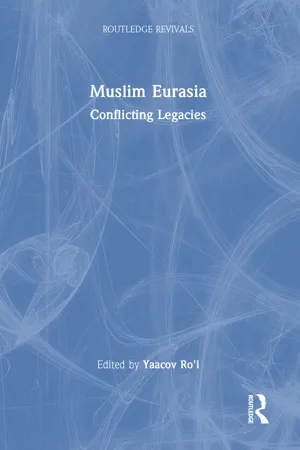
- 340 pages
- English
- ePUB (mobile friendly)
- Available on iOS & Android
eBook - ePub
About this book
Information
Table of contents
- Cover
- Title Page
- Copyright Page
- Original Title Page
- Original Copyright Page
- Table of Contents
- List of Maps
- Preface
- Note on Orthography
- Introduction
- 1 The Secularization of Islam and the USSR’s Muslim Areas
- 2 Islam and Fundamentalism in Independent Central Asia
- 3 Does Islamic Fundamentalism Exist in Russia?
- 4 Islam and Ethnic Identity in Central Asia: A View from Below
- 5 Geopolitics and Ethnic Problems of Uzbekistan and Its Neighbours
- 6 Regionalism and Clan Loyalty in the Political Life of Uzbekistan
- 7 Tajikistan: Political Parties in an Inchoate National Space
- 8 A Year of Rule by the Popular Front of Azerbaijan
- 9 Unity, Diversity and Conflict in the Northern Caucasus
- 10 Soviet Muslims: Gains and Losses as a Result of Soviet Language Planning
- 11 Independence and the Declining Priority of Language Law Implementation in Uzbekistan
- 12 Modernization of Demographic Behaviour in the Muslim Republics of the Former USSR
- 13 The Economies of Central Asia: The Socialist Legacy
- 14 Roots of Diversity and Conflict: Ethnic and Gender Differences in the Work Force of the Former Republics of Soviet Central Asia
- 15 The Russians in Central Asia and Kazakhstan
- Afterword
- Notes on Contributors
- Glossary
- Index
Trusted by 375,005 students
Access to over 1.5 million titles for a fair monthly price.
Study more efficiently using our study tools.
Frequently asked questions
Yes, you can cancel anytime from the Subscription tab in your account settings on the Perlego website. Your subscription will stay active until the end of your current billing period. Learn how to cancel your subscription
No, books cannot be downloaded as external files, such as PDFs, for use outside of Perlego. However, you can download books within the Perlego app for offline reading on mobile or tablet. Learn how to download books offline
Perlego offers two plans: Essential and Complete
- Essential is ideal for learners and professionals who enjoy exploring a wide range of subjects. Access the Essential Library with 800,000+ trusted titles and best-sellers across business, personal growth, and the humanities. Includes unlimited reading time and Standard Read Aloud voice.
- Complete: Perfect for advanced learners and researchers needing full, unrestricted access. Unlock 1.5M+ books across hundreds of subjects, including academic and specialized titles. The Complete Plan also includes advanced features like Premium Read Aloud and Research Assistant.
We are an online textbook subscription service, where you can get access to an entire online library for less than the price of a single book per month. With over 1.5 million books across 990+ topics, we’ve got you covered! Learn about our mission
Look out for the read-aloud symbol on your next book to see if you can listen to it. The read-aloud tool reads text aloud for you, highlighting the text as it is being read. You can pause it, speed it up and slow it down. Learn more about Read Aloud
Yes! You can use the Perlego app on both iOS and Android devices to read anytime, anywhere — even offline. Perfect for commutes or when you’re on the go.
Please note we cannot support devices running on iOS 13 and Android 7 or earlier. Learn more about using the app
Please note we cannot support devices running on iOS 13 and Android 7 or earlier. Learn more about using the app
Yes, you can access Muslim Eurasia by Yaacov Ro'i in PDF and/or ePUB format, as well as other popular books in Politics & International Relations & Politics. We have over 1.5 million books available in our catalogue for you to explore.