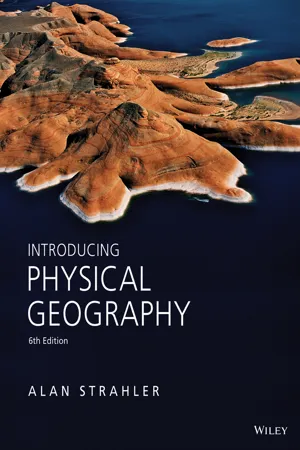
The 6th edition of Introducing Physical Geography is known for its clear writing, distinctive photos and illustrations and a strong supplements program. The text continues its tradition as a great book to help non-science readers visualize and understand earth processes and learn the basic language of physical geography. The new edition features a strengthened "Eye on Global Change" coverage and coverage of the geographer's tool box.
- 661 pages
- English
- PDF
- Available on iOS & Android
eBook - PDF
Introducing Physical Geography
About this book
Key takeaways
AI-Generated Insights
Insight 1
Apply geographic tools such as maps, GIS, and remote sensing to analyze Earth's physical systems and processes. Explain the fundamental principles governing Earth's energy balance and atmospheric dynamics.
Insight 2
Analyze the geological and geomorphic processes, including plate tectonics, weathering, and erosion by water, wind, and ice, that shape Earth's diverse landforms.
Insight 3
Evaluate the interconnections among global climates, terrestrial ecosystems, and soil characteristics, and assess the impacts of global change on these integrated physical environments.
Table of contents
- Cover
- Title Page
- Copyright
- Preface
- Earth from Above: An Aerial Portrait of Our Planet
- Brief Contents
- Contents
- Introduction: Physical Geography and the Tools Geographers Use
- Chapter 1: The Earth as a Rotating Planet
- Chapter 2: The Earth's Global Energy Balance
- Chapter 3: Air Temperature
- Chapter 4: Atmospheric Moisture and Precipitation
- Chapter 5: Winds and Global Circulation
- Chapter 6: Weather Systems
- Chapter 7: Global Climates and Climate Change
- Chapter 8: Biogeographic Processes
- Chapter 9: Global Biogeography
- Chapter 10: Global Soils
- Chapter 11: Earth Materials and Plate Tectonics
- Chapter 12: Tectonic and Volcanic Landforms
- Chapter 13: Weathering and Mass Wasting
- Chapter 14: Freshwater of the Continents
- Chapter 15: Landforms Made by Running Water
- Chapter 16: Landforms Made by Waves and Wind
- Chapter 17: Glacial and Periglacial Landforms
- Appendix 1: Climate Definitions and Boundaries
- Appendix 2: Conversion Factors
- Appendix 3: Topographic Map Symbols
- Glossary
- Illustration Credits
- Index
Trusted by 375,005 students
Access to over 1.5 million titles for a fair monthly price.
Study more efficiently using our study tools.
Frequently asked questions
Yes, you can cancel anytime from the Subscription tab in your account settings on the Perlego website. Your subscription will stay active until the end of your current billing period. Learn how to cancel your subscription
No, books cannot be downloaded as external files, such as PDFs, for use outside of Perlego. However, you can download books within the Perlego app for offline reading on mobile or tablet. Learn how to download books offline
We are an online textbook subscription service, where you can get access to an entire online library for less than the price of a single book per month. With over 1.5 million books across 990+ topics, we’ve got you covered! Learn about our mission
Look out for the read-aloud symbol on your next book to see if you can listen to it. The read-aloud tool reads text aloud for you, highlighting the text as it is being read. You can pause it, speed it up and slow it down. Learn more about Read Aloud
Yes! You can use the Perlego app on both iOS and Android devices to read anytime, anywhere — even offline. Perfect for commutes or when you’re on the go.
Please note we cannot support devices running on iOS 13 and Android 7 or earlier. Learn more about using the app
Please note we cannot support devices running on iOS 13 and Android 7 or earlier. Learn more about using the app
Yes, you can access Introducing Physical Geography by Alan H. Strahler in PDF and/or ePUB format, as well as other popular books in Physical Sciences & Geography. We have over 1.5 million books available in our catalogue for you to explore.