- 1,098 pages
- English
- ePUB (mobile friendly)
- Available on iOS & Android
eBook - ePub
About this book
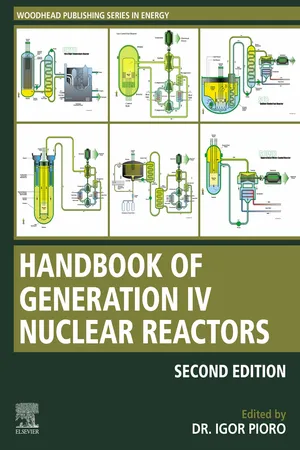
Handbook of Generation IV Nuclear Reactors, Second Edition is a fully revised and updated comprehensive resource on the latest research and advances in generation IV nuclear reactor concepts. Editor Igor Pioro and his team of expert contributors have updated every chapter to reflect advances in the field since the first edition published in 2016. The book teaches the reader about available technologies, future prospects and the feasibility of each concept presented, equipping them users with a strong skillset which they can apply to their own work and research.
- Provides a fully updated, revised and comprehensive handbook dedicated entirely to generation IV nuclear reactors
- Includes new trends and developments since the first publication, as well as brand new case studies and appendices
- Covers the latest research, developments and design information surrounding generation IV nuclear reactors
Information
Table of contents
- Handbook of Generation IV Nuclear Reactors
- Cover
- Title Page
- Copyright
- Table of Contents
- Contributors
- Foreword
- Preface
- Chapter 1 Introduction
- References
- Further reading
- Sub Chapter 1.2 Current status and future trends in the world nuclear-power industry
- 1.2.1: Conclusions
- Chapter 2 Generation IV International Forum (GIF)
- 2.1: Origins of GIF
- Chapter 3 Very High Temperature Reactor
- 3.1: Development history and current status
- Chapter 4 Gas-cooled Fast Reactors (GFRs)
- Chapter 5 Sodium-cooled Fast Reactors (SFRs)
- 5.1: Introduction
- Chapter 6 Lead-cooled Fast Reactors (LFRs)
- 6.1: Overview and motivation for lead-cooled fast reactor systems
- Chapter 7 Homogeneous Molten Salt Reactors (MSRs): The Molten Salt Fast Reactor (MSFR) concept
- 7.1: Introduction
- Chapter 8 SuperCritical Water-cooled Reactors (SCWRs)
- 8.1: Introduction
- Chapter 9 Generation IV: United States
- Chapter 10 Generation IV: European Union
- 10.1: Introduction: “EU Energy Union” (2015) and “EU Green Deal” (2020)—Going climate neutral by 2050—Euratom contribution
- 10.5: Euratom research and training actions in innovative reactor systems and EU “Sustainable Nuclear Energy Technology Platform”
- 10.5.1: EURATOM actions that are considered as contributing to the six GIF reactor systems
- Chapter 11 ESFR SMART: A European Sodium Fast Reactor concept including the European feedback experience and the new safety commitments following Fukushima accident
- 11.1: The ESFR-SMART project
- Chapter 12 Generation-IV Sodium-cooled Fast Reactor (SFR) concepts in Japan
- 12.1: Introduction
- Chapter 13 Generation-IV concepts in Korea
- 13.1: Current status of nuclear power in Korea
- Chapter 14 Generation-IV concepts: China
- 14.1: Current status of nuclear power in China
- Chapter 15 Generation-IV concepts: India
- 15.1: Introduction
- Chapter 16 The safety and risk assessment of Advanced Reactors (ARs)
- 16.1: Basic safety principles
- 16.10: Natural circulation loop and parallel channel thermal-hydraulics
- Chapter 17 Non-proliferation for Advanced Reactors (ARs): Political and Social aspects
- 17.1: Introduction
- Chapter 18 Thermal aspects of conventional and alternative nuclear fuels
- 18.1: Introduction
- Chapter 19 Hydrogen production pathways for Generation-IV reactors
- 19.1: Introduction
- Chapter 20 Small Modular Reactors (SMRs)
- References
- Sub Chapter 20.2 Current status of SMRs and S&MRs development in the world
- 20.2.1: Small Modular and Small- & Medium-size Reactors (SMRs and S&MRs)
- Chapter 21 Alternative power cycles for Generation-IV reactors
- References
- Sub Chapter 21.2 Closed Brayton-cycle configurations for Gas-cooled Fast Reactors (GFRs) and Very-High-Temperature Reactors (VHTRs)
- 21.2.1: Introduction
- 21.2.24: Future trends
- 21.2.24.1: Smaller high-pressure ratio cycle configuration
- Chapter 22 Regulatory and licensing challenges with Generation-IV nuclear energy systems
- Chapter 23 ITER, the way to fusion energy
- 23.1: Nuclear fusion
- 23.13: DEMO and the projects after ITER
- 23.14: Alternative technologies
- Appendix A1 Additional materials (layouts, T-s diagrams, basic parameters, photos, etc.) on thermal and nuclear power plants
- References
- Appendix A2 Comparison of thermophysical properties of reactor coolants
- References
- Index
Trusted by 375,005 students
Access to over 1.5 million titles for a fair monthly price.
Study more efficiently using our study tools.
Frequently asked questions
Yes, you can cancel anytime from the Subscription tab in your account settings on the Perlego website. Your subscription will stay active until the end of your current billing period. Learn how to cancel your subscription
No, books cannot be downloaded as external files, such as PDFs, for use outside of Perlego. However, you can download books within the Perlego app for offline reading on mobile or tablet. Learn how to download books offline
Perlego offers two plans: Essential and Complete
- Essential is ideal for learners and professionals who enjoy exploring a wide range of subjects. Access the Essential Library with 800,000+ trusted titles and best-sellers across business, personal growth, and the humanities. Includes unlimited reading time and Standard Read Aloud voice.
- Complete: Perfect for advanced learners and researchers needing full, unrestricted access. Unlock 1.5M+ books across hundreds of subjects, including academic and specialized titles. The Complete Plan also includes advanced features like Premium Read Aloud and Research Assistant.
We are an online textbook subscription service, where you can get access to an entire online library for less than the price of a single book per month. With over 1.5 million books across 990+ topics, we’ve got you covered! Learn about our mission
Look out for the read-aloud symbol on your next book to see if you can listen to it. The read-aloud tool reads text aloud for you, highlighting the text as it is being read. You can pause it, speed it up and slow it down. Learn more about Read Aloud
Yes! You can use the Perlego app on both iOS and Android devices to read anytime, anywhere — even offline. Perfect for commutes or when you’re on the go.
Please note we cannot support devices running on iOS 13 and Android 7 or earlier. Learn more about using the app
Please note we cannot support devices running on iOS 13 and Android 7 or earlier. Learn more about using the app
Yes, you can access Handbook of Generation IV Nuclear Reactors by Igor Pioro in PDF and/or ePUB format, as well as other popular books in Technology & Engineering & Industrial Health & Safety. We have over 1.5 million books available in our catalogue for you to explore.