- 178 pages
- English
- PDF
- Available on iOS & Android
eBook - PDF
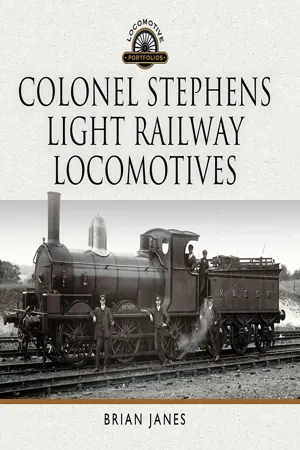
Colonel Stephens Light Railway Locomotives
About this book
Holman Fred Stephens (1868-1931) set himself up in the 1890s as an engineer and manager of the complete light railway as evolved by Victorian theorists to serve rural districts as yet bereft of the benefit of cheaper transport. To them, a light railway was not an assemblage of second-hand mainline equipment of dubious merit but of fit for purpose, new material. This ideal theory did not survive the near universal inability to raise sufficient capital to build and equip a light railway that would give a reasonable profit. Recourse was therefore made to the second-hand market. Stephens became a master at the art of building and running railways with the minimum of capital. The history of the mechanical performance of his railways was also nearly always handicapped with inadequate engineering facilities. This left staff struggling, often surprisingly successfully, with a menagerie of locomotive types. Limited standardization was practiced but most often expediency ruled. This gave rise to a glorious kaleidoscope of locomotives the history of each of which is outlined This variety was further colored by Stephens generally regarding a locomotive name as far more important than its number.
Information
Publisher
Pen and Sword TransporteBook ISBN
9781399023467
Year
2023Table of contents
- Cover
- Book Title
- Copyright
- CONTENTS
- ACKNOWLEDGEMENTS
- FOREWORD
- Chapter 1 THE NEW AND NOVELLOCOMOTIVES
- Chapter 2 STROUDLEY’S TERRIERS
- Chapter 3 ILFRACOMBE GOODS & BEATTIE SADDLEBACKS
- Chapter 4 THE MANNING WARDLE LOCOMOTIVES
- Chapter 5 THE SHROPSHIRE & MONTGOMERYSHIRE COAL ENGINES
- Chapter 6 THE Os AND O1s
- Chapter 7 ODDMENTS/ONE-OFFS/SINGLETONS
- Chapter 8 NARROW GAUGE
- Appendix NAMEPLATES ANDSTEPHENS’ CLASSICAL LOCOMOTIVE NAMES
- LOCOMOTIVE INDEX
- BIBLIOGRAPHY
- Backcover
Trusted by 375,005 students
Access to over 1.5 million titles for a fair monthly price.
Study more efficiently using our study tools.