![]()
CHAPTER 1
A HISTORICAL OVERVIEW OF THE GAME OF BASKETBALL
HISTORY OF THE GAME – MAJOR MILESTONES
Basketball is one of the most spectacular, dynamic and popular team sports on the planet, requiring a high level of fitness and skill. The aim is to score into the opposition’s basket by catching, passing, dribbling and shooting the ball.
The game of basketball was initially designed by Dr James Naismith in 1891 as an activity to keep his students at Massachusetts’ Springfield College busy and active during the winter semester. It was conceived as a much simpler game than is played today – the original rules’ document contained only seven rules – however, since its creation it has transformed into a more complex one, organised and played by people of all ages throughout the world. Many of the rule changes made over the years were done to make the game more attractive to players and coaches, but also more spectacular for spectators and TV viewers.
According to FIBA (Federation Internationale de Basketball Amateur1 or International Basketball Federation), the world’s governing body for basketball and the sole competent authority in basketball recognised by the International Olympic Committee (IOC), there are approximately 450 million people who currently play the sport. There are now 214 affiliated basketball federations, grouped into five continental zones which make up the FIBA family: FIBA Europe, FIBA Africa, FIBA Asia, FIBA Americas and FIBA Oceania (see chapter 8 for more detail).
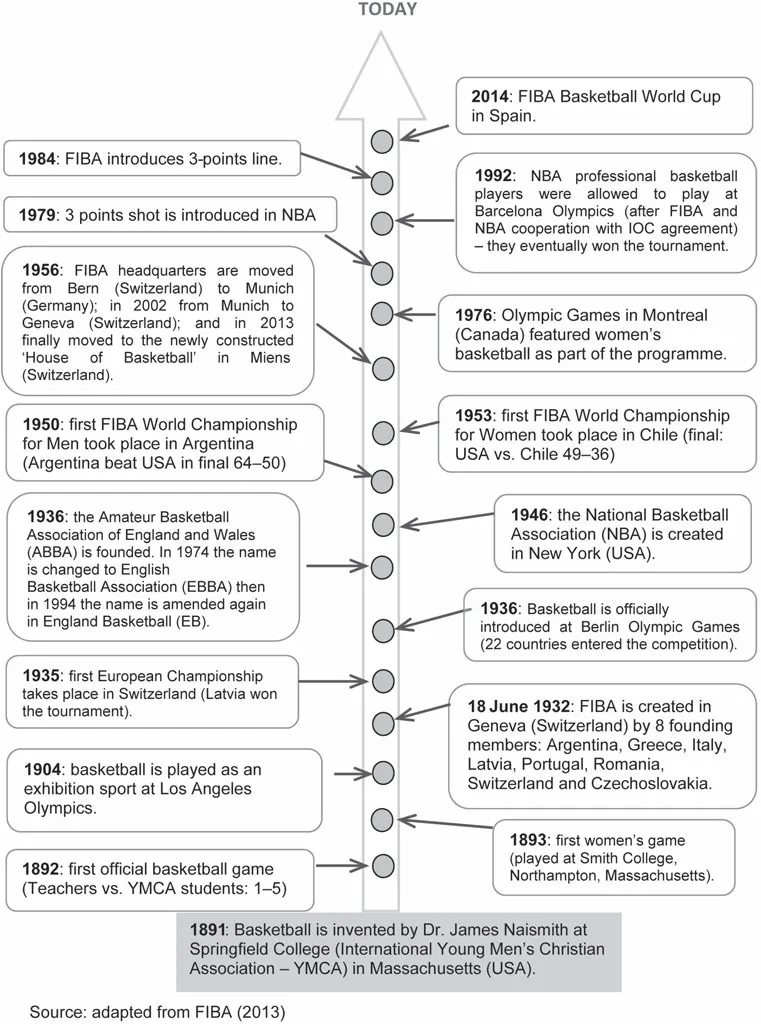
Some of the most important milestones and key events that shaped the development of basketball at world level, including the creation of governing bodies, organisation of various championships at national, European and international level, and creation of various leagues around the world (for example, the NBA – National Basketball Association – which is one of the driving forces in basketball) are summarised in Figure 1.
Basketball has a long and rich tradition, not only in the USA. It developed rapidly in Europe, and countries such as Serbia, Croatia, Spain, France, Lithuania, Russia and Greece were at the forefront of this development. More recently – in the last five to ten years – basketball programmes in Turkey, Italy, Germany and Latvia have greatly improved and these countries now compete on equal terms with traditional powerhouses in basketball at both youth and senior team level.
In the UK, the game developed well, having benefited from a strong American influence in terms of both players and coaches. Some recent successes include: Devon Van Oostrum being named the Most Valued Player (MVP) of the under-20 European Championship Division B in 2013, having helped the under-20 Great Britain men’s team to win promotion to Division A; the Great Britain Senior team qualifying for Eurobasket – the most important competition in Europe – in 2011 and 2013; the England under-18 men’s team playing in Division A in the under-18 European Championship. Some British players have also made the transition to play in strong leagues such as the NBA, including Luol Deng who recently moved to Cleveland Cavaliers from Chicago Bulls, and Joel Freeland who currently plays for Portland Trailblazers. The London 2012 Olympic Games has also contributed to the development of the game in the UK.
Countries in other parts of the world are also making great strides with regards to the quality of basketball being played. In the southern hemisphere, Brazil and Argentina are two of the main ‘players’ for the South American continent. Down under, Australia and New Zealand continue to produce quality players and solid national teams for both men and women.
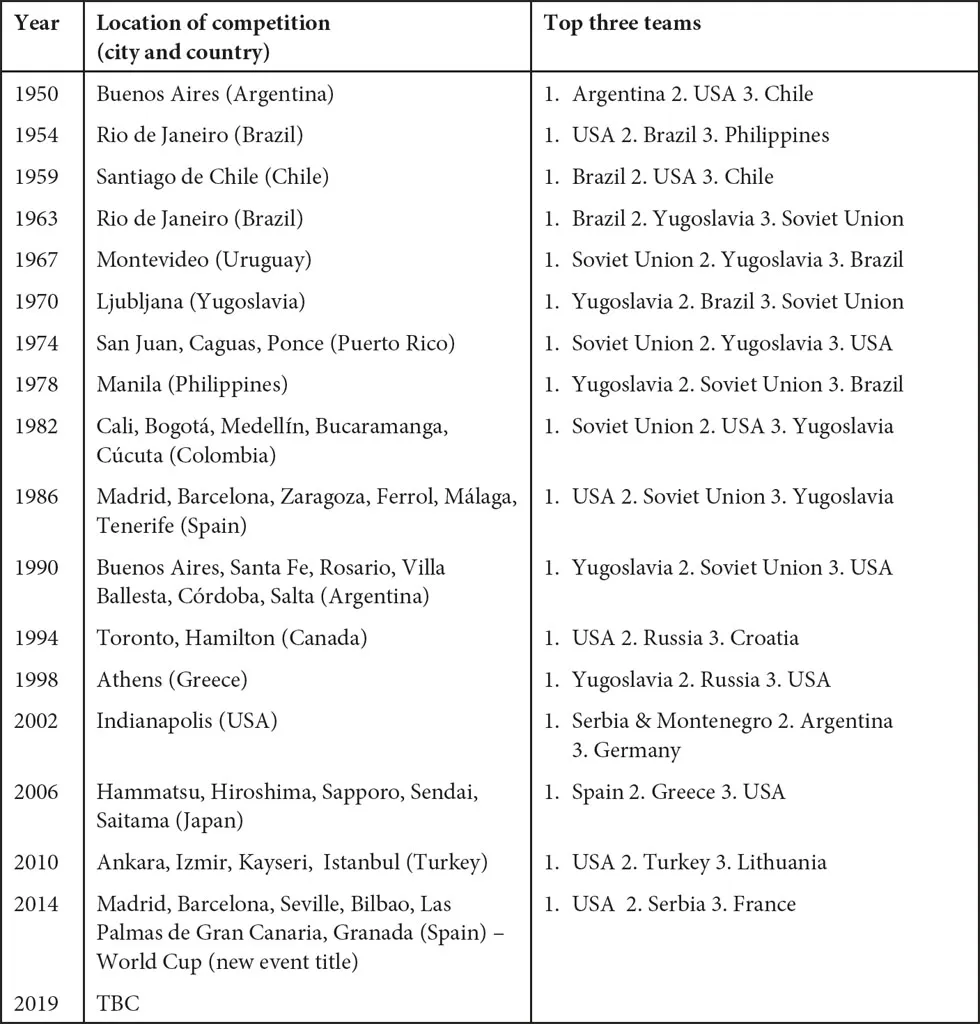
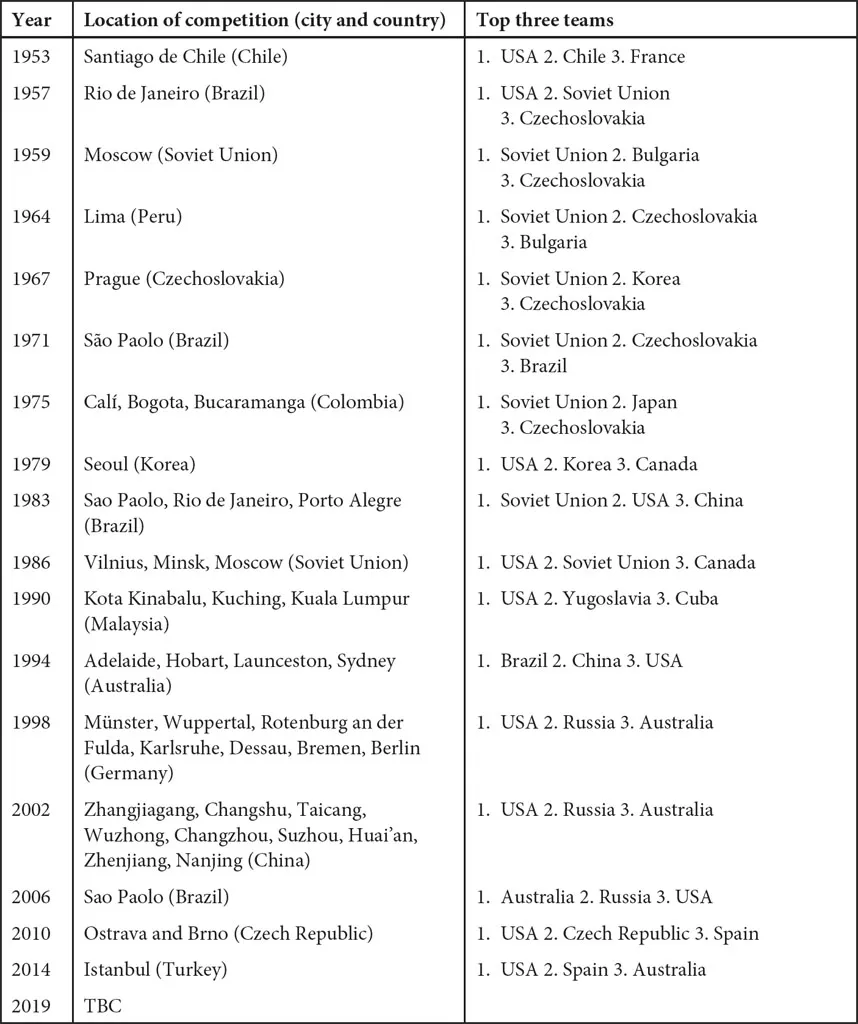
The World Championship for senior men and women teams is held every four years between the Summer Olympic Games. The decision to hold these championships was made at the FIBA Congress in 1948 during the XIVth Olympic Games in London. Ten men’s teams participated at the inaugural World Championship in 1950 and this number has grown over the years to 24 competing teams. In 2010, FIBA renamed the competition the FIBA Basketball World Cup, which was followed in 2012 by a decision of the FIBA Central Board to change the year in which the competition is hosted. As such, the event has been moved to 2019 instead of 2018. Additionally, the number of qualifying teams has been increased to 32 for the 2019 competition. Tables 1.1 and 1.2 provide a detailed overview of previous medal winners (for both men and women teams) throughout the history of these championships, which continue to attract large groups of supporters and a significant media presence.
BASKETBALL AT THE OLYMPIC GAMES
Apart from the World Championship (or World Cup as it will be known from 2019 onwards), the basketball tournament played at the Olympic Games is another example of a competition that continues to benefit from large audiences and global success. Together with the 100-metres athletics final, the basketball tournament at the Olympics is one of the most anticipated and watched spectator events.
Basketball was initially played as an exhibition game at the Olympic Games in 1904 (St Louis), 1924 (Paris) and 1928 (Amsterdam), before it was finally officially introduced into the programme of the Summer Olympics held in Berlin in 1936. There, 22 countries competed for the Olympic medals with the USA beating Canada in the final.
Forty years later, the women’s game also featured in the programme at the 1976 Montreal Olympic Games. Only six countries took part and the Soviet Union managed to finish the event unbeaten, winning Olympic gold with, the USA taking silver. Since then the number of competing teams has gradually increased to eight (Seoul 1988, and Barcelona 1992) and eventually 12 teams, at which it has remained since 1996 Olympics in Atlanta. There are, however, ongoing discussions to increase this number to 16 competing teams.
Tables 1.3 and 1.4 show the top four places at the Olympic Games up to present day. A small number of international teams have dominated the competition from its early days, winning the majority of Olympic medals. The USA, the Soviet Union, Yugoslavia, Spain, Argentina, Lithuania, Croatia and France are among the most successful teams in the men’s game, while the USA, Australia, the Soviet Union, Brazil and China top the women’s medals table. The most recent Olympic event – held in London in 2012 – confirmed once more the dominance of American basketball, with both USA men and women teams winning the gold medals.
RULES OF THE GAME
Playing area and equipment
The playing area for a basketball match is a rectangular court with the following dimensions: 28 metres long and 15 metres wide. The court surface is usually made of wood with a basket at each end of the court. There are several lines drawn on the court and these are linked to the scoring system (see below for how many points each shot is worth depending from where the shot is made) and to the rules of the game – examples include the 3-points shot semicircle line, the free-throw line, the 3-seconds space, and the halfway line. The paint is an area on a basketball court underneath the basket bounded by the end line, the foul line and other lines, which are usually painted. Each team has a specific area alongside the court where the coaches and substitute players are seated during the game – this area is called the team bench area. Between the two team bench areas is a table where the match officials (scorer, timekeeper, 24-seconds clock operator) are located (see Figure 1.2). The match officials use specific equipment to officiate a match, including an official score sheet, a scoreboard that has a stopclock system and numbers to indicate the score, alternating possession arrow, team fouls indicators/ markers (orange cones), some wood-made foul markers (with numbers from 1 to 5) and the 24-seconds device.
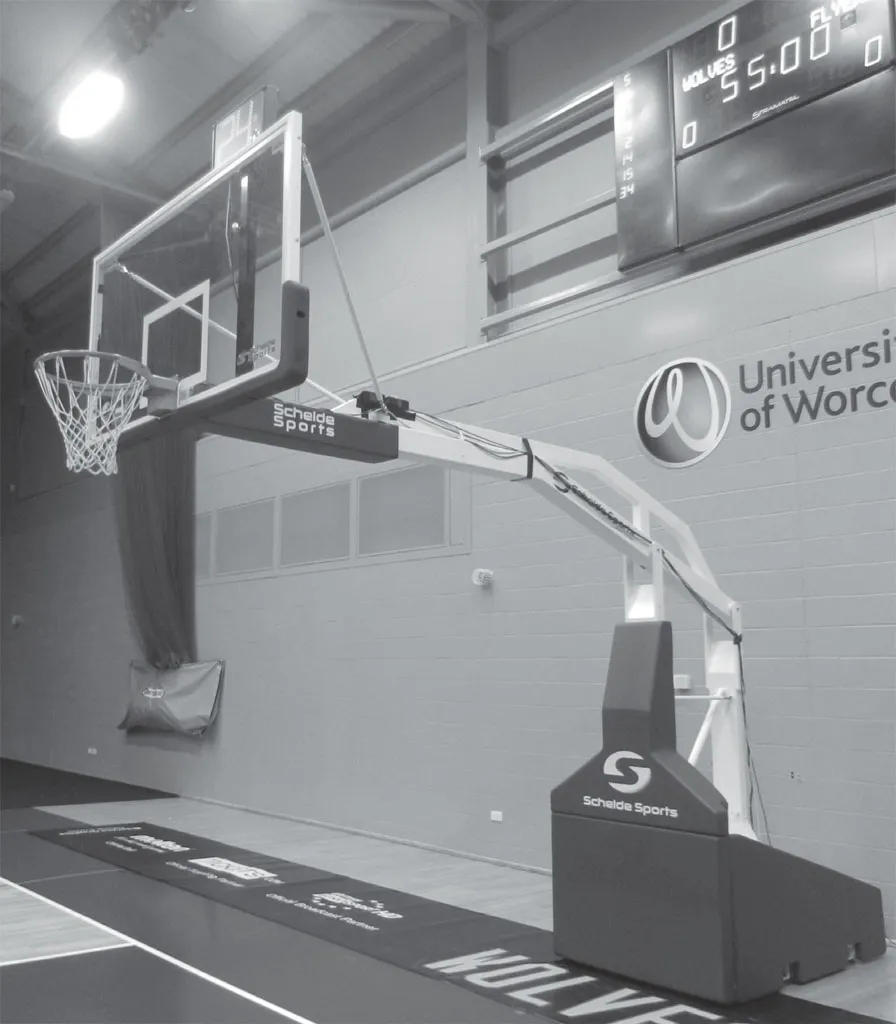
The basket unit comprises a support structure, a backboard, a ring and a net (see Figure 1.3). A special device that shows the 24-seconds shot clock (and sometimes, depending on the model, the game clock too) is fixed at the top of the backboard. For all basketball competitions, the ring is at a height of 3.05 metres above the court and its projection on the floor should be 1.2 metres inside the baseline. The support structure and the lower level of the backboard have padding equipment designed to protect players.
Usually made out of a special glass or out of wood, the backboard is 1.8 metres long and 1.05 metres high and has a small square drawn just above the ring (see Figure 1.4).
The game
Basketball games played under FIBA rules consist of four quarters of 10 minutes each; this is 10 minutes’ effective playing time as the game clock stops every time the ball goes out of bounds. The aim of the game is to score more points than the other team by throwing the ball into the opposition’s basket. The game cannot start if one of the teams has fewer than five play...