This is the fifth edition of the leading work on transnational and comparative commercial and financial law, covering a wide range of complex topics in the modern law of international commerce, finance and trade. As a guide for students and practitioners it has proven to be unrivalled. Since the fourth edition, the work has been divided into three volumes, each of which can be used independently or as part of the complete work.
Volume one covers the roots and foundations of private law; the different orientations and structure of civil and common law; the concept, forces, and theoretical basis of the transnationalisation of the law in the professional sphere; the autonomous sources of the new law merchant or modern lex mercatoria, its largely finance-driven impulses; and its relationship to domestic public policy and public order requirements.
Volume two deals with transnational contract, movable and intangible property law.
Volume three deals with financial products and financial services, with the structure and operation of modern commercial and investment banks, and with financial risk, stability and regulation, including the fall-out from the recent financial crisis and regulatory responses in the US and Europe.
All three volumes may be purchased separately or as a single set.
From the reviews of previous editions:
"...synthesizes and integrates diverse bodies of law into a coherent and accessible account...remarkable in its scope and depth. It stands alone in its field not only due to its comprehensive coverage, but also its original methodology. Although it appears to be a weighty tome, in fact, in light of its scope, it is very concise. While providing a wealth of intensely practical information, its heart is highly conceptual and very ambitious...likely to become a classic text in its field."
American Journal of Comparative Law
"Dalhuisen's style is relaxed...what he writes convinces without the need for an excess of references to sources...a highly valuable contribution to the legal literature. It adopts a useful, modern approach to teaching the young generation of lawyers how to deal with the increasing internationalisation of law. It is also helpful to the practising lawyer and to legislators."
Uniform Law Review/Revue de Droit Uniforme
"this is a big book, with big themes and an author with the necessary experience to back them up. ... Full of insights as to the theories that underlie the rules governing contract, property and security, it is an important contribution to the law of international commerce and finance."
Law Quarterly Review
"...presents a very different case: that of a civilized and cultivated cosmopolitan legal scholar, with a keen sense of international commercial and financial practice, with an in-depth grounding in both comparative legal history and comparative law, combined with the ability to transcend conventional English black-letter law description with critical judgment towards institutional wisdom and intellectual fashions. ...a wide-ranging, historically and comparatively very deep and comprehensive commentary, but which is also very contemporary and forward-looking on many or most of the issues relevant in modern transnational commercial, contract and financial transactions..."
International and Comparative Law Quarterly
This title is included in Bloomsbury Professional's International Arbitration online service.
eBook - ePub
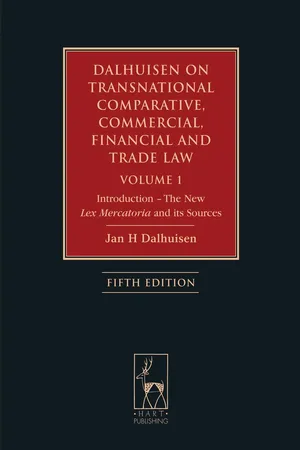
Dalhuisen on Transnational Comparative, Commercial, Financial and Trade Law Volume 1
Introduction - The New Lex Mercatoria and its Sources
- 378 pages
- English
- ePUB (mobile friendly)
- Available on iOS & Android
eBook - ePub
Dalhuisen on Transnational Comparative, Commercial, Financial and Trade Law Volume 1
Introduction - The New Lex Mercatoria and its Sources
About this book
Trusted by 375,005 students
Access to over 1.5 million titles for a fair monthly price.
Study more efficiently using our study tools.
Information
Part I The Transnationalisation of Commercial and Financial Law. The Law Concerning Professional Dealings
1.1 Introduction
1.1.1 The Place and Evolution of Modern Commercial and Financial Law in Civil and Common Law. The Concept of Transnationalisation
Commercial law, including financial and trade law, has long had a somewhat different status in civil and common law. This has, first, to do with the different attitudes towards the role of legislation and particularly towards systematic legal thinking, but it is also a matter of coverage and practice and ultimately one of the recognition (or not) of the special place that commercial and financial law may have in either legal system. This discussion has acquired renewed relevance in modern times and is increasingly influenced or matched by the idea or realisation that, at least in international dealings or professional cross-border activities however defined, the relevant commercial and financial law might not emanate from states at all, either in the civil or common law tradition, but rather from a legal order of its own and may then be considered transnationalised. This goes back to an era when commercial law was indeed not national and did not belong to any particular legal order except its own.
To the extent that commercial and financial law must still be considered national, the evolution of the civil and common law, their origins and their differences, remain very relevant in discussing the nature and application of this law as we shall see. It is of special importance and may create particular problems if these national laws are applied in international cases by courts in other countries or by international arbitrators. Even if commercial and financial law were to become fully transnationalised, consideration should still be given to whether the common law or civil law approach and methodology should be followed or favoured or whether a different approach altogether should prevail. The differences between the two systems will be discussed in greater detail below in sections 1.2 and 1.3.1 Here it is sufficient to note that in civil law countries the codification ethos looks primarily for legislation and (often) assumes in that connection that private law, including commercial and financial law, is one intellectually coherent national system that is essentially statutory or codified. This suggests that private law is imposed from above as an internally consistent system that is complete, explainable from within, and capable of finding solutions for all eventualities, present and future, on the basis of the proper application of its rules or otherwise the principles underlying it.2
This attitude is rule-oriented and formal. In essence, it waits for the state to effectuate change through legislation when there is a need to adapt the law, which is thus nationalised as to its formation, and territorial. Since the system and its coherence are here considered of primary importance, in private law codification, states will rely on academic advice to preserve intellectual rigour and consistency—at least that is the idea. The application of this law is subsequently seen mainly as a technique which has logic as its core and automatically correct solutions are expected if this intellectual system of rules is properly applied. Extraneous sources of law are irrelevant. That applies especially to fundamental and general principles but also to custom and party autonomy unless the statutory texts specifically refer to them and allow them to operate. There is no other source of law.
This approach was the result of three nineteenth-century paradigm shifts that changed the private law on the European Continent completely and also fundamentally affected commercial and financial law. The result was the modern civil law differentiating it henceforth from the earlier universal Roman law and also from the approach of the common law. The idea is then that a) all law, including private law, is national; b) it issues from states, hence the dominance of legislative texts; and c) these texts present or should aspire to present an intellectual system which is internally coherent and complete, and reflects per definition the reality of human relationships. As we shall see, in the European Union (EU) projects for private law unification there is an unarticulated combination of these various views, as there is in UNCITRAL and UNIDROIT, the sum total of which is the continuation of a top-down statist approach to private law formation. It claims exclusivity for its texts which control all private law, including, in principle, the contractual content. There are no overriding values and party autonomy operates only by licence of the state. 3 Private law is nationalised. Treaty law is no more than national law adopted by the contracting states.
This remains the basic approach in modern private law unification to which the Draft Common Frame of Reference (DCFR) and its progeny as models for codification at the level of the EU also testify.4 It follows that there is no real need for empirical research and this law is not questioned, for example, as to its fairness, efficiency or responsiveness to social or economic needs.5 They are assumed to result from the system itself, and because it is the law, it must as such be accepted as correct, never mind how far from practical realities it may be, and whatever unexpected and undesirable side effects it may have, or indeed how poor the intellectual back-up may prove to be or to have become. This is the civil law expression of legal positivism (and formalism) and still the mainstream of its thinking.6 In this approach, it is explicit that commercial (and financial) law is an inextricable part of the national codification (whether or not contained in a separate code) and subject to its method and way of application. It is thus equally national and intellectual, and must be made to fit. It is not independent, merely lex specialis or refinement. In this approach, even international commercial transactions are covered by and must find a solution for their problems in these national laws, the proper one then being found through conflict rules or rules of private international law.
It follows, first, that the further development of the law, even private law, is perceived primarily as an activity of the state and as such is centralised and monopolised at state level. Law, even commercial and financial law, is thus deemed made and imposed, not found, even if it is based on an analysis of prior experiences. In particular, it denies the autonomous law creation impulses that may emanate from other groupings, for example, in commercial and financial practices or custom unless specially admitted by the state system which always has the last word.
Second, this law, even though commercial and financial, is academic and maintains in civil law countries an aura of self-evidence that derives from the pretence of intellectual consistency and completeness of the codified private law system as a whole. Its true legitimacy is not then in the democratic process, which in any event was often wanting when this law was first codified, or even in economic rationality, but in its systemic consistency and conceptual unity which claims by definition to be close enough to reality—even commercial and financial reality—to guide it and, if necessary, to redirect and control it for the greater benefit of all participants and the public at large.
Third, as in codification countries, the national private law regime is thus perceived as one intellectual statist system that monopolises the field, it follows that commercial and financial law is considered part of, and captured in, that system. It is not perceived to be independent from it but is merely lex specialis as just mentioned. These specialised areas have, therefore, no separate place in the law and cannot evolve independently. Commercial and financial law must fit the system and is then confined in its evolution.
Fourth, this monopolisation of the law formation function at the level of the state confirms that there is little room for the operation of other sources of law, such as commercial and financial practice and custom, or for general principles (other than those underlying the codes), whether or not commercial, national or transnational; or for efficiency considerations or considerations of economic growth; or for any cost benefit analysis, unless expressly admitted or tolerated by the codes or their systems themselves. It was already said that in this approach, even party autonomy setting forth the terms of a deal only operates by government licence and is therefore constrained to what the codified system will allow and it is not respected per se.7 This approach to party autonomy goes far beyond the ordinary constraints derived from public order and public policy requirements which parties must respect. It concerns here the validity of their agreement itself, which thus depends on statist fiat. There is in fact no party autonomy as source of law.
Fifth, the result is that this law is static and without a dynamic forward-moving force except through legislation or case law which raises the question of interpretational powers and freedom in the state courts. It was secondary as the legislative approach supported by system thinking and a policy-oriented nationalistic outlook remained the focus and assumed for its further development foremost governmental insight (through its academies) into what was necessary in terms of updating and adaptation. Commercial and financial law shows, however— as does regulation— that such insight may not be forthcoming and that autonomous law-creating forces therefore remain necessary to keep private law up to date and functional. Thus fundamental and general principle, custom and practices, and party autonomy may still have to be included, although not openly but rather hidden in a liberal interpretation technique of a domestic nature; in contract, in modern times often operating behind the notion of good faith.
Sixth, in case of doubt or when situations were not explicitly covered or were new, and thus where the formal law lagged behind, it is true that even in civil law there had always been some interpretational flexibility largely based on an extrapolation of rules from existing legislation and its system or implementing case law. It could also mean inductive or otherwise analogical reasoning, but, although in this approach in modern times a more liberal teleological interpretation technique was allowed to provide greater flexibility, whilst even pressing ethical, social, and efficiency considerations might be admitted in the interpretation process, this was still mainly done to support and complete the national system, its tenets and especially its credibility. In essence, this method of interpretation continued to be subservient to the system rather than to society or to the community this law served, which system was thus perceived as remaining formal and closed in principle.
Seventh, this attitude also fundamentally affected international transactions, even those in commerce and finance. Although these transactions were likely to be outside the immediate scope and concern of local codifications which were seldom written for them, they had to fit into national laws as there was (in this way of thinking) no other. It thus became necessary to search for the more appropriate but always national law in the above sense under applicable conflicts of law (or private international law) rules in international cases leading to the application of the domestic law considered the most closely connected with the case in question, even if, as we shall see, it became increasingly difficult and artificial to define or identify.
Eighth, as a more liberal interpretation technique created some flexibility at the edges, this could have led to the extrapolation and expansion of the lex fori into international cases, especially taking into account the foreign elements of the case and increasingly also other more transnational sources of law so that a form of transnationalisation would result in the interpretation of domestic laws. It is an approach that gained some ground in the US also (interstate) as we shall see8 but not so far in Europe. The problem is that each legal system then creates its own form of transnationalisation.
Ninth, quite apart from the problems of identifying the closest connection, particularly in factual situations with many contacts, there naturally arose, in this approach, ever greater problems when considerations (or values) that surpassed national concerns, it being implicit in the codification approach that all moral, social and economic ordering as well as an adequate level of legal certainty, were expected from and had to be provided by a national legislator in international cases as well. This was hardly any longer feasible in an ever more globalised world and economy, nor was it rational to continue to expect it.
Tenth, regulation which remained mostly domestic also became increasingly a problem in international transactions as it had to be established which governmental interests prevailed in this connection and in what aspects if they were conflicting. This raised the issue of the proper jurisdiction to prescribe, as the Americans call it, as well as the question of the operation of international minimum standards.
At a more philosophical level, the civil law approach assumes above all that in matters of private law we live with an account of human behaviour that can be clarified scientifically and is orderly, in essence based on repetition. That is the neo-classical view in macroeconomics which is often believed to have failed us, but we struggle with the same problem in the law, where it is further complicated by nationalistic thinking. Indeed, the codification approach in its purest form does not consider or accept that the future is different from the past and that it cannot be systematically captured nor that international transactions may require their own transnationalised legal regime that might operate quite differently.
It means that in considering better (private) law, the inclination is always to remedy the shortcomings of the past in a national context, the idea being that new or ever evolving patterns, even if transnational, can still be satisfactorily covered in this man...
Table of contents
- Cover
- Title Page
- Contents
- Table of Cases
- Table of Legislation and Related Documents
- Part I: The Transnationalisation of Commercial and Financial Law. The Law Concerning Professional Dealings
- Part II: The Nature, Status and Function of Private International Law
- Part III: The Operation and Substance of Transnational Commercial and Financial Law or the Modern Lex Mercatoria
- eCopyright
Frequently asked questions
Yes, you can cancel anytime from the Subscription tab in your account settings on the Perlego website. Your subscription will stay active until the end of your current billing period. Learn how to cancel your subscription
No, books cannot be downloaded as external files, such as PDFs, for use outside of Perlego. However, you can download books within the Perlego app for offline reading on mobile or tablet. Learn how to download books offline
Perlego offers two plans: Essential and Complete
- Essential is ideal for learners and professionals who enjoy exploring a wide range of subjects. Access the Essential Library with 800,000+ trusted titles and best-sellers across business, personal growth, and the humanities. Includes unlimited reading time and Standard Read Aloud voice.
- Complete: Perfect for advanced learners and researchers needing full, unrestricted access. Unlock 1.5M+ books across hundreds of subjects, including academic and specialized titles. The Complete Plan also includes advanced features like Premium Read Aloud and Research Assistant.
We are an online textbook subscription service, where you can get access to an entire online library for less than the price of a single book per month. With over 1.5 million books across 990+ topics, we’ve got you covered! Learn about our mission
Look out for the read-aloud symbol on your next book to see if you can listen to it. The read-aloud tool reads text aloud for you, highlighting the text as it is being read. You can pause it, speed it up and slow it down. Learn more about Read Aloud
Yes! You can use the Perlego app on both iOS and Android devices to read anytime, anywhere — even offline. Perfect for commutes or when you’re on the go.
Please note we cannot support devices running on iOS 13 and Android 7 or earlier. Learn more about using the app
Please note we cannot support devices running on iOS 13 and Android 7 or earlier. Learn more about using the app
Yes, you can access Dalhuisen on Transnational Comparative, Commercial, Financial and Trade Law Volume 1 by Jan H Dalhuisen in PDF and/or ePUB format, as well as other popular books in Law & International Trade Law. We have over 1.5 million books available in our catalogue for you to explore.