![]()
CHAPTER 1
Introduction to Leadership Theory
Leaders contribute on the average no more than 20 percent to the success of organizations.1 Those who follow the leader are critical to the completion of the remaining 80 percent. Most people working in organizations, irrespective of their title, spend more time following than leading. Moreover, people tend to move back and forth between leading and following on a continuous basis throughout their working day. Most people follow more than they lead, and following represents 70 to 90 percent of their lives. While people spend most of their working life contributing as followers to the success of their organizations, there is little discussion of what the role of the follower is and how it relates to that of a leader. In most debates about leadership, 80 to 90 percent of people who do the work are never mentioned. We all know that followership dominates organizations; there are many more followers than leaders in any organization you review.2 So much attention is paid to what makes a person a successful leader, however, this attention ignores the fact that followers are needed by leaders, to get their jobs done.3
If you are reading this book, it means you are involved in a continuous search for knowledge and the quest for self-improvement. My intent for this book is to provide a collection of information you most likely have been exposed to in some form or fashion: leadership theory. And to perhaps provide some information that you may not have thought about as of yet: followership theory and how it applies to the practice of leadership. Followership is the ability of individuals to follow the instructions of their superior to achieve organizational goals.4
Followership is not synonymous with being a subordinate. Ira Chaleff stated that “Followers and leaders both orbit around the purpose, followers do not orbit around the leader.”5 Being a follower is not the same as being a subordinate. You can be one or the other, but an exemplary follower shares a common purpose with the leader. The exemplary follower believes in what the organization is trying to accomplish, wants everyone to succeed, and works tirelessly to make that happen.6
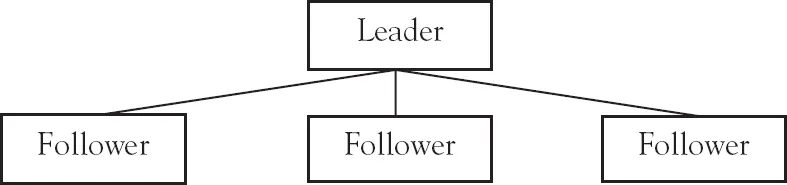
Barbara Kellerman said, “Followers are more important to leaders than leaders are to followers.” A leader cannot be a leader without any followers. But can a person be both a leader and a follower at the same time? I believe they can and here is why. Think about a simple organizational chart for any company, most likely it will look something like this:
Why is it important to understand that an employee can be both a leader and a follower at the same time? Many times an organizational chart has more than two levels of supervision. We should add at least one additional level to the chart and notice what happens to the followers in the previous chart. Now they have become leaders for the folks below them in the chart and followers of the folks above them in the chart. So it appears there are people in an organization who are both leaders and followers at the same time.
If there are people in an organization that are leaders and followers at the same time, then what do you think has been missing from any of the leadership training you have attended, or any of the leadership books you have read? You are correct, information about how and what it takes to be a good follower. Think back for a moment to your first job as an adult, where were you on the preceding organizational chart? Most likely it was in one of the pure follower spots toward the bottom of the chart. Think about what it took, in that company, to move into one of the leader or follower positions? More than likely, an individual had to do their job in an exemplary fashion in order to be recognized as someone with leadership potential.
This book is not just another self-help leadership book similar to many you have read and studied in the past. This book should help you understand what it takes to be a good follower. I submit that in order to be a good leader you must first be a good follower. Therefore, I want you to know how to be a good follower. That is right; in order to be a good leader you must first be a good follower. All of us at some point either as a child or as an adult, working and making a living for our families, have been a follower.
This word follower can conjure up many images. In can remind one of many things such as the religious followers of Buddha, Mohamed, or Jesus. Alternatively, it can remind us of the hundreds of lemmings running toward cliffs and following the one in front and over the cliff they go. Having grown up in the Midwest my Mother always said that I did not want to be a follower. She always used the lemming example. When I pointed out that my friend Bill got to do such and such, she would reply, “Well if Bill jumped off a cliff would you follow him over the edge?” I still get images of those lemmings rushing over the edge of a cliff when I think of my Mother extolling the fact that I should not be a follower. Although the stories may vary, many of you may have no doubt had the same or similar experience. As a result of that early training, the term follower more often than not has gotten a bad rap. No one wants to be a follower. However, I submit that being a good follower, or being an exemplary follower, is not a bad thing.
I fast forward to the beginnings of my career in the U.S. Air Force. At basic training, every recruit arrived as an individual. However, that changed quickly; each recruit received the same haircut, the same clothes, and, if one wore glasses, the same glasses. We all looked alike; we were not individuals any longer we were members of the group known as a flight. We trained as a flight; we ate together as a flight; we exercised as a flight; and we were rewarded and punished as a flight. The individual differences between us were diminished until we all became as one: one group of real followers. We were taught and trained that we must be good followers. We learned quickly to follow orders exactly, or there would be dire consequences.
Before too long, all of my hard work and nearly constant attention of my drill instructor began to pay off, I learned how to be a good follower. The fruit of this hard work was evidenced by the fact that one day after some very strenuous training I was told to report to my drill instructor’s office. There he told me that because of my recognized ability to follow orders and direction (in other words, I was a good follower), I was going to be assigned a leadership position within the flight. He said I was to be assigned as a squad leader, I was to become a leader of men. However, all of my training so far had been about following; I had not heard a single thing about leading. How did he know that I had leadership potential? He had only observed me following orders and readily accepting direction. I did not understand how as a good follower I could become a leader. Perhaps a person is both a leader and a follower at the same time.
A while back, I did a Google search for leadership theory. The results were about what I expected; Google searched for 0.30 seconds and returned 48,100,000 hits. Then I searched “followership theory” and the results were not what I expected. Google searched for 0.20 seconds and returned 112,000 hits, less than one quarter of 1 percent of the material had anything to do with followership. I expected more information about followership, after all nearly everyone is a follower of some type, and few are actual leaders. This Google search revealed a great deal of information about leadership theories such as Great Man theories, trait theories, contingency theories, behavioral theories, transactional theories, and transformational theories. It is important to gain a clear understanding of these leadership theories in order to better understand how exemplary followership relates to those theories.
Great Man Theory
If we look at the great leaders of the past, we see history often portrays them as heroic and even mythical. These leaders appear to have been destined to rise to positions of leadership when required. Even today, sports heroes, top executives, and politicians are often set apart and, in most instances, thought of as leaders. These people are characterized as natural leaders, born with a set of personal qualities that made them effective leaders. These people are good examples of the Great Man theory, which makes the assumptions that leaders are born and not made and possess certain characteristics which were inherited and that great leaders can arise when there is a great need. The term Great Man was coined by Thomas Carlyle in 1888 because leadership was thought of primarily as a male quality, especially in terms of military leadership.7 The characteristics that these great leaders were born with have been cited as being paramount to becoming an effective leader. The study of these characteristics began the interest of trying to come to an understanding of what leadership is and, as a result, researchers have focused on the leader. At the genesis, researchers focused on the traits that some people inherit leading to trait theories.
Trait Theories
According to the trait theorists, people inherit traits and qualities that make some better suited to lead than others. The early trait theories attempted to identify specific behavioral and personality characteristics shared by leaders. Once they identified some of these leadership characteristics, the researchers had a difficult time explaining how some people who exhibited these traits were not also leaders. Researchers started coming up with personality traits. Gordon Allport8 came up with a list of 4,000 personality traits; Raymond Cattell9 came up with 16 personality traits; and Hans Eysenck10 developed only a three-factor theory.
Most researchers, today, have settled down with five basic dimensions of personality. The body of evidence of this theory has been growing beginning with the research of D.W. Fiske11 and later expanded upon by other researchers including Norman12, Goldberg13, and McCrae and Costa.14 Researchers today believe that these models were either too complex or too simplistic and, as a result, a five-trait theory has emerged to describe the basic personality traits of human personality.
These five-core personality traits are broad categories of personality traits and are known as the big five. Ernest Tupes and Raymond Christal advanced the initial model in 1961.15 Many times researchers do not agree on the labels but here is my version:
1. Extraversion: This trait includes characteristics such as excitability, sociability, talkativeness, assertiveness, and high amounts of emotional expressiveness.
2. Agreeableness: This personality dimension includes attributes such as trust, altruism, kindness, affection, and other prosocial behaviors.
3. Conscientiousness: Common features of this dimension include high levels of thoughtfulness, with good impulse control and goal-directed behaviors. Those high in conscientiousness tend to be organized and mindful of details.
4. Neuroticism: Individuals high in this trait tend to experience emotional instability, anxiety, moodiness, irritability, and sadness.
5. Openness: This trait features characteristics such as imagination and insight, and those high in this trait also tend to have a broad range of interests.
Contingency Theories
Next are contingency theories of leadership. These theories focus on particular variables related to the situation that might determine which particular style of leadership is best suited. In the early 60s, Fred Fielder advanced the first theory using the contingency approach, the contingency theory of effectiveness. The central idea of this early theory is that leadership effectiveness (in terms of group performance) depends on the interaction of two factors: the leader’s job or motivations and aspects of the situation.16 The work of Fielder and many colleagues are considered as classic contributions to the body of knowledge about person and situational aspects of leadership.
Path–goal theory was originally developed by Martin Evans in 1970 and expanded by Robert House in 1971 into a more complex contingency theory.17 Drawing on expectancy theory, House suggested that a leader should help elucidate the path for followers to achieve group goals. This involves the leader employing particular behaviors in specific situations to increase follower satisfaction and motivate efforts toward task accomplishment. The theory identifies four types of leader behavior that include supportive (relations oriented), directive (task-oriented), achievement oriented, and participative leader performance, as well as two aspects of the situation, namely, follower characteristics and job characteristics.18
The normative decision model, originally developed by Victor Vroom and Phillip Yetton in 1973 and later revised by Victor Vroom and Arthur Jago, emphasizes situational factors more than leadership behaviors.19 It outlines a set of five different decision-making strategi...