eBook - ePub
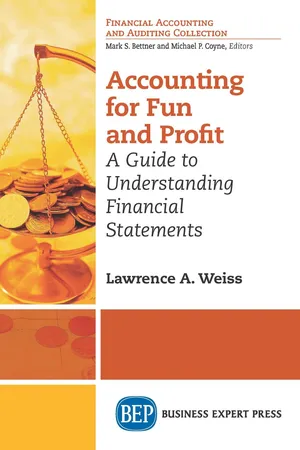
Accounting For Fun and Profit
A Guide to Understanding Financial Statements
- 194 pages
- English
- ePUB (mobile friendly)
- Available on iOS & Android
eBook - ePub
About this book
Accounting is an economic information system, and can be thought of as the language of business. Accounting principles cannot be discovered; they are created, developed, or decreed and are supported or justified by intuition, authority, and acceptability. Managers have alternatives in their accounting choices; the decisions are political, and trade-offs will be made. Accounting information provides individuals, both inside and outside a firm, with a starting point to understand and evaluate the key drivers of a firm, its financial position, and performance. If you are managing a firm, investing in a firm, lending to a firm, or even working for a firm, you should be able to read the firm's financial statements and ask questions based on those statements. This book explains the fundamentals of financial statements. It is designed and meant to explain the language of accounting to non-accountants (i.e., those who hire accountants). After reading this book, you should be able to pick up an annual report, read it, understand much of it, and have a solid foundation to start asking questions about the firm. This book will show you that accounting can be informative and fun!
Trusted by 375,005 students
Access to over 1.5 million titles for a fair monthly price.
Study more efficiently using our study tools.
Information
CHAPTER 1
Introduction
Accounting is about communication. It is an economic information system and can be thought of as the language of business. Accounting standards are as much a product of political action as they are of careful logic or empirical findings. Accounting principles cannot be discovered; they are created, developed, or decreed and are supported or justified by intuition, authority, and acceptability. This is important to note, as accounting rules may or may not have any inherent logic to them. We have alternatives in our accounting choices; the decisions are political and trade-offs will be made. However, if a user of accounting information understands the economic consequences of each choice, she can base her own accounting choices on her desired outcome and also interpret the decisions made by others.
Accounting information provides individuals, both inside and outside a firm, with a starting point to understand and evaluate the key drivers of a firm, its financial position and performance. This information can then be used to enhance decisions as well as help predict a firm’s future cash flows. The present “current” value of those cash flows provides an estimate for the value of the firm. Accounting systems and information are also required for business and legal reasons. It is therefore essential for managers, investors, and others to be aware of the signals given and received by the business community through financial reports.
Who has access to an organization’s accounting information? It depends on the nature of the organization. For-profit firms can be public or private. A firm goes “public” when its ownership units “shares” can be exchanged “traded” in a public capital market (e.g., the New York Stock Exchange). Public firms are much more heavily regulated by the government and must provide a prescribed set of accounting information to the government and the general public.1 By contrast, private firms do not have to disclose their accounting information to the general public.2
Not-for-profit organizations (charities, churches, private universities, and so on) must file a set of specified information to the government that is made public.
Who (or what group) is responsible for issuing an organization’s annual report? Senior management.
Who (or what group) is the annual report for? There are lots of different potential users including:
• Owners, both current (those who actually own a piece or share of the firm) and potential (those who are thinking about buying a piece or share of the firm),
• Suppliers of goods, services, and funds. Individuals and other firms who do something for the firm and expect, at some point, to receive something (usually cash) from the firm. This includes both current and potential employees (i.e., suppliers of labor),
• Customers (who purchase the firm’s goods and services),
• The government, both in the sense of taxes (getting money from the firm) but also in terms of regulation, since government regulators are supposed to ensure the firm operates and reports according to the law, and
• Various other outside groups, including accounting professors (who will use the firm’s reports in class), reporters (who may use the firm’s reports in a story), environmental groups, and so on.
In sum, senior management publishes annual reports for various users.
What is this report about? What is it meant to tell the users? It is designed to give the users identified above information about the firm’s economic resources, how it obtained those resources, who has claims on the resources, what the firm has done with those resources, and how they have changed over time. It is designed and meant for users who have some understanding of basic business, economics, and accounting.
How are these various groups going to use this information? The information should be used as a starting point in trying to estimate the timing, likelihood, and amount of future cash flows. Why? So they can assess a firm’s financial health and make better informed decisions (i.e., invest in the firm, sell to the firm, lend to the firm, buy from the firm, and so on).
Okay, so if senior management is producing this information for a variety of users, it means management is basically providing outsiders with information about the senior management’s activities. Is that right? Yes, it is like a student (as opposed to a teacher) producing the report card on how well she did. Are there any checks to make sure what management says is true? Actually, there are not many checks we can use for this. Accounting has limitations; it is not, in any sense of the word, trustworthy (more on this in Chapter 2) and it provides limited supervision of senior management. This is why it is critical for anyone using the information in financial statements to understand how the information is prepared.
Consider, if you were senior management, what would you want to say? Well, that depends on whom your message is for.
What does senior management normally tell the owners? It is not uncommon for them to report, “I am great. You could not have a better manager. It is true we lost a lot of money this year, but anyone else would have lost much more. You are lucky to have us, and there is no question you should keep us as your senior management.” Normally, management wants to keep their jobs, and they therefore tell the owners they are doing a good, if not great, job. However, “normally” does not mean always.
What if senior management itself wants to buy the firm from the non-management owners? Imagine you are managing a firm you inherited from your parents. You are working hard and doing your best, but you do not own the firm outright. You have some siblings who also own part of the firm, and they do not help at all. They do not pull their fair share, yet they still demand money from the firm. Because of this, you want to buy them out. What would you tell them? You could say the firm is doing great. Or you could say that the firm is barely making it and that while it is really worth next to nothing, you still want to buy it from them and will pay them some minor amount for their shares. When reading a financial statement, you need to know not just to whom management is talking to, but also what senior management’s bias is. Does senior management want to make the firm look good or bad? It depends on their bias.
What does management normally want to tell bankers and the people or companies who sell goods and services to the firm? Typically, management wants to tell these readers not to worry because the firm will pay what it owes (i.e., repay loans to the banks or pay suppliers for services rendered or goods provided).
What does management want to tell the firm’s employees? We are doing okay but not great, so the firm is unable to give raises this year, but employees’ jobs are secure and they do not need to look for other ones. Note that we have a potential conflict here. Management may want to tell the owners they are doing great, but tell the employees the firm is doing okay.
How about the customers? What does management want to tell them? Again, management wants to tell them that the firm is doing okay, that it will be around to supply them next year, but that it is not doing well enough to give any discounts.
What about the government? Well, the primary governmental entity looking at firm’s financial information is the Internal Revenue Service (IRS). To this group, management probably wants to show minimal profits saying that it does not have much to give to the government this year. Maybe in a few years when the firm is doing better, the government can ask for something.
Notice that what management wants to tell the government is pretty much the exact opposite of what they normally want to tell the firm’s owners. The good news for management today is that in most countries, firms are allowed to produce two sets of financial statements: one for the government (which is private and intended to be read only by the government’s taxing authorities) and another for everyone else. So to some extent, management can plead poverty to the government, while telling others they are doing well. It may seem hard to believe that there are two sets of financial statement reporting about the same firm’s performance in the same year, but it is what happens. Management can make different accounting choices and their decision to do so may depend on whether their report is going to the government or to everyone else. Over time the cumulative numbers will match, but in a given year they may be very different.
Think of the annual report as a public relations tool. Better yet, think of it as a painting. Accounting is an art: it really is much closer to art, or perhaps to the legal profession, than it is to math or science. Management is painting a picture of the firm. Management may try to paint like Rembrandt and give you a picture that illustrates fairly transparently what the firm looks like (you look at the painting and know what the author was painting). However, management may paint more like Picasso. My Dad loved Picasso, but I have never understood him (the painter, not my Dad). Still, I have read that Picasso painted his mistresses, who I have seen in photos and who were beautiful (at least superficially). So, even though when I look at a Picasso painting that is supposedly of a female but to me it does not look human, I know the person being painted was physically beautiful. In accounting, like art, it helps to know something about the composer.
For fun: Can you identify what firm produced the Annual Report covers in Exhibit 1.1?

Exhibit 1.1 What firm produced these covers?
They are for the wine and spirits firm Pernod Ricard whose 37 premium brands include Absolut, Chivas, Glenlivet, G.H. Mumm Champagne, and Kahlua among many others (the reports shown are for the years ending 2006, 2010, and 2015). I am not really sure how they relate to the financials, but clearly they have an artistic bend.
By contrast, the report covers in Exhibit 1.2, for Boeing, reveals its products by showing them on the covers. Boeing is saying “this is who we are and what we do.”

Exhibit 1.2 Boeing Annual Report covers 2012 to 2014
Most firms no longer have fancy covers. They simply have the information required by the government (see www.sec.gov/edgar.shtml) and maybe the firm’s logo. Exhibit 1.3 shows the cover for Apple Inc.

Exhibit 1.3 Apple Inc. Annual Report cover 2015
The covers of annual reports tell you something about the firms that published them. It is like getting dressed in the morning: What you wear tells the world not only something about you but also something about what you want the world to think about you.
And that is what the annual report is meant to do. It is senior management telling the world something about the firm and what senior management wants the world to think about the firm.
So, let us open the cover and take a look at what is inside.
Inside an Annual Report
The annual report usually begins with a summary or the highlights of the firm’s results for the year (and usually some prior years) being reviewed. This is generally followed by a letter from the Chief Executive Officer (CEO) of the firm (and sometimes from the chairman of the board as well). This letter should be read carefully, as it outlines the CEO’s view of what happened and where the firm is heading. It often includes an overview of the firm’s strategy, and generally thanks the investors and employees. It should be read as a political statement and a piece of public relations, which is what it is. Still, it can contain valuable information about what the head of the organization is thinking.
Though the exact ordering can differ, the CEO’s letter is usually followed by lots of information on the firm’s products (e.g., what they are, how they are being developed, perhaps even how they compare to those of major competitors). This provides background not only of the firm’s products, but often on the industry and general economy as well. Again, this should be viewed with a great deal of skepticism as the firm is usually trying to present its products and markets in the best possible light.
Next up is normally a brief review of the firm’s major accounting policies, some of which will be discussed in more detail later in the book. It is very important to read the accounting policies as they set the context for the accounting numbers.
Then, somewhere in the middle of the annual report comes the main dish: the financial statements. These are the Balance Sheet, the Income Statement, and the Statement of Cash Flows.3 All three will be discussed in greater detail in the coming chapters.
The financial statements are followed by the Notes to the Financial Statements,...
Table of contents
- Cover
- Half Title Page
- Title Page
- Copyright Page
- Dedication
- Contents
- Acknowledgments
- Preface
- Chapter 1 Introduction
- Chapter 2 Accounting is Not Economic Reality
- Chapter 3 The Accounting Process
- Chapter 4 Accrual Accounting
- Chapter 5 Current Assets
- Chapter 6 Long-Term Assets
- Chapter 7 Current Liabilities
- Chapter 8 The Time Value of Money: Discounting and Net Present Values
- Chapter 9 Long-Term Debt
- Chapter 10 Owners’ Equity
- Chapter 11 Cash is King
- Chapter 12 Financial Statement Analysis
- Index
Frequently asked questions
Yes, you can cancel anytime from the Subscription tab in your account settings on the Perlego website. Your subscription will stay active until the end of your current billing period. Learn how to cancel your subscription
No, books cannot be downloaded as external files, such as PDFs, for use outside of Perlego. However, you can download books within the Perlego app for offline reading on mobile or tablet. Learn how to download books offline
Perlego offers two plans: Essential and Complete
- Essential is ideal for learners and professionals who enjoy exploring a wide range of subjects. Access the Essential Library with 800,000+ trusted titles and best-sellers across business, personal growth, and the humanities. Includes unlimited reading time and Standard Read Aloud voice.
- Complete: Perfect for advanced learners and researchers needing full, unrestricted access. Unlock 1.5M+ books across hundreds of subjects, including academic and specialized titles. The Complete Plan also includes advanced features like Premium Read Aloud and Research Assistant.
We are an online textbook subscription service, where you can get access to an entire online library for less than the price of a single book per month. With over 1.5 million books across 990+ topics, we’ve got you covered! Learn about our mission
Look out for the read-aloud symbol on your next book to see if you can listen to it. The read-aloud tool reads text aloud for you, highlighting the text as it is being read. You can pause it, speed it up and slow it down. Learn more about Read Aloud
Yes! You can use the Perlego app on both iOS and Android devices to read anytime, anywhere — even offline. Perfect for commutes or when you’re on the go.
Please note we cannot support devices running on iOS 13 and Android 7 or earlier. Learn more about using the app
Please note we cannot support devices running on iOS 13 and Android 7 or earlier. Learn more about using the app
Yes, you can access Accounting For Fun and Profit by Lawrence A. Weiss in PDF and/or ePUB format, as well as other popular books in Business & Financial Accounting. We have over 1.5 million books available in our catalogue for you to explore.