- 160 pages
- English
- ePUB (mobile friendly)
- Available on iOS & Android
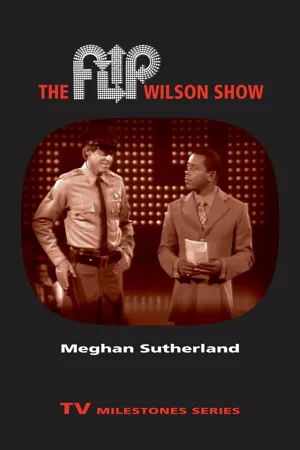
The Flip Wilson Show
About this book
Analyzes the social, political, and institutional context of The Flip Wilson Show, which ran on NBC between 1970 and 1974.
When The Flip Wilson Show debuted on NBC in 1970, the major legislative victories of the civil rights movement had been won, but the broadcast airwaves were far from integrated. A handful of shows featured black leading characters, but none had quite reached the top spot of the Nielsen ratings. By 1971, however, Wilson's "old-fashioned" comedy-variety hour was a bonafide hit, and in January 1972 Time magazine declared Wilson "TV's First Black Superstar." In this volume, Meghan Sutherland examines how The Flip Wilson Show succeeded in the volatile racial and economic milieu of the early 1970s and how its success shaped the prevailing codes of black performance and political discourse on television.
In particular, Sutherland examines the ambivalence that pervades discussions of Wilson's outlandish performance style—discussions that generally treat the question of whether his characters lampooned or simply reprised the stereotypes of minstrelsy as a problem for reception studies. Sutherland argues that this ambivalence was actually the basis of the show's wide appeal, and must thus be understood as an aesthetic strategy rather than as a mere effect of different viewers' interpretations. Along these same lines, she asserts that Wilson used the non-naturalistic aesthetics of variety performance in order to mount a critique of "realist" race sitcoms of the period, on the one hand, and the discourse of authentic masculinity that accompanied the rise of Black Power, on the other. Finally, she considers how the show used its integrated studio audience to stage the reconstitution of one, big, happy broadcast audience after the social, racial, and political upheavals of the late 1960s.
The Flip Wilson Show is the most detailed study of Wilson's variety show in its cultural and institutional context. This volume elucidates the characteristics of the variety genre that continue to make it a popular medium for political discourse in fractious social moments. In this way, it offers a fresh approach to understanding the enduring importance of the variety genre for black comedians—from Richard Pryor to the Wayans Brothers to Dave Chappelle—and for television in general. Scholars of film and television studies will appreciate this newest addition to the TV Milestones Series.
Frequently asked questions
- Essential is ideal for learners and professionals who enjoy exploring a wide range of subjects. Access the Essential Library with 800,000+ trusted titles and best-sellers across business, personal growth, and the humanities. Includes unlimited reading time and Standard Read Aloud voice.
- Complete: Perfect for advanced learners and researchers needing full, unrestricted access. Unlock 1.4M+ books across hundreds of subjects, including academic and specialized titles. The Complete Plan also includes advanced features like Premium Read Aloud and Research Assistant.
Please note we cannot support devices running on iOS 13 and Android 7 or earlier. Learn more about using the app.
Information
Table of contents
- Cover Page
- Title Page
- Copyright Page
- Dedication
- Contents
- Acknowledgments
- Introduction
- 1. Instituting Ambivalence: Race, Comedy-Variety, and Seventies TV
- 2. Entertaining Identities, or the Politics of Variety Performance
- 3. Variety and the Art of the Audience
- Conclusion
- Notes
- Selected Bibliography
- Index