Welcome to the uncertain world of "Radio 2.0"—where podcasts, mobile streaming, and huge music databases are the new reality, as are tweeting deejays and Apple's Siri serving as music announcer—and understand the exciting status this medium has, and will continue to have, in our digitally inclined society.
How did popular radio in past decades—from President Franklin D. Roosevelt's "Fireside Chats" in the 1930s through Top 40 music and Rush Limbaugh's talk radio empire—shape American society? How did devices and systems like the iPhone, Pandora, and YouTube turn the radio industry upside-down? Does radio still have a future, and if so, what will we want it to look like?
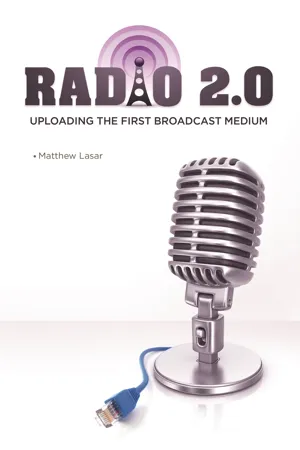
Radio 2.0: Uploading the First Broadcast Medium covers the history and evolution of Internet radio, explaining what came before, where Internet radio came from, and where it is likely headed. It also gives readers a frame of reference by describing radio from its introduction to American audiences in the 1920s—a medium that brought people together through a common experience of the same broadcast—and shows how technologies like digital music and streaming music services put into question the very definition of "radio." By examining new radio and media technologies, the book explores an important societal trend: the shift of media toward individualized or personalized forms of consumption.
- 208 pages
- English
- ePUB (mobile friendly)
- Available on iOS & Android
eBook - ePub
About this book
Information
Table of contents
- Cover
- Title
- Copyright
- Contents
- Acknowledgments
- Introduction
- Chapter 1: Songs about Radio
- Chapter 2: Eve of Chaos
- Chapter 3: The Age of Pandora
- Chapter 4: Talkers and Texters in Space
- Chapter 5: I’m Still Here!
- Chapter 6: Signs of Hope
- Chapter 7: Conclusion: A History of Radio’s Future
- Timelines
- Notes
- Glossary
- Index
- About the Authors
Trusted by 375,005 students
Access to over 1.5 million titles for a fair monthly price.
Study more efficiently using our study tools.
Frequently asked questions
Yes, you can cancel anytime from the Subscription tab in your account settings on the Perlego website. Your subscription will stay active until the end of your current billing period. Learn how to cancel your subscription
No, books cannot be downloaded as external files, such as PDFs, for use outside of Perlego. However, you can download books within the Perlego app for offline reading on mobile or tablet. Learn how to download books offline
Perlego offers two plans: Essential and Complete
- Essential is ideal for learners and professionals who enjoy exploring a wide range of subjects. Access the Essential Library with 800,000+ trusted titles and best-sellers across business, personal growth, and the humanities. Includes unlimited reading time and Standard Read Aloud voice.
- Complete: Perfect for advanced learners and researchers needing full, unrestricted access. Unlock 1.5M+ books across hundreds of subjects, including academic and specialized titles. The Complete Plan also includes advanced features like Premium Read Aloud and Research Assistant.
We are an online textbook subscription service, where you can get access to an entire online library for less than the price of a single book per month. With over 1.5 million books across 990+ topics, we’ve got you covered! Learn about our mission
Look out for the read-aloud symbol on your next book to see if you can listen to it. The read-aloud tool reads text aloud for you, highlighting the text as it is being read. You can pause it, speed it up and slow it down. Learn more about Read Aloud
Yes! You can use the Perlego app on both iOS and Android devices to read anytime, anywhere — even offline. Perfect for commutes or when you’re on the go.
Please note we cannot support devices running on iOS 13 and Android 7 or earlier. Learn more about using the app
Please note we cannot support devices running on iOS 13 and Android 7 or earlier. Learn more about using the app
Yes, you can access Radio 2.0 by Matthew Lasar in PDF and/or ePUB format, as well as other popular books in Technology & Engineering & Electrical Engineering & Telecommunications. We have over 1.5 million books available in our catalogue for you to explore.