Explains some of the ways in which technological advances are altering, for better or worse, large-scale human behavior, thought processes, and critical thinking skills.
Recent technological advances—from dating apps to artificial insemination, from "smart" phones to portable computers that can instantly search the World Wide Web for information, and from robots performing surgery to cars driving themselves—once remarkable, have become an unremarkable part of our lives. The team of authors of this book asks, "How are they changing us?"
We all recognize that these innovations have altered our lives, often making them easier, but it is also important to ask if we have lost anything while we have gained from them. The authors of How Technology Is Changing Human Behavior: Issues and Benefits show that human behaviors and thinking skills are rapidly being reprogrammed by technology, with even more developments on the horizon sure to further alter our future and shape our identity.
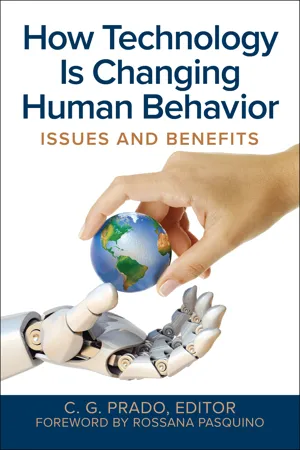
- 178 pages
- English
- PDF
- Available on iOS & Android
eBook - PDF
About this book
Information
Table of contents
- Cover
- Title
- Copyright
- Contents
- Foreword
- Introduction: Technology Is Changing Us
- Chapter 1: The Robotization of Everything
- Chapter 2: On Passing as Human and Robot Love
- Chapter 3: Who Is Responsible for a Self-Driving Car?
- Chapter 4: Who’s Your Mama? Assisted Reproductive Technology and the Meaning of Motherhood
- Chapter 5: Screen Autism, Cell Phone Zombies, and GPS Mutes
- Chapter 6: Technology in the Hands of Children: Helpful Tools or Harmful Distractions?
- Chapter 7: Learning in an Age of Digital Distraction: Education versus Consumption
- Chapter 8: The Kids Are All Right: Lessons from the March for Our Lives
- Chapter 9: Anonymity and (Mis)representation on Social Media Are Changing Who We Are and How We Think About Identity
- Chapter 10: Deep Fakes and Computer Vision: The Paradox of New Images
- About the Editor and Contributors
- Index
Trusted by 375,005 students
Access to over 1.5 million titles for a fair monthly price.
Study more efficiently using our study tools.
Frequently asked questions
Yes, you can cancel anytime from the Subscription tab in your account settings on the Perlego website. Your subscription will stay active until the end of your current billing period. Learn how to cancel your subscription
No, books cannot be downloaded as external files, such as PDFs, for use outside of Perlego. However, you can download books within the Perlego app for offline reading on mobile or tablet. Learn how to download books offline
Perlego offers two plans: Essential and Complete
- Essential is ideal for learners and professionals who enjoy exploring a wide range of subjects. Access the Essential Library with 800,000+ trusted titles and best-sellers across business, personal growth, and the humanities. Includes unlimited reading time and Standard Read Aloud voice.
- Complete: Perfect for advanced learners and researchers needing full, unrestricted access. Unlock 1.5M+ books across hundreds of subjects, including academic and specialized titles. The Complete Plan also includes advanced features like Premium Read Aloud and Research Assistant.
We are an online textbook subscription service, where you can get access to an entire online library for less than the price of a single book per month. With over 1.5 million books across 990+ topics, we’ve got you covered! Learn about our mission
Look out for the read-aloud symbol on your next book to see if you can listen to it. The read-aloud tool reads text aloud for you, highlighting the text as it is being read. You can pause it, speed it up and slow it down. Learn more about Read Aloud
Yes! You can use the Perlego app on both iOS and Android devices to read anytime, anywhere — even offline. Perfect for commutes or when you’re on the go.
Please note we cannot support devices running on iOS 13 and Android 7 or earlier. Learn more about using the app
Please note we cannot support devices running on iOS 13 and Android 7 or earlier. Learn more about using the app
Yes, you can access How Technology Is Changing Human Behavior by C.G. Prado in PDF and/or ePUB format, as well as other popular books in Psychology & History & Theory in Psychology. We have over 1.5 million books available in our catalogue for you to explore.