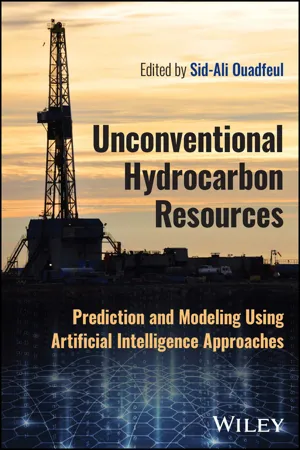
Unconventional Hydrocarbon Resources
Prediction and Modeling Using Artificial Intelligence Approaches
- English
- ePUB (mobile friendly)
- Available on iOS & Android
Unconventional Hydrocarbon Resources
Prediction and Modeling Using Artificial Intelligence Approaches
About this book
Enables readers to save time and effort in exploring and exploiting shale gas and other unconventional fossil fuels by making use of advanced predictive tools
Unconventional Hydrocarbon Resources highlights novel concepts and techniques for the geophysical exploration of shale and other tight hydrocarbon reservoirs, focusing on artificial intelligence approaches for modeling and predicting key reservoir properties such as pore pressure, water saturation, and wellbore stability. Numerous application examples and case studies present real-life data from different unconventional hydrocarbon fields such as the Barnett Shale (USA), the Williston Basin (USA), and the Berkine Basin (Algeria).
Unconventional Hydrocarbon Resources explores a wide range of reservoir properties, including modeling of the geomechanics of shale gas reservoirs, petrophysics analysis of shale and tight sand gas reservoirs, and prediction of hydraulic fracturing effects, fluid flow, and permeability.
Sample topics covered in Unconventional Hydrocarbon Resources include:
- Calculation of petrophysical parameter curves for non-conventional reservoir modeling and characterization
- Comparison of the Levenberg-Marquardt and conjugate gradient learning methods for total organic carbon prediction in the Barnett shale gas reservoir
- Use of pore effective compressibility for quantitative evaluation of low resistive pays and identifying sweet spots in shale reservoirs
- Pre-drill pore pressure estimation in shale gas reservoirs using seismic genetic inversion
- Using well-log data to classify lithofacies of a shale gas reservoir
Unconventional Hydrocarbon Resources is a valuable resource for researchers and professionals working on unconventional hydrocarbon exploration and in geoengineering projects.
Tools to learn more effectively

Saving Books

Keyword Search

Annotating Text

Listen to it instead
Information
Table of contents
- Cover
- Table of Contents
- Title Page
- Copyright Page
- Preface
- 1 Predrill Pore Pressure Estimation in Shale Gas Reservoirs Using Seismic Genetic Inversion with an Example from the Barnett Shale
- 2 An Analysis of the Barnett Shale's Seismic Anisotropy's Role in the Exploration of Shale Gas Reservoirs (United States)
- 3 Wellbore Stability in Shale Gas Reservoirs with a Case Study from the Barnett Shale
- 4 A Comparison of the Levenberg‐Marquardt and Conjugate Gradient Learning Methods for Total Organic Carbon Prediction in the Barnett Shale Gas Reservoir
- 5 Identifying Sweet Spots in Shale Reservoirs
- 6 Surfactants in Shale Reservoirs
- 7 Neuro‐Fuzzy Algorithm Classification of Ordovician Tight Reservoir Facies in Algeria
- 8 Recognition of Lithology Automatically Utilizing a New Artificial Neural Network Algorithm
- 9 Construction of a New Model (ANNSVM) Compensator for the Low Resistivity Phenomena Saturation Computation Based on Logging Curves
- 10 A Practical Workflow for Improving the Correlation of Sub‐Seismic Geological Structures and Natural Fractures using Seismic Attributes
- 11 Calculation of Petrophysical Parameter Curves for Nonconventional Reservoir Modeling and Characterization
- 12 Fuzzy Logic for Predicting Pore Pressure in Shale Gas Reservoirs With a Barnett Shale Application
- 13 Using Well‐Log Data, a Hidden Weight Optimization Method Neural Network Can Classify the Lithofacies of a Shale Gas Reservoir
- 14 The Use of Pore Effective Compressibility for Quantitative Evaluation of Low Resistive Pays
- 15 The Influence of Pore Levels on Reservoir Quality Based on Rock Typing
- 16 An Example from the Algerian Sahara Illustrates the Use of the Hydraulic Flow Unit Technique to Discriminate Fluid Flow Routes in Confined Sand Reservoirs
- 17 Integration of Rock Types and Hydraulic Flow Units for Reservoir Characterization. Application to Three Forks Formation, Williston Basin, North Dakota, USA
- 18 Stress‐Dependent Permeability and Porosity and Hysteresis. Application to the Three Forks Formation, Williston Basin, North Dakota, USA
- 19 Petrophysical Analysis of Three Forks Formation in Williston Basin, North Dakota, USA
- 20 Water Saturation Prediction Using Machine Learning and Deep Learning. Application to Three Forks Formation in Williston Basin, North Dakota, USA
- Appendix: Hysteresis Testing and Mineralogy
- Index
- End User License Agreement
Frequently asked questions
- Essential is ideal for learners and professionals who enjoy exploring a wide range of subjects. Access the Essential Library with 800,000+ trusted titles and best-sellers across business, personal growth, and the humanities. Includes unlimited reading time and Standard Read Aloud voice.
- Complete: Perfect for advanced learners and researchers needing full, unrestricted access. Unlock 1.4M+ books across hundreds of subjects, including academic and specialized titles. The Complete Plan also includes advanced features like Premium Read Aloud and Research Assistant.
Please note we cannot support devices running on iOS 13 and Android 7 or earlier. Learn more about using the app