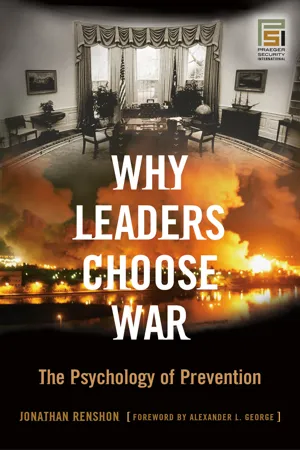
Preventive war has a long history in international politics, but until it became an instrumental part of the Bush Doctrine, it was mostly overlooked. Renshon argues that the best avenue for understanding decisions to initiate preventive action is through a close examination of the individual leader responsible for such decisions. In this work, he develops a theory of psychological motivations for preventive action. By examining five situations, including the Iraq war, he pinpoints the factors that matter most in decisions to take preventive military action.
There have been preventive wars throughout history, but the motivations behind them have remained elusive, and many crucial questions remain unanswered. What exactly constitutes preventive action? What differentiates preventive action from pre-emptive action? Are there significant differences between preventive strikes and full-on preventive wars? What is the relationship of preventive action to traditional concepts of deterrence, compellence, and international law? Finally, why do states initiate preventive action?
Renshon argues that the best avenue for understanding decisions to initiate preventive action is through a close examination of the individual leader responsible for such decisions.
- 239 pages
- English
- PDF
- Available on iOS & Android
eBook - PDF
About this book
Information
Table of contents
- Contents
- Foreword by Alexander L. George
- Preface
- 1. Preventive War: An Introduction
- 2. Preventing What? The Suez Canal Crisis
- 3. Israel’s Preventive Strike against Iraq
- 4. How Real Was ‘‘Dr. Strangelove?’’ American Preventive War Thinking Post–WWII
- 5. To the Brink . . . India and Pakistan’s Nuclear Standoff
- 6. Preventive War as a Grand Strategy? George W. Bush and ‘‘Operation Iraqi Freedom’’
- 7. Conclusion: Preventive War in Perspective
- Epilogue: Preventive War in the Age of Terrorism and Rogue States
- Notes
- Bibliography
- Index
Trusted by 375,005 students
Access to over 1.5 million titles for a fair monthly price.
Study more efficiently using our study tools.
Frequently asked questions
Yes, you can cancel anytime from the Subscription tab in your account settings on the Perlego website. Your subscription will stay active until the end of your current billing period. Learn how to cancel your subscription
No, books cannot be downloaded as external files, such as PDFs, for use outside of Perlego. However, you can download books within the Perlego app for offline reading on mobile or tablet. Learn how to download books offline
We are an online textbook subscription service, where you can get access to an entire online library for less than the price of a single book per month. With over 1.5 million books across 990+ topics, we’ve got you covered! Learn about our mission
Look out for the read-aloud symbol on your next book to see if you can listen to it. The read-aloud tool reads text aloud for you, highlighting the text as it is being read. You can pause it, speed it up and slow it down. Learn more about Read Aloud
Yes! You can use the Perlego app on both iOS and Android devices to read anytime, anywhere — even offline. Perfect for commutes or when you’re on the go.
Please note we cannot support devices running on iOS 13 and Android 7 or earlier. Learn more about using the app
Please note we cannot support devices running on iOS 13 and Android 7 or earlier. Learn more about using the app
Yes, you can access Why Leaders Choose War by Jonathan Renshon in PDF and/or ePUB format, as well as other popular books in Politics & International Relations & Military & Maritime History. We have over 1.5 million books available in our catalogue for you to explore.