What if the true weak link of the Information Age force is not the hardware of machines, but the software of the human mind? And if so, could it be that the entire conceptual structure of the Information Revolution theorists, at least as it applies to military affairs, is built on sand, on the notorious fickleness of human cognition? These are the questions this book strives to examine. Looking at the command and control of information-rich warfare, the contributors explore its potential new processes, techniques, and organizational structures. As they do so, they find reasons for both optimism and concerns about the limitations of human cognition and supporting technologies in commanding battles in the Information Age.
Since the beginning of the Information Revolution, the military in the United States and elsewhere has been analyzing and implementing the changes driven by the rapidly advancing information technologies. Among military theorists and practitioners, many focus on the Information Revolution's impact on matters of military equipment. Far fewer, however, seem to worry about the gray matter—the mind of the commander, the place where all the information power of the new age is supposed to converge and to yield its mighty dividends.
Consider that it is the human mind, particularly the minds of military commanders and their staffs that remain the pinnacle and the ultimate consumer of the rapidly growing information flows. What if the true weak link of the Information Age force is not the hardware of machines, but the software of the human mind? And if so, could it be that the entire conceptual structure of the Information Revolution theorists, at least as it applies to military affairs, is built on sand, on the notorious fickleness of human cognition? These are the questions this book strives to examine. Looking at the command and control of information-rich warfare, the authors explore its potential new processes, techniques, and organizational structures. As they do so, they find reasons for both optimism and concerns about the limitations of human cognition and supporting technologies in commanding Information Age battles.
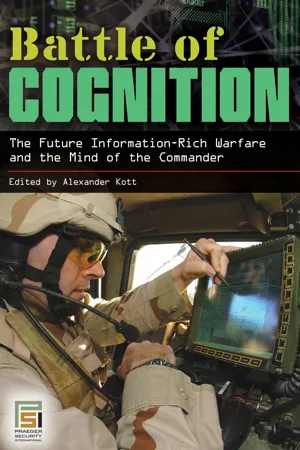
eBook - PDF
Battle of Cognition
The Future Information-Rich Warfare and the Mind of the Commander
- 273 pages
- English
- PDF
- Available on iOS & Android
eBook - PDF
Table of contents
- Contents
- Introduction
- 1 Variables and Constants: How the Battle Command of Tomorrow Will Differ (or Not) from Today's
- 2 A Journey into the Mind of Command: How DARPA and the Army Experimented with Command in Future Warfare
- 3 New Tools of Command: A Detailed Look at the Technology That Helps Manage the Fog of War
- 4 Situation Awareness: A Key Cognitive Factor in Effectiveness of Battle Command
- 5 The Hunt for Clues: How to Collect and Analyze Situation Awareness Data
- 6 Making Sense of the Battlefield: Even with Powerful Tools, the Task Remains Difficult
- 7 Enabling Collaboration: Realizing the Collaborative Potential of Network-Enabled Command
- 8 The Time to Decide: How Awareness and Collaboration Affect the Command Decision Making
- Concluding Thoughts
- Appendix: Terms, Acronyms, and Abbreviations
- Acknowledgments
- Notes
- Index
- About the Contributors
Trusted by 375,005 students
Access to over 1.5 million titles for a fair monthly price.
Study more efficiently using our study tools.
Frequently asked questions
Yes, you can cancel anytime from the Subscription tab in your account settings on the Perlego website. Your subscription will stay active until the end of your current billing period. Learn how to cancel your subscription
No, books cannot be downloaded as external files, such as PDFs, for use outside of Perlego. However, you can download books within the Perlego app for offline reading on mobile or tablet. Learn how to download books offline
Perlego offers two plans: Essential and Complete
- Essential is ideal for learners and professionals who enjoy exploring a wide range of subjects. Access the Essential Library with 800,000+ trusted titles and best-sellers across business, personal growth, and the humanities. Includes unlimited reading time and Standard Read Aloud voice.
- Complete: Perfect for advanced learners and researchers needing full, unrestricted access. Unlock 1.5M+ books across hundreds of subjects, including academic and specialized titles. The Complete Plan also includes advanced features like Premium Read Aloud and Research Assistant.
We are an online textbook subscription service, where you can get access to an entire online library for less than the price of a single book per month. With over 1.5 million books across 990+ topics, we’ve got you covered! Learn about our mission
Look out for the read-aloud symbol on your next book to see if you can listen to it. The read-aloud tool reads text aloud for you, highlighting the text as it is being read. You can pause it, speed it up and slow it down. Learn more about Read Aloud
Yes! You can use the Perlego app on both iOS and Android devices to read anytime, anywhere — even offline. Perfect for commutes or when you’re on the go.
Please note we cannot support devices running on iOS 13 and Android 7 or earlier. Learn more about using the app
Please note we cannot support devices running on iOS 13 and Android 7 or earlier. Learn more about using the app
Yes, you can access Battle of Cognition by Alexander Kott in PDF and/or ePUB format, as well as other popular books in History & Military & Maritime History. We have over 1.5 million books available in our catalogue for you to explore.