eBook - PDF
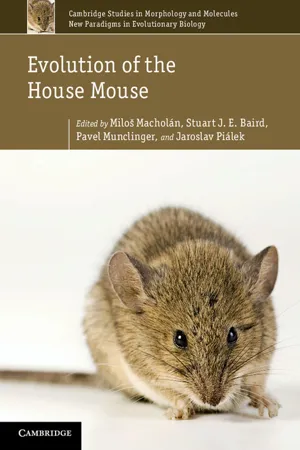
Evolution of the House Mouse
- 566 pages
- English
- PDF
- Available on iOS & Android
eBook - PDF
Evolution of the House Mouse
About this book
The house mouse is the source of almost all genetic variation in laboratory mice; its genome was sequenced alongside that of humans, and it has become the model for mammalian speciation. Featuring contributions from leaders in the field, this volume provides the evolutionary context necessary to interpret these patterns and processes in the age of genomics. The topics reviewed include mouse phylogeny, phylogeography, origins of commensalism, adaptation, and dynamics of secondary contacts between subspecies. Explorations of mouse behaviour cover the nature of chemical and ultrasonic signalling, recognition, and social environment. The importance of the mouse as an evolutionary model is highlighted in reviews of the first described example of meiotic drive (t-haplotype) and the first identified mammalian speciation gene (Prdm9). This detailed overview of house mouse evolution is a valuable resource for researchers of mouse biology as well as those interested in mouse genetics, evolutionary biology, behaviour, parasitology, and archaeozoology.
Information
Table of contents
- Cover
- Evolution of the House Mouse
- Series
- Title
- Copyright
- Contents
- Contributors
- Preface
- Foreword: Mice and (wo)men – an evolving relationship
- 1: The house mouse and its relatives: systematics and taxonomy: JEAN-CHRISTOPHE AUFFRAY AND JANICE BRITTON-DAVIDIAN
- 2: Phylogeny and biogeography of the genus Mus in Eurasia
- 3: On the origin of the house mouse synanthropy and dispersal in the Near East and Europe: zooarchaeological review and perspectives
- 4: Origin and genetic status of Mus musculus molossinus: a typical example of reticulate evolution in the genus Mus
- 5: The complex social environment of female house mice (Mus domesticus)
- 6: Development of the mouse mandible: a model system for complex morphological structures
- 7: Recognition of subspecies status mediated by androgen-binding protein (ABP) in the evolution of incipient reinforcement on the European house mouse hybrid zone
- 8: Mechanisms of chemical communication
- 9: The evolution of MHC diversity in house mice
- 10: Ultrasonic vocalizations in house mice: a cryptic mode of acoustic communication
- 11: House mouse phylogeography
- 12: The mouse t-haplotype: a selfish chromosome – genetics, molecular mechanism, and evolution
- 13: Tracing recent adaptations in natural populations of the house mouse
- 14: What can the Mus musculus musculus/M. m. domesticus hybrid zone tell us about speciation?
- 15: Behaviour, ecology, and speciation in the house mouse
- 16: Chromosomal hybrid zones in the house mouse
- 17: The role of the X chromosome in house mouse speciation
- 18: New insights into parasitism in the house mouse hybrid zone
- 19: Hybrid male sterility genes in the mouse subspecific crosses
- 20: Linkage disequilibrium approaches for detecting hybrid zone movement: a study of the house mouse hybrid zone in southern Bavaria
- Index
Trusted by 375,005 students
Access to over 1.5 million titles for a fair monthly price.
Study more efficiently using our study tools.
Frequently asked questions
Yes, you can cancel anytime from the Subscription tab in your account settings on the Perlego website. Your subscription will stay active until the end of your current billing period. Learn how to cancel your subscription
No, books cannot be downloaded as external files, such as PDFs, for use outside of Perlego. However, you can download books within the Perlego app for offline reading on mobile or tablet. Learn how to download books offline
Perlego offers two plans: Essential and Complete
- Essential is ideal for learners and professionals who enjoy exploring a wide range of subjects. Access the Essential Library with 800,000+ trusted titles and best-sellers across business, personal growth, and the humanities. Includes unlimited reading time and Standard Read Aloud voice.
- Complete: Perfect for advanced learners and researchers needing full, unrestricted access. Unlock 1.5M+ books across hundreds of subjects, including academic and specialized titles. The Complete Plan also includes advanced features like Premium Read Aloud and Research Assistant.
We are an online textbook subscription service, where you can get access to an entire online library for less than the price of a single book per month. With over 1.5 million books across 990+ topics, we’ve got you covered! Learn about our mission
Look out for the read-aloud symbol on your next book to see if you can listen to it. The read-aloud tool reads text aloud for you, highlighting the text as it is being read. You can pause it, speed it up and slow it down. Learn more about Read Aloud
Yes! You can use the Perlego app on both iOS and Android devices to read anytime, anywhere — even offline. Perfect for commutes or when you’re on the go.
Please note we cannot support devices running on iOS 13 and Android 7 or earlier. Learn more about using the app
Please note we cannot support devices running on iOS 13 and Android 7 or earlier. Learn more about using the app
Yes, you can access Evolution of the House Mouse by Miloš Macholán,Stuart J. E. Baird,Pavel Munclinger ,Jaroslav Piálek,Pavel Munclinger in PDF and/or ePUB format, as well as other popular books in Biological Sciences & Biology. We have over 1.5 million books available in our catalogue for you to explore.