- 526 pages
- English
- PDF
- Available on iOS & Android
eBook - PDF
Pliny the Elder and the Emergence of Renaissance Architecture
About this book
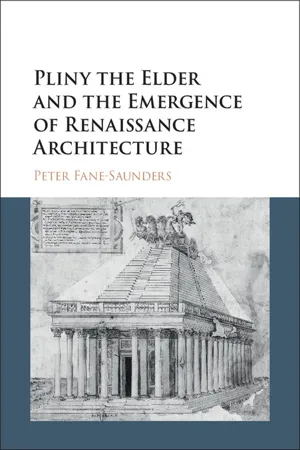
The Naturalis historia by Pliny the Elder provided Renaissance scholars, artists and architects with details of ancient architectural practice and long-lost architectural wonders - material that was often unavailable elsewhere in classical literature. Pliny's descriptions frequently included the dimensions of these buildings, as well as details of their unusual construction materials and ornament. This book describes, for the first time, how the passages were interpreted from around 1430 to 1580, that is, from Alberti to Palladio. Chapters are arranged chronologically within three interrelated sections - antiquarianism; architectural writings; drawings and built monuments - thereby making it possible for the reader to follow the changing attitudes to Pliny over the period. The resulting study establishes the Naturalis historia as the single most important literary source after Vitruvius's De architectura.
Information
Topic
ArtSubtopic
Art GeneralTable of contents
- Cover
- Half-title page
- Title page
- Copyright page
- Dedication
- Contents
- Illustrations
- Editorial Note
- Acknowledgements
- Abbreviations
- Introduction
- Chapter One Pliny the Elder and His Place in Antique and Mediaeval Writings on Architecture
- Plates
- Part I Pliny the Elder and Antiquarian Studies of the Roman Ruins
- Part II Pliny the Elder and Architectural Writings
- Part III Pliny the Elder, Architectural Drawings, and Built Monuments
- Appendix I Editions of the Naturalis historia Printed in Italy during the Fifteenth Century
- Appendix II Editions of De Architectura Printed In Italy During The Fifteenth and Sixteenth Centuries
- Notes
- Bibliography
- Credits
- Index
Trusted by 375,005 students
Access to over 1.5 million titles for a fair monthly price.
Study more efficiently using our study tools.
Frequently asked questions
Yes, you can cancel anytime from the Subscription tab in your account settings on the Perlego website. Your subscription will stay active until the end of your current billing period. Learn how to cancel your subscription
No, books cannot be downloaded as external files, such as PDFs, for use outside of Perlego. However, you can download books within the Perlego app for offline reading on mobile or tablet. Learn how to download books offline
We are an online textbook subscription service, where you can get access to an entire online library for less than the price of a single book per month. With over 1.5 million books across 990+ topics, we’ve got you covered! Learn about our mission
Look out for the read-aloud symbol on your next book to see if you can listen to it. The read-aloud tool reads text aloud for you, highlighting the text as it is being read. You can pause it, speed it up and slow it down. Learn more about Read Aloud
Yes! You can use the Perlego app on both iOS and Android devices to read anytime, anywhere — even offline. Perfect for commutes or when you’re on the go.
Please note we cannot support devices running on iOS 13 and Android 7 or earlier. Learn more about using the app
Please note we cannot support devices running on iOS 13 and Android 7 or earlier. Learn more about using the app
Yes, you can access Pliny the Elder and the Emergence of Renaissance Architecture by Peter Fane-Saunders in PDF and/or ePUB format, as well as other popular books in Art & Art General. We have over 1.5 million books available in our catalogue for you to explore.