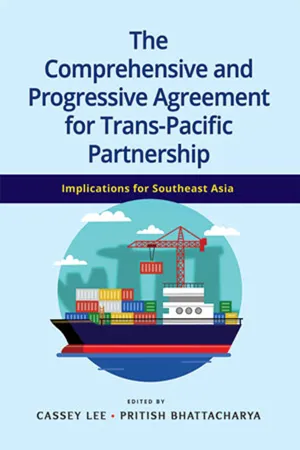
"The Comprehensive and Progressive Agreement for Trans-Pacific Partnership (CPTPP) is a free trade agreement involving major countries across the Asia Pacific region. The trade pact, which entered into force on 30 December 2018, is considered by many to be the "gold standard", given its ambitious scope and depth. This volume offers multi-dimensional insights into the CPTPP and its impact on Southeast Asia. It begins with broad analyses covering the historical, economic and geopolitical aspects of the CPTPP. Subsequent chapters focus on the nature and implications of three key path-breaking provisions in the trade agreement, namely investor-state dispute settlement, intellectual property rights and state-owned enterprises. The effect of the CPTPP on Southeast Asia in terms of regional production networks is also examined from the perspective of Japanese multinational enterprises. The potential economic impact of the agreement is analysed for member countries (Vietnam and Malaysia) as well as countries that aspire to join the CPTPP in the future (Indonesia and Thailand). The world trading system is in disarray: the World Trade Organization has been weakened, perhaps terminally; the world's two economic superpowers are locked in deep, politicized disputes; the forces of populism and nationalism are everywhere complicating the return to a more liberal, rules-based order. These trends are challenging one of the building blocks of ASEAN economic development, namely these countries' outward-looking trade and investment policies. With impeccable timing this important volume by a group of eminent authors assesses these issues with reference to the Comprehensive and Progressive Agreement for Trans-Pacific Partnership. The CPTPP excludes the three largest traders—China, the EU and the US—but it is a welcome second-best initiative that may have broader, positive ripple effects. This is the volume to read to gain a deeper understanding of the many complex issues at play." -- Hal Hill, H.W. Arndt Professor Emeritus of Southeast Asian Economies, College of Asia & the Pacific, Australian National University
eBook - PDF
The Comprehensive and Progressive Agreement for Trans-Pacific Partnership
Implications for Southeast Asia
- 334 pages
- English
- PDF
- Available on iOS & Android
eBook - PDF
The Comprehensive and Progressive Agreement for Trans-Pacific Partnership
Implications for Southeast Asia
About this book
Information
Subtopic
Social PolicyTable of contents
- Contents
- 1. Introduction
- 2. The Economics of the CPTPP and RCEP: Asia Pacific Trade Agreements without the United States
- 3. The TPP and CPTPP: Truths about Power Politics
- 4. The Investment Chapter and ISDS in the CPTPP: Lessons from and for Southeast Asia
- 5. Intellectual Property in the CPTPP and Access to Medicines: A Thai Perspective
- 6. New Rules for State-Owned Enterprises in the CPTPP
- 7. Impact of the CPTPP on Japanese Manufacturing Affiliates in ASEAN
- 8. Reassessing Malaysia’s Export Opportunities in the TPP and CPTPP
- 9. Impact of the CPTPP on Vietnam
- 10. Should Thailand Join the CPTPP?
- 11. Indonesia, the TPP and CPTPP: Hold Your Breath
- Index
Trusted by 375,005 students
Access to over 1.5 million titles for a fair monthly price.
Study more efficiently using our study tools.
Frequently asked questions
Yes, you can cancel anytime from the Subscription tab in your account settings on the Perlego website. Your subscription will stay active until the end of your current billing period. Learn how to cancel your subscription
No, books cannot be downloaded as external files, such as PDFs, for use outside of Perlego. However, you can download books within the Perlego app for offline reading on mobile or tablet. Learn how to download books offline
Perlego offers two plans: Essential and Complete
- Essential is ideal for learners and professionals who enjoy exploring a wide range of subjects. Access the Essential Library with 800,000+ trusted titles and best-sellers across business, personal growth, and the humanities. Includes unlimited reading time and Standard Read Aloud voice.
- Complete: Perfect for advanced learners and researchers needing full, unrestricted access. Unlock 1.5M+ books across hundreds of subjects, including academic and specialized titles. The Complete Plan also includes advanced features like Premium Read Aloud and Research Assistant.
We are an online textbook subscription service, where you can get access to an entire online library for less than the price of a single book per month. With over 1.5 million books across 990+ topics, we’ve got you covered! Learn about our mission
Look out for the read-aloud symbol on your next book to see if you can listen to it. The read-aloud tool reads text aloud for you, highlighting the text as it is being read. You can pause it, speed it up and slow it down. Learn more about Read Aloud
Yes! You can use the Perlego app on both iOS and Android devices to read anytime, anywhere — even offline. Perfect for commutes or when you’re on the go.
Please note we cannot support devices running on iOS 13 and Android 7 or earlier. Learn more about using the app
Please note we cannot support devices running on iOS 13 and Android 7 or earlier. Learn more about using the app
Yes, you can access The Comprehensive and Progressive Agreement for Trans-Pacific Partnership by Cassey Lee,Pritish Bhattacharya in PDF and/or ePUB format, as well as other popular books in Politics & International Relations & Social Policy. We have over 1.5 million books available in our catalogue for you to explore.