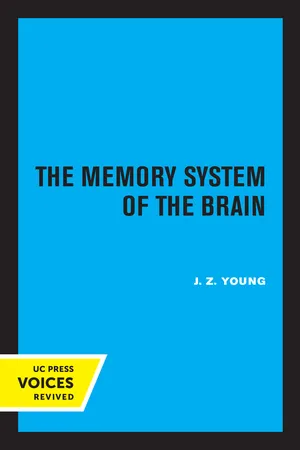
In The Memory System of the Brain, eminent neurobiologist J. Z. Young presents a bold model of the brain as an adaptive computer designed for the maintenance of life. Drawing on his Hitchcock Lectures delivered at Berkeley in 1964, Young weaves together insights from experimental work on the octopus, comparative anatomy, and emerging computer science to explain how nervous systems code, store, and retrieve information. He situates memory as a functional component of homeostasis, arguing that the capacity to select appropriate responses from a repertoire is the defining feature of brain organization. Young's analysis ranges from the cellular to the systemic: he describes nerve fibers as communication channels, synapses as computational units, and brain lobes as specialized processors that together generate memory records. Case studies of octopus learning experiments illuminate how representation, coding, and inhibition may constitute the neural basis of memory. By connecting neurobiology with cybernetics and evolutionary theory, The Memory System of the Brain offers both a historical snapshot of mid-twentieth-century neuroscience and a forward-looking framework that continues to inspire research into cognition, learning, and the origins of intelligence. This title is part of UC Press's Voices Revived program, which commemorates University of California Press's mission to seek out and cultivate the brightest minds and give them voice, reach, and impact. Drawing on a backlist dating to 1893, Voices Revived makes high-quality, peer-reviewed scholarship accessible once again using print-on-demand technology. This title was originally published in 1966.
Many titles in the Voices Revived program are also newly available as ebooks, offered at a discounted price to support wider access to scholarly work.
- 136 pages
- English
- ePUB (mobile friendly)
- Available on iOS & Android
eBook - ePub
The Memory System of the Brain
About this book
Information
Table of contents
- Cover
- Title
- Copyright
- Contents 1
- CHAPTER ONE The Brain as the Computer of a Homeostat
- CHAPTER TWO Breaking the Code of the Brain
- CHAPTER THREE The Requirements of an Exploratory Computer
- CHAPTER FOUR The Nature of the Memory Record and the Origin of Learning
- References
- Index
Trusted by 375,005 students
Access to over 1.5 million titles for a fair monthly price.
Study more efficiently using our study tools.
Frequently asked questions
Yes, you can cancel anytime from the Subscription tab in your account settings on the Perlego website. Your subscription will stay active until the end of your current billing period. Learn how to cancel your subscription
No, books cannot be downloaded as external files, such as PDFs, for use outside of Perlego. However, you can download books within the Perlego app for offline reading on mobile or tablet. Learn how to download books offline
Perlego offers two plans: Essential and Complete
- Essential is ideal for learners and professionals who enjoy exploring a wide range of subjects. Access the Essential Library with 800,000+ trusted titles and best-sellers across business, personal growth, and the humanities. Includes unlimited reading time and Standard Read Aloud voice.
- Complete: Perfect for advanced learners and researchers needing full, unrestricted access. Unlock 1.5M+ books across hundreds of subjects, including academic and specialized titles. The Complete Plan also includes advanced features like Premium Read Aloud and Research Assistant.
We are an online textbook subscription service, where you can get access to an entire online library for less than the price of a single book per month. With over 1.5 million books across 990+ topics, we’ve got you covered! Learn about our mission
Look out for the read-aloud symbol on your next book to see if you can listen to it. The read-aloud tool reads text aloud for you, highlighting the text as it is being read. You can pause it, speed it up and slow it down. Learn more about Read Aloud
Yes! You can use the Perlego app on both iOS and Android devices to read anytime, anywhere — even offline. Perfect for commutes or when you’re on the go.
Please note we cannot support devices running on iOS 13 and Android 7 or earlier. Learn more about using the app
Please note we cannot support devices running on iOS 13 and Android 7 or earlier. Learn more about using the app
Yes, you can access The Memory System of the Brain by J. Z. Young in PDF and/or ePUB format, as well as other popular books in Medicine & Neurology. We have over 1.5 million books available in our catalogue for you to explore.