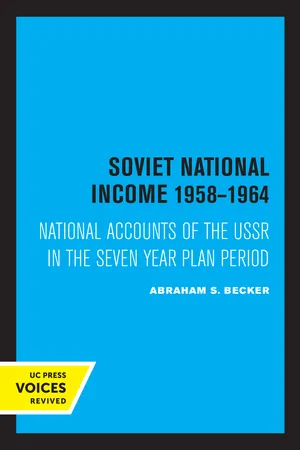
Soviet National Income, 1958–1964: National Accounts of the USSR in the Seven Year Plan Period by Abraham S. Becker offers a rigorous reconstruction and analysis of Soviet national income during a critical juncture in postwar economic history. Using the Soviet National Income and Product (SNIP) accounting framework pioneered by Abram Bergson and colleagues, Becker presents independently compiled accounts for each year of 1958–1964 and for the plan year 1965 as originally envisioned in the Seven Year Plan (SYP). By reworking household income and expenditure flows, public sector financing, investment, and capital-output relationships, the study provides a comprehensive portrait of the Soviet economy under Khrushchev. Central to the analysis are the difficulties of valuation in a command economy—distorted prices, turnover taxes, subsidies, and agricultural price disparities—and the adjustments necessary to approximate factor cost and constant-price measures. These methodological refinements allow Becker to chart growth trends, resource allocation, and structural change with unusual precision, while also probing the limits of Soviet statistical transparency. The results reveal both the ambitions and contradictions of the Seven Year Plan era. Growth slowed markedly compared to the rapid postwar decades, with per capita gains narrowing and agricultural stagnation undermining official targets. Military expenditures remained significant, though their accounting was obscured by budgetary categories. Investment continued at high rates but yielded diminishing returns, reflected in rising capital-output ratios. By juxtaposing ex ante SYP goals with ex post outcomes, Becker highlights the gap between Soviet planners' aspirations and economic realities, showing how policy adjustments responded to agricultural shortfalls, shifting defense priorities, and fiscal pressures. Comparative chapters situate Soviet performance within broader international trends, contrasting consumption, investment, and structural change with those of Western economies. The study concludes that the economic retardation of the SYP years was not merely cyclical but symptomatic of deeper inefficiencies in Soviet planning and valuation practices, setting the stage for the hesitant reforms of the mid-1960s. For scholars of comparative economic systems, Becker's work remains a foundational examination of how to measure—and interpret—growth in a socialist command economy. This title is part of UC Press's Voices Revived program, which commemorates University of California Press's mission to seek out and cultivate the brightest minds and give them voice, reach, and impact. Drawing on a backlist dating to 1893, Voices Revived makes high-quality, peer-reviewed scholarship accessible once again using print-on-demand technology. This title was originally published in 1969.
Many titles in the Voices Revived program are also newly available as ebooks, offered at a discounted price to support wider access to scholarly work.
eBook - ePub
Soviet National Income 1958-1964
National Accounts of the USSR in the Seven Year Plan period
- 626 pages
- English
- ePUB (mobile friendly)
- Available on iOS & Android
eBook - ePub
Soviet National Income 1958-1964
National Accounts of the USSR in the Seven Year Plan period
About this book
Information
Publisher
University of California PressYear
1969Print ISBN
9780520321533
Edition
1eBook ISBN
9780520321540
Table of contents
- Cover
- Title
- Copyright
- Preface
- A NOTE ON TABLES, REFERENCES, AND RUBLE VALUES
- Contents 1
- 1 Introduction Purpose of the Study
- NATIONAL INCOME 1958-1964
- SYP AND SNIP
- Plan of the Work
- 2 National Income and Product at Established Prices
- The Accounting System
- SECTORING
- PRODUCTION BOUNDARIES
- IMPUTATIONS
- Income and Outlay Categories
- Reliability of the 1958-1964 Estimates
- HOUSEHOLD INCOME AND OUTLAYS
- THE PUBLIC SECTORS
- SNIP AND OFFICIAL SOVIET INCOME ESTIMATES
- The Meaning of SNIP 1965S
- SCOPE OF THE “SEVEN YEAR PLAN”
- ORIGINAL VERSUS REVISED GOALS
- PRICES
- 3 The Problem of Valuation
- Production Potential at a Point in Time and the AFCS
- The AFCS and Soviet Prices
- TURNOVER TAXES; NONAGRICULTURAL RENT
- INTEREST AND PROFITS
- SUBSIDIES
- DEPRECIATION
- FARM PRICES
- AGRICULTURAL—NONAGRICULTURAL INCOME DIFFERENTIALS
- WAGES
- SUMMARY
- Growth of Production Potential
- 4 Incomes and Outlays at Current Prevailing Prices
- Sectoral Incomes and Outlays INCOMES OF HOUSEHOLDS
- HOUSEHOLD SPENDING PATTERNS
- SOURCES OF PUBLIC SECTOR FINANCE
- PUBLIC SECTOR OUTLAYS
- A SENSITIVITY TEST
- The State Budget and GNP
- 5 Resource Allocation: National Product at Current Factor Cost
- The Basic Factor Cost Series
- Adjustments of the Basic Factor Cost Series
- 6 Growth: National Product at Constant Prices
- Growth of EP and Basic AFC Series INDEXES OF GROWTH
- AVERAGE ANNUAL RATES OF GROWTH
- GNP at Constant Factor Cost: Supplementary Adjustments
- Rates of Growth, 1958-1964: Summary
- Growth Per Capita
- 7 Military Outlays
- The Scope of “Defense”
- Military Outlays in Other Budget Categories
- Military Outlays in the NMP Accounts
- “Defense” Versus Military Outlays
- A Concluding Reflection
- 8 Investment, Capital, and Output
- Sectoral Distribution and Growth of Investment
- Investment and Output THE RATE OF INVESTMENT
- CAPITAL-OUTPUT RATIOS
- Addendum to Chapter 8 Relationships Between the Two Methods of Calculating Fixed Capital Increments
- 9 1965S: Tile SYP and Its Implementation
- Sectoral Incomes and Outlays HOUSEHOLDS
- PUBLIC SECTOR INCOMES
- PUBLIC SECTOR OUTLAYS
- SECTORAL DISTRIBUTION OF GNP
- Resource Allocation at Current Prices
- SYP Growth Objectives and Their Fulfillment
- Capital, Investment and Output
- 10 Comparisons with Other Calculations
- Structure of Final Use
- Consumption
- Investment
- Aggregate Output
- Sources of Divergences in Table 40
- BRANCH INDEXES
- THE WEIGHTS
- CONCLUSION
- 11 Intertemporal and International Comparisons
- Soviet Economic Growth Since 1950
- International Growth Comparisons, 1950-1964
- Longer Period Comparisons of Soviet GNP Structure
- Resource Allocation in Noncommunist Countries, 1950-1964
- Soviet Capital-Output Ratios, 1950-1964
- 12 Summary and Conclusions
- Summary of Findings
- THE VALUATION PROBLEM
- MEASUREMENT OF THE RATE OF GROWTH
- SECTORAL INCOMES AND OUTLAYS
- STRUCTURE AND GROWTH OF THE ECONOMY
- The Growth of Production Potential
- The Seven Year Plan in Retrospect
- THE SYP AS PLAN
- PLAN AND FULFILLMENT
- Appendixes
- A Sources to Table 1: 1958-1964
- Sources to Table 2: 1958-1964
- Sources to Table 3: 1958-1964
- D Sources to Table 4: 1958-1964
- E Sources to Table 1: 1965S
- F Sources to Table 2: 1965S
- G Sources to Table 3: 1965S
- H Sources to Table 4: 1965S
- I Profits, Losses, and Subsidies in the State Sector
- J Factor Cost Adjustments: Basic Series
- K The Deflation of GNP by Use at Established Prices and Factor Costs
- L The Deflation of State-Cooperative Inventory Investment
- M The Sensitivity of Various Series to the Magnitude of Public Sector Revenues
- N On the Reliability of Aggregate Household Incomes and Outlays
- O Calculation of tKe Relative Undervaluation of Collective Farmer Incomes
- P Sources to Table 26
- Q Public Sector Residuai Outlays in 1965S and NMP by Final Use
- Bibliography
- Index
Trusted by 375,005 students
Access to over 1.5 million titles for a fair monthly price.
Study more efficiently using our study tools.
Frequently asked questions
Yes, you can cancel anytime from the Subscription tab in your account settings on the Perlego website. Your subscription will stay active until the end of your current billing period. Learn how to cancel your subscription
No, books cannot be downloaded as external files, such as PDFs, for use outside of Perlego. However, you can download books within the Perlego app for offline reading on mobile or tablet. Learn how to download books offline
Perlego offers two plans: Essential and Complete
- Essential is ideal for learners and professionals who enjoy exploring a wide range of subjects. Access the Essential Library with 800,000+ trusted titles and best-sellers across business, personal growth, and the humanities. Includes unlimited reading time and Standard Read Aloud voice.
- Complete: Perfect for advanced learners and researchers needing full, unrestricted access. Unlock 1.5M+ books across hundreds of subjects, including academic and specialized titles. The Complete Plan also includes advanced features like Premium Read Aloud and Research Assistant.
We are an online textbook subscription service, where you can get access to an entire online library for less than the price of a single book per month. With over 1.5 million books across 990+ topics, we’ve got you covered! Learn about our mission
Look out for the read-aloud symbol on your next book to see if you can listen to it. The read-aloud tool reads text aloud for you, highlighting the text as it is being read. You can pause it, speed it up and slow it down. Learn more about Read Aloud
Yes! You can use the Perlego app on both iOS and Android devices to read anytime, anywhere — even offline. Perfect for commutes or when you’re on the go.
Please note we cannot support devices running on iOS 13 and Android 7 or earlier. Learn more about using the app
Please note we cannot support devices running on iOS 13 and Android 7 or earlier. Learn more about using the app
Yes, you can access Soviet National Income 1958-1964 by Abraham S. Becker in PDF and/or ePUB format, as well as other popular books in Economics & Economic Conditions. We have over 1.5 million books available in our catalogue for you to explore.