This book uniquely provides both the scientific basis of equine nutrition and the translation of that science into practical, day-to-day feeding advice. It summarises the latest research to provide readers with the evidence base needed to both confidently advise those who want to understand the science behind equine nutrition, and apply that evidence into practical advice for anyone who just wants to know how to feed horses. Both veterinary and animal science courses struggle to provide adequate nutrition training within their syllabuses. Much of the general information available is poorly explained and not evidence based. This book fills that gap, with the author team relaying over 50 cumulative years' experience teaching equine nutrition to both practising clinicians and students.Find answers to the most common queries and challenges encountered during nutritional consultations across 17 informative chapters, using typical case-based examples as experienced by the authors. Fully supported throughout with visual aids and photographic illustrations, they show how to easily increase compliance and understanding.Key topics covered include: How to take a diet history, including which forage and concentrates are most appropriate, and how to interpret the information on feed labels;How to take the horse's history, including workload, body weight and body fat scoring;Supporting achievable and sustainable fat loss in overweight horses; Appropriate rations across a range of performance disciplines and for breeding horses;Appropriate feeds and supplements for competition, including how to recognise potential hazards, signs of quality and issues of feed safety;How to use ration programmes, including a range of frequently asked questions for horses with specific nutritional requirements from allergies to obesity. A recommended resource to support the teaching of veterinary nutrition, this book should also be found on the bookshelf of all veterinarians, animal scientists, trainers, nutritionists, and nutritional advisors.This book includes forewords by Carl Lester, Honorary Fellow of the British Horse Society and recipient of an MBE for his services to Equestrianism, and Tim Mair, former President of the British Equine Veterinary Association.
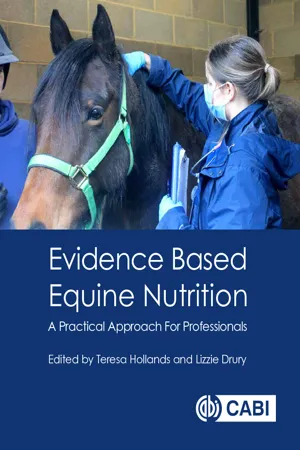
eBook - ePub
Evidence Based Equine Nutrition
A Practical Approach For Professionals
- 616 pages
- English
- ePUB (mobile friendly)
- Available on iOS & Android
eBook - ePub
Evidence Based Equine Nutrition
A Practical Approach For Professionals
About this book
Information
Topic
MedicineSubtopic
Equine Veterinary ScienceTable of contents
- Cover
- Title Page
- Copyright
- Contents
- Contributors List
- Authors’ details
- Forewords
- Acknowledgements
- Glossary of Abbreviations
- 1 Why This Book?
- 2 Taking a Nutritional History: an Overview of the 5th Vital Sign
- 3 Horse Information Required to Check Dietary Adequacy as Part of a Dietary History
- 4 Diet Details: the Evidence Behind the Practice. What Are Forages? Factors Affecting Feed Value and Intake
- 5 Diet Details: What Are Cereals and Complementary Feeds? The Importance of Energy Sources in the Horse’s Diet
- 6 What Are Supplements? The Importance of Micronutrients in the Horse’s Diet
- 7 Advising a Feed: How to Read a Label
- 8 Which Feed? Advising a Quality Feed Formulation, Quality Control and Expertise Standards
- 9 Which Fibre? Choosing a Forage and Understanding a Forage Analysis
- 10 Intake versus Requirements: Using Computer Programs
- 11 Feeding the Leisure Horse
- 12 Feeding the Performance Horse
- 13 Electrolytes
- 14 Feeding for Breeding
- 15 The Chronically Inflamed (Obese) Horse: Understanding Adipose Biology
- 16 Feeding the Aged Horse
- 17 Feeding the Donkey
- Index
- Back Cover
Trusted by 375,005 students
Access to over 1.5 million titles for a fair monthly price.
Study more efficiently using our study tools.
Frequently asked questions
Yes, you can cancel anytime from the Subscription tab in your account settings on the Perlego website. Your subscription will stay active until the end of your current billing period. Learn how to cancel your subscription
No, books cannot be downloaded as external files, such as PDFs, for use outside of Perlego. However, you can download books within the Perlego app for offline reading on mobile or tablet. Learn how to download books offline
Perlego offers two plans: Essential and Complete
- Essential is ideal for learners and professionals who enjoy exploring a wide range of subjects. Access the Essential Library with 800,000+ trusted titles and best-sellers across business, personal growth, and the humanities. Includes unlimited reading time and Standard Read Aloud voice.
- Complete: Perfect for advanced learners and researchers needing full, unrestricted access. Unlock 1.5M+ books across hundreds of subjects, including academic and specialized titles. The Complete Plan also includes advanced features like Premium Read Aloud and Research Assistant.
We are an online textbook subscription service, where you can get access to an entire online library for less than the price of a single book per month. With over 1.5 million books across 990+ topics, we’ve got you covered! Learn about our mission
Look out for the read-aloud symbol on your next book to see if you can listen to it. The read-aloud tool reads text aloud for you, highlighting the text as it is being read. You can pause it, speed it up and slow it down. Learn more about Read Aloud
Yes! You can use the Perlego app on both iOS and Android devices to read anytime, anywhere — even offline. Perfect for commutes or when you’re on the go.
Please note we cannot support devices running on iOS 13 and Android 7 or earlier. Learn more about using the app
Please note we cannot support devices running on iOS 13 and Android 7 or earlier. Learn more about using the app
Yes, you can access Evidence Based Equine Nutrition by Teresa Hollands, Lizzie Drury, Teresa Hollands,Lizzie Drury in PDF and/or ePUB format, as well as other popular books in Medicine & Equine Veterinary Science. We have over 1.5 million books available in our catalogue for you to explore.