This new book, from the editor of the highly successful Pharmaceutical Analysis, sets out to define the area of pharmaceutical chemistry as distinct from medicinal chemistry. It focuses less on prototypes of drugs that perhaps never came to market and more on the drugs currently in use. The emphasis in the book is on the physicochemical properties of drug molecules and, in so far as they are known, the way that these properties govern the interaction of the drug with its target. Important physicochemical properties include pKa and partition coefficient and the properties of the structural elements within the drug which provide interactions with the target via a range of intermolecular forces. The last fifteen years has seen a great advance in the knowledge of protein structures and a strong emphasis is given to the interaction of drugs with proteins which shape the majority of drug mechanisms.Features: - Focus on intramolecular actions- Mechanisms of action richly illustrated- Self-assessment included- Comprehensive chapters on vitamins and biotechnological productsThis new book, from the editor of the highly successful Pharmaceutical Analysis, sets out to define the area of pharmaceutical chemistry as distinct from medicinal chemistry. It focuses less on prototypes of drugs that perhaps never came to market and more on the drugs currently in use. The emphasis in the book is on the physicochemical properties of drug molecules and, in so far as they are known, the way that these properties govern the interaction of the drug with its target. Important physicochemical properties include pKa and partition coefficient and the properties of the structural elements within the drug which provide interactions with the target via a range of intermolecular forces. The last fifteen years has seen a great advance in the knowledge of protein structures and a strong emphasis is given to the interaction of drugs with proteins which shape the majority of drug mechanisms.Features: - Focus on intramolecular actions- Mechanisms of action richly illustrated- Self-assessment included- Comprehensive chapters on vitamins and biotechnological products
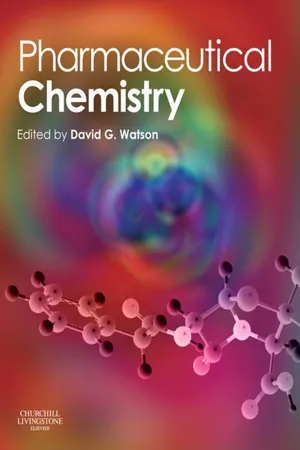
- 652 pages
- English
- ePUB (mobile friendly)
- Available on iOS & Android
eBook - ePub
Pharmaceutical Chemistry E-Book
About this book
Information
Topic
MedicineSubtopic
PharmacologyTable of contents
- Cover
- Title Page
- Front matter
- Copyright
- Preface
- Contributors
- Table of Contents
- Chapter 1: Bond type and bond strength
- Chapter 2: Hydrocarbons: alkanes, alkenes, aromatic and alkylhalides
- Chapter 3: Amines
- Chapter 4: Neutral and acidic nitrogen compounds
- Chapter 5: Oxygen- and sulphur-containing functional groups
- Chapter 6: Protein structure and its relevance to drug action
- Chapter 7: DNA structure and its importance to drug action
- Chapter 8: Drug absorption, distribution, metabolism and excretion
- Chapter 9: Structure, activity and drug design
- Chapter 10: Drugs affecting the adrenergic system
- Chapter 11: Drugs exerting non-adrenergic effects on cardiac output and vascular tone
- Chapter 12: Drugs interacting with mammalian enzymes
- Chapter 13: Central nervous system depressants
- Chapter 14: Analgesics
- Chapter 15: Local anaesthetics
- Chapter 16: Anticholinergic agents
- Chapter 17: Antihistamine drugs
- Chapter 18: CNS stimulants and CNS-active drugs affecting the serotonergic system
- Chapter 19: Drugs affecting haemostasis and thrombosis
- Chapter 20: Drugs affecting the endocrine system
- Chapter 21: Anticancer drugs
- Chapter 22: Antimicrobial chemotherapy
- Chapter 23: Antiviral drugs
- Chapter 24: Antifungal chemotherapy
- Chapter 25: Antiparasitic drugs
- Chapter 26: Vitamins and minerals
- Chapter 27: Biotechnologically produced products
- Chapter 28: Drug and gene delivery systems
- Chapter 29: The tonic and toxic effects of alcohol and its metabolites
- Index
Trusted by 375,005 students
Access to over 1.5 million titles for a fair monthly price.
Study more efficiently using our study tools.
Frequently asked questions
Yes, you can cancel anytime from the Subscription tab in your account settings on the Perlego website. Your subscription will stay active until the end of your current billing period. Learn how to cancel your subscription
No, books cannot be downloaded as external files, such as PDFs, for use outside of Perlego. However, you can download books within the Perlego app for offline reading on mobile or tablet. Learn how to download books offline
Perlego offers two plans: Essential and Complete
- Essential is ideal for learners and professionals who enjoy exploring a wide range of subjects. Access the Essential Library with 800,000+ trusted titles and best-sellers across business, personal growth, and the humanities. Includes unlimited reading time and Standard Read Aloud voice.
- Complete: Perfect for advanced learners and researchers needing full, unrestricted access. Unlock 1.5M+ books across hundreds of subjects, including academic and specialized titles. The Complete Plan also includes advanced features like Premium Read Aloud and Research Assistant.
We are an online textbook subscription service, where you can get access to an entire online library for less than the price of a single book per month. With over 1.5 million books across 990+ topics, we’ve got you covered! Learn about our mission
Look out for the read-aloud symbol on your next book to see if you can listen to it. The read-aloud tool reads text aloud for you, highlighting the text as it is being read. You can pause it, speed it up and slow it down. Learn more about Read Aloud
Yes! You can use the Perlego app on both iOS and Android devices to read anytime, anywhere — even offline. Perfect for commutes or when you’re on the go.
Please note we cannot support devices running on iOS 13 and Android 7 or earlier. Learn more about using the app
Please note we cannot support devices running on iOS 13 and Android 7 or earlier. Learn more about using the app
Yes, you can access Pharmaceutical Chemistry E-Book by David G. Watson in PDF and/or ePUB format, as well as other popular books in Medicine & Pharmacology. We have over 1.5 million books available in our catalogue for you to explore.