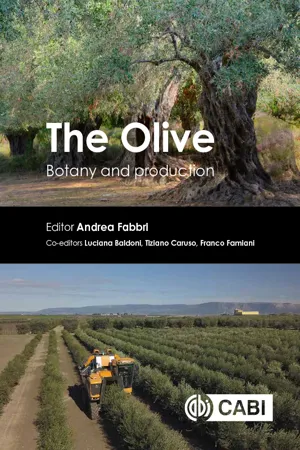
The European or Mediterranean cultivated olive (Olea europaea L., subsp. europaea, var. europaea) is an ancient crop notable for its early domestication. Today, hundreds of olive varieties are grown to produce high-quality fruit for oil and table olives for human consumption. Over the last 30 years, the olive industry has undergone profound innovation due to scientific and technical advances, particularly in genomics, breeding, orchard management, mechanization and agro-ecology. Not all these developments are currently available to smaller producers. Outside the Mediterranean Basin, where it has been present for over 6, 000 years, olive cultivation has spread to many other countries. These new olive-growing areas are helping further the expansion of the industry, due to increased awareness of the nutritional and health properties of extra virgin olive oil.This book is a much-needed update on olive biology and cultivation, with contributions from leading international experts, and includes: Genetics and breedingOlive propagation and nurseryPlanting olive orchardsHorticultural management of olive orchardsPlant protectionOlive by-productsMultifunctionality of olive groves and ecosystem servicesThe Olive: Botany and Production is an invaluable resource for researchers and students in horticulture and agriculture, in addition to producers involved in olive orchard management.
eBook - ePub
The Olive
Botany and Production
- 656 pages
- English
- ePUB (mobile friendly)
- Available on iOS & Android
eBook - ePub
The Olive
Botany and Production
About this book
Information
Table of contents
- Cover
- Title Page
- Copyright
- Contents
- List of Contributors
- Presentation
- 1. A Short History of the Olive
- 2.1. Anatomy and Morphology
- 2.2. Vegetative and Reproductive Physiology
- 2.3. Ecophysiology
- 3.1. Olive Genome Structure, Evolution and Domestication
- 3.2. Cultivated and Wild Olive Germplasm: Distribution, Management, Exploitation
- 3.3. Genotyping Technologies for Olive Cultivar Characterization and Development of Functional Markers
- 3.4. Morphological Phenotyping
- 3.5. Developing Tools for Genomics-assisted Breeding
- 3.6. Breeding Strategies and Achievements for New Olive Oil Varieties
- 3.7. Breeding Strategies and Achievements for Table Olive Varieties
- 3.8. Biotechnological Approaches in Olive Breeding
- 4. Olive Propagation and Nursery
- 5.1. Planting Models for New Olive Growing
- 5.2. Site Selection and Olive Orchard Design and Establishment
- 6.1. Soil Management
- 6.2. Water Requirements and Irrigation
- 6.3. Nutrition and Fertilization
- 6.4. Olive Training Systems and Pruning
- 6.5. Olive Harvesting
- 7.1. Responses to Abiotic Stresses
- 7.2. Pest Management in Olive Orchards
- 7.3. Olive Diseases
- 8.1. Olive Leaf Extract
- 8.2. Valorization of the Olive-oil Chain Byproducts as Soil Amendment
- 9.1. Multifunctionality of Olive Groves
- 9.2. Towards Modern Olive Polycultures
- 9.3. The Landscape of the Olive Tree: Old and New Visions
- Index
- Back Cover
Trusted by 375,005 students
Access to over 1.5 million titles for a fair monthly price.
Study more efficiently using our study tools.
Frequently asked questions
Yes, you can cancel anytime from the Subscription tab in your account settings on the Perlego website. Your subscription will stay active until the end of your current billing period. Learn how to cancel your subscription
No, books cannot be downloaded as external files, such as PDFs, for use outside of Perlego. However, you can download books within the Perlego app for offline reading on mobile or tablet. Learn how to download books offline
We are an online textbook subscription service, where you can get access to an entire online library for less than the price of a single book per month. With over 1.5 million books across 990+ topics, we’ve got you covered! Learn about our mission
Look out for the read-aloud symbol on your next book to see if you can listen to it. The read-aloud tool reads text aloud for you, highlighting the text as it is being read. You can pause it, speed it up and slow it down. Learn more about Read Aloud
Yes! You can use the Perlego app on both iOS and Android devices to read anytime, anywhere — even offline. Perfect for commutes or when you’re on the go.
Please note we cannot support devices running on iOS 13 and Android 7 or earlier. Learn more about using the app
Please note we cannot support devices running on iOS 13 and Android 7 or earlier. Learn more about using the app
Yes, you can access The Olive by Andrea Fabbri, Luciana Baldoni, Tiziano Caruso, Franco Famiani, Andrea Fabbri,Luciana Baldoni,Tiziano Caruso,Franco Famiani in PDF and/or ePUB format, as well as other popular books in Biological Sciences & Horticulture. We have over 1.5 million books available in our catalogue for you to explore.