These case studies offer new approaches to the analysis and interpretation of symbols in a variety of media and as expressed on a range of objects at different scales.
This third volume in the Material Religion in Antiquity series stems from the First International Congress on the Archaeology of Symbols (ICAS I) that took place in Florence in May 2022. The archaeological process of reconstructing and understanding our past has undergone several reassessments in the last century, producing an equal number of new perspectives and approaches. The recent materiality turn emphasizes the necessity to ground those achievements in order to build fresh avenues of interpretation and reach new boundaries in the study of the human kind and its ecology. Symbols must not be conceived only as allegory but also, and perhaps mainly, as reason (raison d’être) and meaning (culture). They may be considered key elements leading to interpretation, not only in their physical manifestation but by being infused with the gestures, beliefs and intentions of their creators, created in a specific context and with a specific chaîne opératoire.
In this volume a variety of case studies is offered, representing disparate ancient cultures in the Mediterranean and central Europe and the Near East. The thread that connects them revolves around the prominence of symbols and allegorical aspects in archaeology, whether they are considered as expressions of iconographic evidence, material culture or ritual ceremonies, seen from a multicultural perspective. This (and subsequent ICAS) volumes, therefore, aims to embrace all the different aspects pertaining to symbols in archaeology in a specific ‘place’, allowing the reader to deepen their knowledge of such a fascinating and multifaceted topic, by looking at it from a multicultural perspective.
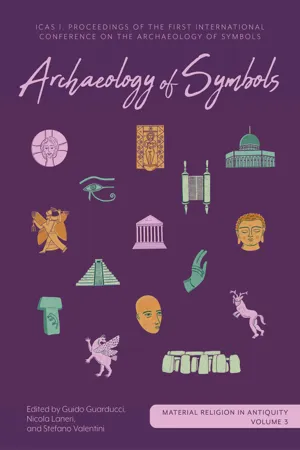
eBook - ePub
Archaeology of Symbols
ICAS I: Proceedings of the First International Conference on the Archaeology of Symbols
- 336 pages
- English
- ePUB (mobile friendly)
- Available on iOS & Android
eBook - ePub
Archaeology of Symbols
ICAS I: Proceedings of the First International Conference on the Archaeology of Symbols
About this book
Information
Subtopic
Egyptian Ancient HistoryIndex
Social SciencesTable of contents
- Cover page
- Title page
- Copyright
- List of contributors
- Introduction: symbols in mind, symbols in matter
- 1. Symbols in currents or strings of energy
- 2. Some remarks about the representation of cupping vessels (σικύα/cucurbita) in the ancient world
- 3. Abstract depictions of animals on Late Bronze swords from East Georgia
- 4. A comparison between Philistine/Canaanite and Judean iconography during the Iron Age II
- 5. Reflection of a soul? Mirror-linked symbolism in early nomadic burials (Southern Urals, Russia)
- 6. The physical materiality of the divine and its symbols: the case of Sarapis’ attributes in Hellenistic Egypt
- 7. Ritual and symbolism in the Matiate underground city
- 8. The architectural system of the step pyramid of King Djoser at Saqqara: its symbolic expression between social and semiotic sphere
- 9. Icon – index – symbol. Experiencing material semiotics through ancient figurines
- 10. The human hand as a symbol in ancient Egyptian thought
- 11. Feminine symbolism in the iconography of ‘Luristan Bronzes’: a look through the Ashmolean Museum collection
- 12. Images and symbols of 12th-century BC pictorial pottery from Cyprus
- 13. Insights from the Philistine ‘Symbol-Scape’ on Philistine origins and social structure
- 14. Deer symbolism in the Kura-Araxes culture: a view from the village of Kvatskhelebi, Georgia
- 15. Network of symbolisms in a private tomb in ancient Thebes
- 16. Is it the hairstyle? Female figurines with hairstyles in the context of the 6th millennium BC imagery of the Southern Levant
Trusted by 375,005 students
Access to over 1.5 million titles for a fair monthly price.
Study more efficiently using our study tools.
Frequently asked questions
Yes, you can cancel anytime from the Subscription tab in your account settings on the Perlego website. Your subscription will stay active until the end of your current billing period. Learn how to cancel your subscription
No, books cannot be downloaded as external files, such as PDFs, for use outside of Perlego. However, you can download books within the Perlego app for offline reading on mobile or tablet. Learn how to download books offline
We are an online textbook subscription service, where you can get access to an entire online library for less than the price of a single book per month. With over 1.5 million books across 990+ topics, we’ve got you covered! Learn about our mission
Look out for the read-aloud symbol on your next book to see if you can listen to it. The read-aloud tool reads text aloud for you, highlighting the text as it is being read. You can pause it, speed it up and slow it down. Learn more about Read Aloud
Yes! You can use the Perlego app on both iOS and Android devices to read anytime, anywhere — even offline. Perfect for commutes or when you’re on the go.
Please note we cannot support devices running on iOS 13 and Android 7 or earlier. Learn more about using the app
Please note we cannot support devices running on iOS 13 and Android 7 or earlier. Learn more about using the app
Yes, you can access Archaeology of Symbols by Guido Guarducci,Nicola Laneri,Stefano Valentini, Guido Guarducci, Nicola Laneri, Stefano Valentini in PDF and/or ePUB format, as well as other popular books in Social Sciences & Egyptian Ancient History. We have over 1.5 million books available in our catalogue for you to explore.