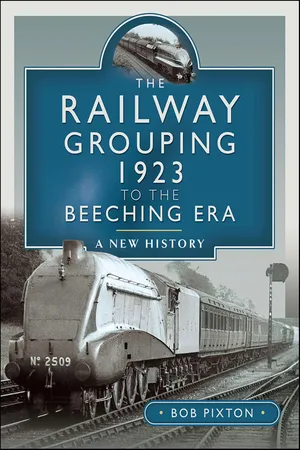
- 224 pages
- English
- ePUB (mobile friendly)
- Available on iOS & Android
eBook - ePub
About this book
British railways evolved through wars and state control, facing innovations like diesel engines and challenges from road transport amid financial struggles. When King George V ascended to the throne in 1910, world trade was increasing and at home the country's private enterprise railways were booming with larger trains and more freight being carried than ever before. Over the next fifty years the country had experienced not one, but two world wars. Railways had been forcefully reorganized, not once but twice, eventually becoming state owned. With the Government now in control of the railway's finances, reformation was on the horizon in the medicine of Dr. Beeching. This volume sets out to chart the passage of the railways during these turbulent times. Contrary to popular belief, life on the railways during these times was not all doom and gloom but times of innovation, competition, new buildings, new lines and the spread of electrification. This was the era of faster, larger, non-stop expresses, streamlined trains: we even showcased our best trains abroad, not once but twice! More and more people were taking holidays by trains and holiday camps emerged. Challenging the position of steam engines were new diesel locomotives. The Festival of Britain (1951) and the Coronation of Elizabeth (1953) saw the country emerge from the devastation and crippling debt after World War 2. On the horizon were devastating rivals that wounded the previously unassailable position of steam trains: motor lorries and family cars. With looming unsustainable finances, the Government solicited external help to help sort out matters.
Information
Publisher
Pen and Sword TransporteBook ISBN
9781399088299
Year
2024Table of contents
- Cover
- Title
- Copyright
- Contents
- Acknowledgements
- Chapter 1 Beginning
- Chapter 2 Causes of the Grouping
- Chapter 3 Pre-Grouping Amalgamations
- Chapter 4 The Grouping
- Chapter 5 Personalities
- Chapter 6 The Early Years
- Chapter 7 The Economic Conditions After the Grouping
- Chapter 8 Railway Finances
- Chapter 9 Electrification Schemes
- Chapter 10 The Rise of Cars and Lorries
- Chapter 11 Trainspotting
- Chapter 12 Post-Grouping Innovation
- Chapter 13 Coping with Heavier Trains
- Chapter 14 Streamlined Engines
- Chapter 15 England’s First Streamlined Train
- Chapter 16 Rivalry in the High Speed Era of the 1930s
- Chapter 17 Engines Touring Abroad
- Chapter 18 Camping Coaches
- Chapter 19 Excursions and Holidays in the 1920s and 1930s
- Chapter 20 Named Trains in the Post-Grouping Years
- Chapter 21 1930s Stories That Weren’t Happy Endings
- Chapter 22 Line Closures Before Dr Beeching
- Chapter 23 London Transport Board
- Chapter 24 New Engines Built During the 1940s
- Chapter 25 Effects of the War on the Railways
- Chapter 26 The Legacy of the Grouping
- Chapter 27 The Eventful 1950s
- Chapter 28 Standardisation of Railway Locomotives
- Chapter 29 The Rise of the Motor Car, Package Holidays and Motorways
- Chapter 30 BR’s Modernisation Plan
- Chapter 31 New Diesel Locomotives
- Chapter 32 The Arrival of Dr Beeching
- Select Bibliography
- Glossary
Trusted by 375,005 students
Access to over 1.5 million titles for a fair monthly price.
Study more efficiently using our study tools.