eBook - ePub
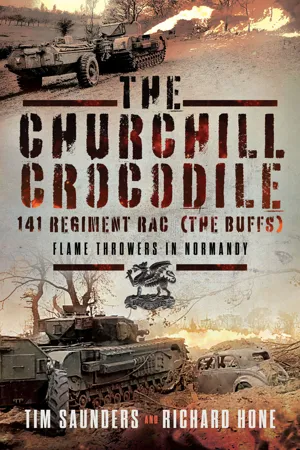
The Churchill Crocodile
141 Regiment RAC—Flame Throwers in Normandy
- 288 pages
- English
- ePUB (mobile friendly)
- Available on iOS & Android
eBook - ePub
About this book
The British Army started the development of flame throwers in 1938, but progress was slow and interest was side-lined after Dunkirk while the army reequipped. Investment in a flame-throwing tank only returned to the agenda thanks to interest by General Percy Hobart when he developed 'funnies' for 79th armored Division and the concept gained the support of General Sir Alan Brooke. 141 (The Buffs) Regiment RAC had been converted to Churchill Tanks at the end of 1941 and in early 1944 they were earmarked for another change of role to the Crocodile conversion of the new Mk VII Churchill tank. This flame throwing system was secret and started to arrive with the regiment in April 1944. By D-Day only one squadron was equipped and trained, with space on the landing craft only available for two troops to land in support of 50th Division. The rest of the regiment arrived by the end of June and were in action with various formations across the front. There followed a period of misuse by those they supported and learning on the job by the regiment's squadrons, but by the middle of the campaign a clear doctrine for the use of the Crocodile had emerged and they were in great demand.
Information
Subtopic
British HistoryIndex
HistoryTable of contents
- Cover
- Title
- Copyright
- Contents
- Acknowledgements
- Introduction
- Glossary of Terms
- 1. Conversion and Experimentation
Trusted by 375,005 students
Access to over 1.5 million titles for a fair monthly price.
Study more efficiently using our study tools.
Frequently asked questions
Yes, you can cancel anytime from the Subscription tab in your account settings on the Perlego website. Your subscription will stay active until the end of your current billing period. Learn how to cancel your subscription
No, books cannot be downloaded as external files, such as PDFs, for use outside of Perlego. However, you can download books within the Perlego app for offline reading on mobile or tablet. Learn how to download books offline
We are an online textbook subscription service, where you can get access to an entire online library for less than the price of a single book per month. With over 1.5 million books across 990+ topics, we’ve got you covered! Learn about our mission
Look out for the read-aloud symbol on your next book to see if you can listen to it. The read-aloud tool reads text aloud for you, highlighting the text as it is being read. You can pause it, speed it up and slow it down. Learn more about Read Aloud
Yes! You can use the Perlego app on both iOS and Android devices to read anytime, anywhere — even offline. Perfect for commutes or when you’re on the go.
Please note we cannot support devices running on iOS 13 and Android 7 or earlier. Learn more about using the app
Please note we cannot support devices running on iOS 13 and Android 7 or earlier. Learn more about using the app
Yes, you can access The Churchill Crocodile by Tim Saunders,Richard Hone in PDF and/or ePUB format, as well as other popular books in History & British History. We have over 1.5 million books available in our catalogue for you to explore.