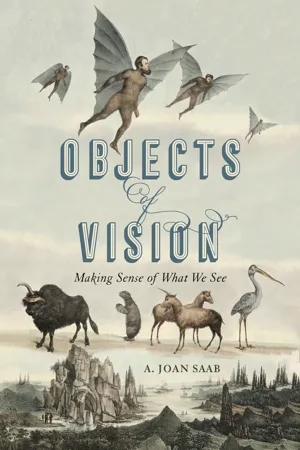
Objects of Vision
eBook - PDF

Objects of Vision

Making Sense of What We See

  1. English
  2. PDF
  3. Available on iOS & Android
eBook - PDF

Objects of Vision

Making Sense of What We See

About this book

Advances in technology allow us to see the invisible: fetal heartbeats, seismic activity, cell mutations, virtual space. Yet in an age when experience is so intensely mediated by visual records, the centuries-old realization that knowledge gained through sight is inherently fallible takes on troubling new dimensions. This book considers the ways in which seeing, over time, has become the foundation for knowing (or at least for what we think we know).

A. Joan Saab examines the scientific and socially constructed aspects of seeing in order to delineate a genealogy of visuality from the Renaissance to the present, demonstrating that what we see and how we see it are often historically situated and culturally constructed. Through a series of linked case studies that highlight moments of seeming disconnect between seeing and believing—hoaxes, miracles, spirit paintings, manipulated photographs, and holograms, to name just a few—she interrogates the relationship between "visions" and visuality. This focus on the strange and the wonderful in understanding changing notions of visions and visual culture is a compelling entry point into the increasingly urgent topic of technologically enhanced representations of reality.

Accessibly written and thoroughly enlightening, Objects of Vision is a concise history of the connections between seeing and knowing that will appeal to students and teachers of visual studies and sensory, social, and cultural history.

Frequently asked questions

Yes, you can cancel anytime from the Subscription tab in your account settings on the Perlego website. Your subscription will stay active until the end of your current billing period. Learn how to cancel your subscription.
No, books cannot be downloaded as external files, such as PDFs, for use outside of Perlego. However, you can download books within the Perlego app for offline reading on mobile or tablet. Learn more here.
Perlego offers two plans: Essential and Complete
  • Essential is ideal for learners and professionals who enjoy exploring a wide range of subjects. Access the Essential Library with 800,000+ trusted titles and best-sellers across business, personal growth, and the humanities. Includes unlimited reading time and Standard Read Aloud voice.
  • Complete: Perfect for advanced learners and researchers needing full, unrestricted access. Unlock 1.4M+ books across hundreds of subjects, including academic and specialized titles. The Complete Plan also includes advanced features like Premium Read Aloud and Research Assistant.
Both plans are available with monthly, semester, or annual billing cycles.
We are an online textbook subscription service, where you can get access to an entire online library for less than the price of a single book per month. With over 1 million books across 1000+ topics, we’ve got you covered! Learn more here.
Look out for the read-aloud symbol on your next book to see if you can listen to it. The read-aloud tool reads text aloud for you, highlighting the text as it is being read. You can pause it, speed it up and slow it down. Learn more here.
Yes! You can use the Perlego app on both iOS or Android devices to read anytime, anywhere — even offline. Perfect for commutes or when you’re on the go.
Please note we cannot support devices running on iOS 13 and Android 7 or earlier. Learn more about using the app.
Yes, you can access Objects of Vision by A. Joan Saab in PDF and/or ePUB format, as well as other popular books in History & History of Art. We have over one million books available in our catalogue for you to explore.

Information

Table of contents

  1. COVER Front
  2. Copyright Page
  3. Table of Contents
  4. Acknowledgments
  5. Prologue: In Memory of . . .
  6. Notes to Prologue
  7. Introduction
  8. Notes to Introduction
  9. Chapter 1: The Persistence of Miraculous Vision
  10. Notes to Chapter 1
  11. Chapter 2: Technological Vision Hoaxes and the Desire to Believe
  12. Notes to Chapter 2
  13. Chapter 3: Camera Vision and the Quest for Indexical Truths
  14. Notes to Chapter 3
  15. Chapter 4: Untitled: Postmodern Vision and the Triumph of the Pseudo-Event
  16. Notes to Chapter 4
  17. Conclusion: How to Look at a Million Images
  18. Notes to Conclusion
  19. Notes
  20. Bibliography
  21. Index