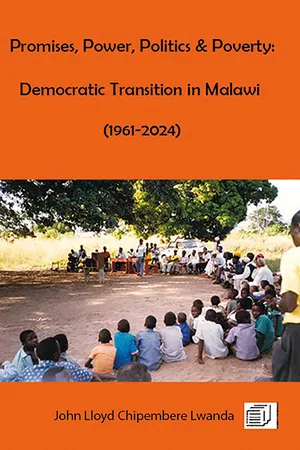
Dr. Banda's thirty-year rule was the subject of Lwanda's earlier book Kamuzu Banda of Malawi: a Study in Promise, Power and Paralysis, the first edition of which was in 1993. Now the small Southern African nation of Malawi has been a multiparty democracy since the first multiparty elections on 17 May 1994. The first multiparty dispensation, under the United Democratic Front's President Bakili Muluzi, experienced both startling successes and fantastic failures. Since then, the paralysing poverty has persisted, yet the once silent land is resonating with freedom of speech, free universal primary school education, an independent judiciary...The first incarnation of this book was written in 1996, three years before the elections of 1999. At the time, some of the critical political questions then were: Could the UDF begin delivering on their pledges on poverty alleviation and development? Was the MCP capable of genuinely reforming itself? Could AFORD survive? Could democracy itself survive in Malawi? Could a new cadre of leadership emerge; one that was both unencumbered by the Banda legacy and which spoke for both rich and poor, rural and urban? These are some of the issues discussed in Promises, Power, Politics and Poverty the Democratic Transition in Malawi.This book is still, by far, the most detailed account of the political transition of 1991 to 1994, containing details of the origins of the UDF and AFORD, and charting the rise and fall of the Diaspora-based political parties. It also critically examined the performance of the new government up to 1996. It is an essential comprehensive reading for all those interested in the turbulent politics of Malawi, from 1961 to the present. It has dozens of illuminative pictures and anecdotes."Lwanda is the kind of writer who wants to put everything in..." Landeg White, (Emeritus Director, Centre for Southern African Studies, York University)."He writes with deep knowledge, commendable compassion, and often remarkable analytical insight. This analysis of a complex political situation in Malawi since the defeat of Dr. Banda deserves to be considered very carefully by anyone who has the future of Africa, especially central Africa, at questions at heart" (Professor George Shepperson).
- 606 pages
- English
- PDF
- Available on iOS & Android
eBook - PDF
About this book
Information
Table of contents
- Front cover
- Copyright
- Title page
- Contents
- Preface
- Acknowledgements
- 1 A Turning Point or another Bend?
- 2 The Nature of Malawi Society
- 3 The Persistent Presence of Dissent
- 4 Enter Achikulire, and Mwambo Wathu
- 5 The Lion and His Cubs
- 6 Finding a Common Cause?
- 7 Converting the Bishops?
- 8 A Time for Protestants
- 9 Re/De-Colonising the Rural Mind?
- 10 The Pressure Groups Emerge
- 11 The Re-Emergence of Power Politics
- 12 The Emergence of the ‘Free Press’
- 13 Politics in a Vacuum
- 14 The New Patrons
- 15 Chitukuko cha Azimai M'tsogolo? (Life after Mbumbahood)
- 16 Voting for the Future
- 17 A Man of the People
- 18 Alleviating Whose Poverty?
- 19 The Lion on Trial: Reconciliation or Revenge?
- 20 Malawi What Lies Ahead?
- 21 Mchape, Tradition and the Concept of Health
- 22 Epilogue
- 23 Afterword and Postscript: The New Ngwazis
- Bibliography
- Index
- Back cover
Trusted by 375,005 students
Access to over 1.5 million titles for a fair monthly price.
Study more efficiently using our study tools.
Frequently asked questions
Yes, you can cancel anytime from the Subscription tab in your account settings on the Perlego website. Your subscription will stay active until the end of your current billing period. Learn how to cancel your subscription
No, books cannot be downloaded as external files, such as PDFs, for use outside of Perlego. However, you can download books within the Perlego app for offline reading on mobile or tablet. Learn how to download books offline
Perlego offers two plans: Essential and Complete
- Essential is ideal for learners and professionals who enjoy exploring a wide range of subjects. Access the Essential Library with 800,000+ trusted titles and best-sellers across business, personal growth, and the humanities. Includes unlimited reading time and Standard Read Aloud voice.
- Complete: Perfect for advanced learners and researchers needing full, unrestricted access. Unlock 1.5M+ books across hundreds of subjects, including academic and specialized titles. The Complete Plan also includes advanced features like Premium Read Aloud and Research Assistant.
We are an online textbook subscription service, where you can get access to an entire online library for less than the price of a single book per month. With over 1.5 million books across 990+ topics, we’ve got you covered! Learn about our mission
Look out for the read-aloud symbol on your next book to see if you can listen to it. The read-aloud tool reads text aloud for you, highlighting the text as it is being read. You can pause it, speed it up and slow it down. Learn more about Read Aloud
Yes! You can use the Perlego app on both iOS and Android devices to read anytime, anywhere — even offline. Perfect for commutes or when you’re on the go.
Please note we cannot support devices running on iOS 13 and Android 7 or earlier. Learn more about using the app
Please note we cannot support devices running on iOS 13 and Android 7 or earlier. Learn more about using the app
Yes, you can access Promises, Power, Politics and Poverty by in PDF and/or ePUB format, as well as other popular books in Politics & International Relations & Politics. We have over 1.5 million books available in our catalogue for you to explore.