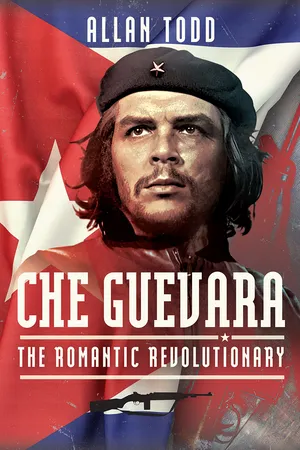
Although Che Guevara was murdered almost sixty years ago, thefamous red-and-black image of him is still widely seen around theworld: at leftist political demonstrations and, ironically - given hisstrong opposition to capitalism - on many commercial products.However, he was a controversial figure during his lifetime - andremains so today. On both the political left and the political right, attitudes to him vary widely: while some see him as a romantic, highly-principled and legendary fighter for the world's poor andexploited masses, others depict him either as an unrealistic and thusirrelevant adventurer, or even as a ruthless and cold-blooded butcher.Consequently, biographies about him over the decades have rangedfrom the overly sympathetic, to the extremely hostile. As well as covering aspects of his family life and his loves - and hisearly, sometimes less-than-revolutionary, attitudes - this biography, as expected, deals with those areas for which Che is best known.These include his adventurous explorations, as a young man on amotorbike, of Latin and Central America; his leadership and braveryduring Cuba's Revolutionary War; his practical and theoreticalcontributions to the conduct of guerrilla warfare; and his emergence asan international revolutionary legend who inspired radical youngpeople in the 1960s, and who continues to inspire rebellious peoplearound the world today. However, this biography also explores other aspects of Che's lifewhich are not so well-known. From an early age, he developed akeen love of reading, covering an eclectic mix of adventure stories, poetry, history and philosophy - and, from his teens, he began alifetime habit of making notes on what he read. He also became astrong chess player, able enough to draw with one of the world'sleading grandmasters. Even during guerrilla campaigns, he managedto maintain those loves. Since his murder, he has emerged as an original contributor toMarxist economics and philosophy. It was his wide-ranging studiesthat led him to become an outspoken opponent of the 'orthodox'communism followed in the Soviet Union - and of its Cold War foreignpolicy of 'peaceful coexistence'. His tolerance of, and willingness towork with, those having different views saw him accused of Maoism -and even Trotskyism. More accurately, Che has bequeathed theunique strand of revolutionary socialism known as 'Guevarism'.
- 298 pages
- English
- PDF
- Available on iOS & Android
eBook - PDF
About this book
Information
Table of contents
- Cover
- Book Title
- Copyright
- Contents
- Acknowledgements
- A Note on Usages
- Family Tree
- Main Characters
- Maps
- Introduction: An Icon Of International Revolution
- Chapter 1 The Young Che, 1928–43
- Chapter 2 Learning And Love, 1943–50
- Chapter 3 Motorcycles, Medicine and Marxism 1951–53
- Chapter 4 Revolution and Romance in Guatemala, 1953–54
- Chapter 5 Committing to Revolution, 1954–56
- Plates
- Chapter 6 Becoming ‘El Che’, 1956–59
- Chapter 7 The Revolutionary Minister, 1959–63
- Chapter 8 The Great Debate, 1963–64
- Chapter 9 Failure in the Congo, 1965–66
- Chapter 10 The Fatal Mission, 1966–67
- Conclusion: Guevarism – Che’s Legacy
- Endnotes
- Bibliography/Further Reading
- Index
- Back Cover
Trusted by 375,005 students
Access to over 1.5 million titles for a fair monthly price.
Study more efficiently using our study tools.
Frequently asked questions
Yes, you can cancel anytime from the Subscription tab in your account settings on the Perlego website. Your subscription will stay active until the end of your current billing period. Learn how to cancel your subscription
No, books cannot be downloaded as external files, such as PDFs, for use outside of Perlego. However, you can download books within the Perlego app for offline reading on mobile or tablet. Learn how to download books offline
Perlego offers two plans: Essential and Complete
- Essential is ideal for learners and professionals who enjoy exploring a wide range of subjects. Access the Essential Library with 800,000+ trusted titles and best-sellers across business, personal growth, and the humanities. Includes unlimited reading time and Standard Read Aloud voice.
- Complete: Perfect for advanced learners and researchers needing full, unrestricted access. Unlock 1.5M+ books across hundreds of subjects, including academic and specialized titles. The Complete Plan also includes advanced features like Premium Read Aloud and Research Assistant.
We are an online textbook subscription service, where you can get access to an entire online library for less than the price of a single book per month. With over 1.5 million books across 990+ topics, we’ve got you covered! Learn about our mission
Look out for the read-aloud symbol on your next book to see if you can listen to it. The read-aloud tool reads text aloud for you, highlighting the text as it is being read. You can pause it, speed it up and slow it down. Learn more about Read Aloud
Yes! You can use the Perlego app on both iOS and Android devices to read anytime, anywhere — even offline. Perfect for commutes or when you’re on the go.
Please note we cannot support devices running on iOS 13 and Android 7 or earlier. Learn more about using the app
Please note we cannot support devices running on iOS 13 and Android 7 or earlier. Learn more about using the app
Yes, you can access Che Guevara by Allan Todd in PDF and/or ePUB format, as well as other popular books in Politics & International Relations & Political Biographies. We have over 1.5 million books available in our catalogue for you to explore.