- 958 pages
- English
- ePUB (mobile friendly)
- Available on iOS & Android
eBook - ePub
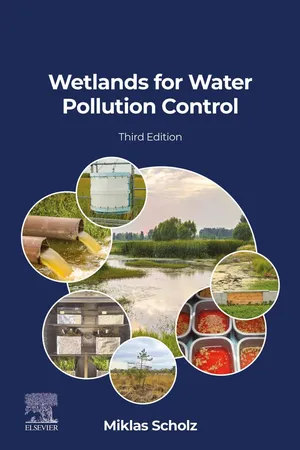
Wetlands for Water Pollution Control
About this book
Wetlands for Water Pollution Control is the third edition of the reputable reference guide by Miklas Scholz- formerly known as Wetland Systems to Control Urban Runoff. The book covers broad water and environmental engineering aspects relevant for the drainage and treatment of storm water and wastewater, providing a descriptive overview of complex 'black box' treatment systems and general design issues involved.
The fundamental science and engineering principles will be explained to address the student and professional market. Standard and novel design recommendations for predominantly constructed wetlands and related sustainable drainage systems will also be provided to account for the interests of the professional engineers and environmental scientists. Latest research findings in wastewater treatment and runoff control will be discussed to attract academics and senior consultants who should recommend the proposed textbook to final year and postgraduate students, and graduate engineers, respectively.
- Includes twelve new chapters with a broad overview of water and environmental engineering aspects relevant for the drainage and treatment of stormwater and wastewater
- Contains case study topics covering wetlands, including natural wetlands and constructed treatment wetlands, sustainable water management, including sustainable drainage systems, and specific applications such as wetlands treating hydrocarbon, greywater, and piggery dye wastewater
- Captures the latest findings in wastewater treatment, with chapters focusing on practical applications and field studies
Information
Table of contents
- Cover
- Front Matter
- Table of Contents
- Copyright
- Dedication
- About the author
- Preface
- Acknowledgments
- Common acronyms and abbreviations
- List of Illustrations
- List of Tables
- Section A : Introduction
- Chapter 1 : Water quality standards
- Chapter 2 : Water treatment
- Chapter 3 : Sewage treatment
- Chapter 4 : Stream pollution and effluent standards
- Chapter 5 : Preliminary treatment
- Chapter 6 : Primary treatment
- Chapter 7 : Coagulation and flocculation
- Chapter 8 : Sludge blanket clarifiers
- Chapter 9 : Flotation systems
- Chapter 10 : Slow filtration
- Chapter 11 : Rapid filtration
- Chapter 12 : Biological treatment
- Chapter 13 : Biological filtration
- Chapter 14 : Rotating biological contactors
- Chapter 15 : Activated sludge processes
- Chapter 16 : Iron and manganese removal
- Chapter 17 : Water softening
- Chapter 18 : Water microbiology
- Chapter 19 : Disinfection
- Chapter 20 : Constructed wetlands
- Chapter 21 : Sludge treatment and disposal
- Section B : Introduction
- Chapter 22 : Wetlands treating contaminated stream water
- Chapter 23 : Wetland systems to control roof runoff
- Chapter 24 : Wetlands treating road runoff
- Chapter 25 : Combined wetland and below-ground detention systems
- Chapter 26 : Modeling of constructed wetland performance
- Chapter 27 : Infiltration wetland systems
- Section C : Introduction
- Chapter 28 : Retrofitting of sustainable drainage systems in the presence of vegetation
- Chapter 29 : Tree species for use in urban areas supporting sustainable drainage
- Chapter 30 : Expert tool based on ecosystem service variables for retrofitting of wetland systems
- Chapter 31 : Sustainable drainage system model
- Section D : Introduction
- Chapter 32 : Natural wetlands treating diffuse pollution
- Chapter 33 : Impact of climate change on wetland ecosystems
- Chapter 34 : Future climate scenario impacts on peatland and constructed wetland water quality under water level management
- Chapter 35 : Integrated constructed wetlands for pollution control
- Chapter 36 : Infiltration and contaminant migration beneath integrated constructed wetlands
- Section E : Introduction
- Chapter 37 : Seasonal assessment of vertical-flow wetlands treating domestic wastewater
- Chapter 38 : Comparison of domestic wastewater treatment by mature vertical-flow constructed wetlands and ponds
- Chapter 39 : Recycling of domestic wastewater treated by vertical-flow wetlands for irrigation
- Chapter 40 : Microbial contamination of Capsicum annuum irrigated with recycled domestic wastewater treated by wetlands
- Chapter 41 : Contamination of soil and Capsicum annuum irrigated with recycled domestic wastewater
- Chapter 42 : Modeling of vertical subsurface-flow constructed wetlands treating municipal wastewater in hot and dry climate
- Chapter 43 : Remediation of graywater in floating treatment wetlands
- Chapter 44 : Graywater treatment with pelletized mine water sludge
- Chapter 45 : Industrial water treatment within a planted wetland and subsequent effluent reuse to grow vegetables
- Chapter 46 : Piggery wastewater treatment with integrated constructed wetlands
- Chapter 47 : Dye wastewater treatment by vertical-flow wetlands
- Chapter 48 : Ponds covered with Lemna minor treating dyes
- Section F : Introduction
- Chapter 49 : Wetland systems as part of the sustainable flood retention basin concept
- Chapter 50 : Classification of sustainable flood retention basins
- Chapter 51 : Water-sensitive urban development for climate change adaptation*
- GENERIC-TITLE
- Index
Trusted by 375,005 students
Access to over 1.5 million titles for a fair monthly price.
Study more efficiently using our study tools.
Frequently asked questions
Yes, you can cancel anytime from the Subscription tab in your account settings on the Perlego website. Your subscription will stay active until the end of your current billing period. Learn how to cancel your subscription
No, books cannot be downloaded as external files, such as PDFs, for use outside of Perlego. However, you can download books within the Perlego app for offline reading on mobile or tablet. Learn how to download books offline
Perlego offers two plans: Essential and Complete
- Essential is ideal for learners and professionals who enjoy exploring a wide range of subjects. Access the Essential Library with 800,000+ trusted titles and best-sellers across business, personal growth, and the humanities. Includes unlimited reading time and Standard Read Aloud voice.
- Complete: Perfect for advanced learners and researchers needing full, unrestricted access. Unlock 1.5M+ books across hundreds of subjects, including academic and specialized titles. The Complete Plan also includes advanced features like Premium Read Aloud and Research Assistant.
We are an online textbook subscription service, where you can get access to an entire online library for less than the price of a single book per month. With over 1.5 million books across 990+ topics, we’ve got you covered! Learn about our mission
Look out for the read-aloud symbol on your next book to see if you can listen to it. The read-aloud tool reads text aloud for you, highlighting the text as it is being read. You can pause it, speed it up and slow it down. Learn more about Read Aloud
Yes! You can use the Perlego app on both iOS and Android devices to read anytime, anywhere — even offline. Perfect for commutes or when you’re on the go.
Please note we cannot support devices running on iOS 13 and Android 7 or earlier. Learn more about using the app
Please note we cannot support devices running on iOS 13 and Android 7 or earlier. Learn more about using the app
Yes, you can access Wetlands for Water Pollution Control by Miklas Scholz in PDF and/or ePUB format, as well as other popular books in Biological Sciences & Environmental Science. We have over 1.5 million books available in our catalogue for you to explore.