eBook - ePub
Earthworm Technology in Organic Waste Management
Recent Trends and Advances
- 410 pages
- English
- ePUB (mobile friendly)
- Available on iOS & Android
eBook - ePub
Earthworm Technology in Organic Waste Management
Recent Trends and Advances
About this book
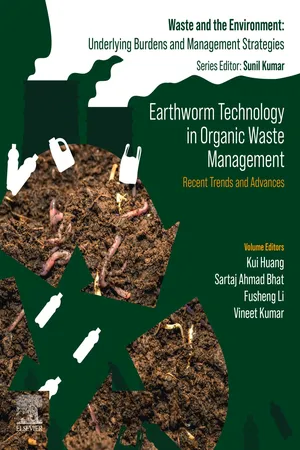
Earthworm Technology in Organic Waste Management: Recent Trends and Advances is a suitable contribution to the Waste and The Environment: Underlying Burdens And Management Strategies series that will be helpful in classifying and broadly addressing assessments, mitigation strategies, and the management of organic wastes using earthworms. In addition, the book provides a summary of the latest findings on emerging pollution-related issues, their sustainable management, and future perspectives. The book covers recent trends and developments in organic waste management, including the use of earthworms in municipal and industrial waste management, the role of earthworms in vermifiltration/vermiwash, and of vermicompost in crops.
Finally, the book covers the potential of earthworms in the remediation of emerging contaminants. This includes antibiotic resistance genes, heavy metals, pesticides, microplastics, and other emerging pollutants that are not covered in-depth in previously published titles.
- Covers a broad range of information on different aspects of organic waste treatment by earthworm technology
- Illustrates how earthworms can be used in modeling, assessment and management of environmental issues caused by geogenic, industrial and emerging pollutants
- Highlights the reuse and recycling of industrial and municipal organic waste and recovery of value-added resources from organic waste
Information
Subtopic
Scienze ambientaliTable of contents
- Cover
- Front Matter
- Table of Contents
- Copyright
- Contributors
- About the editors
- List of Illustrations
- List of Tables
- Chapter 1 : Earthworm-associated bacterial community and its role in organic waste decomposition
- Chapter 2 : How do earthworms affect the microbial community during vermicomposting for organic waste recycling?
- Chapter 3 : Exploring the transfer and transformation of Polycyclic Aromatic Hydrocarbons in vermifiltration for domestic wastewater treatment
- Chapter 4 : Vermiremediation of organic wastes: vermicompost as a powerful plant growth promoter
- Chapter 5 : Vermiremediation of plant agro waste to recover residual nutrients and improve crop productivity
- Chapter 6 : Biochemical alterations of vermicompost produced from Eichhornia crassipes (water hyacinth) and cattle dung
- Chapter 7 : Use of vermicompost and vermiwash for the growth and production of tomatoes (Lycopersicon esculentum Mill.): A case study in Suriname
- Chapter 8 : Earthworm mediated amelioration of heavy metals from solid organic waste: an ecotechnological approach toward valorization
- Chapter 9 : Vermicomposting as a tool for removal of heavy metal contaminants from soil and water environment
- Chapter 10 : Earthworms and microplastics: Transport from sewage sludge to soil, antibiotic-resistant genes, and soil remediation
- Chapter 11 : Instrumental characterization of matured vermicompost produced from organic waste
- Chapter 12 : Exposure to emerging contaminants: ecotoxicological effects on earthworms and the potential of gut-associated microorganisms in bioremediation
- Chapter 13 : Influence of earthworm combined with bermudagrass on the content and bioavailability of heavy metal in reclaimed soil
- Chapter 14 : The power of earthworm: vermicompost drives to sustainable agriculture
- Chapter 15 : Utilization of vermicompost and vermileachate on plant growth and development: aspects to consider
- Chapter 16 : Emerging pollutants in waste: occurrence, impact, removal, and screening technologies
- Chapter 17 : Analysis of carbon emissions in composting and vermicomposting of excess sludge
- Chapter 18 : Bacterial 16s rDNA diversity in the gut of Eisenia fetida revealed by metagenomics and high-throughput sequencing technology
- Index
- A
Trusted by 375,005 students
Access to over 1.5 million titles for a fair monthly price.
Study more efficiently using our study tools.
Frequently asked questions
Yes, you can cancel anytime from the Subscription tab in your account settings on the Perlego website. Your subscription will stay active until the end of your current billing period. Learn how to cancel your subscription
No, books cannot be downloaded as external files, such as PDFs, for use outside of Perlego. However, you can download books within the Perlego app for offline reading on mobile or tablet. Learn how to download books offline
Perlego offers two plans: Essential and Complete
- Essential is ideal for learners and professionals who enjoy exploring a wide range of subjects. Access the Essential Library with 800,000+ trusted titles and best-sellers across business, personal growth, and the humanities. Includes unlimited reading time and Standard Read Aloud voice.
- Complete: Perfect for advanced learners and researchers needing full, unrestricted access. Unlock 1.5M+ books across hundreds of subjects, including academic and specialized titles. The Complete Plan also includes advanced features like Premium Read Aloud and Research Assistant.
We are an online textbook subscription service, where you can get access to an entire online library for less than the price of a single book per month. With over 1.5 million books across 990+ topics, we’ve got you covered! Learn about our mission
Look out for the read-aloud symbol on your next book to see if you can listen to it. The read-aloud tool reads text aloud for you, highlighting the text as it is being read. You can pause it, speed it up and slow it down. Learn more about Read Aloud
Yes! You can use the Perlego app on both iOS and Android devices to read anytime, anywhere — even offline. Perfect for commutes or when you’re on the go.
Please note we cannot support devices running on iOS 13 and Android 7 or earlier. Learn more about using the app
Please note we cannot support devices running on iOS 13 and Android 7 or earlier. Learn more about using the app
Yes, you can access Earthworm Technology in Organic Waste Management by Kui Huang,Sartaj Ahmad Bhat,Fusheng Li,Vineet Kumar in PDF and/or ePUB format, as well as other popular books in Tecnologia e ingegneria & Scienze ambientali. We have over 1.5 million books available in our catalogue for you to explore.