- 434 pages
- English
- ePUB (mobile friendly)
- Available on iOS & Android
eBook - ePub
The Science, Etiology and Mechanobiology of Diabetes and its Complications
About this book
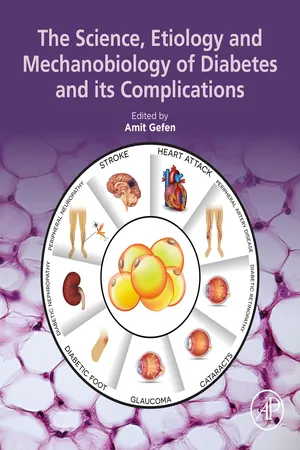
The Science, Etiology and Mechanobiology of Diabetes and Its Complications presents the most comprehensive synthesis of contemporary global research on diabetes, covering a novel and unique mechanobiological perspective – addressing prevention, management and treatment of tissue, organ and body system damage associated with diabetes and its complications. The book provides a unique approach to communicating diabetes-associated symptoms and opens avenues for development of novel therapeutic and preventive methods. It offers descriptive pathophysiology of diabetes and its complications with great emphasis on mechanobiology. Content coverage also includes management of tissue, organ and body system damage caused by chronic hyperglycemia.
Biologists, life scientists, physicians, pharmacists, biomedical engineers, medical physicists, biomathematicians and computer scientists who are interested in the state-of-science and current challenges in the mechanobiology of diabetes should find this book very useful. Likewise, medical researchers in fields such as endocrinology, cardiovascular medicine, oncology, obesity, the immune system, inflammation and wound care and others who wish to be updated about the latest achievements in this exciting arena of research will find that information here.
- Covers the state-of-knowledge in diabetes research from a mechanobiological perspective, including cell death and (neural, connective, adipose, vascular, renal etc.) tissue damage cascades and healing processes
- Describes state-of-the-art technology in prevention, diagnosis, prognosis and treatment of tissue, organ and body system damage caused by chronic hyperglycemia and diabetes
- Explores emerging research directions and future technology trends in the field of diabetes prevention and care, including common complications of diabetes (foot ulcers and amputation, peripheral neuropathy, retinal damage, renal damage, vascular and cardiac damage, connective tissue damage etc.) at the early stage of research and development in academia and industry
Information
Table of contents
- The Science, Etiology and Mechanobiology of Diabetes and its Complications
- Chapter 1 Heel ulcers in patients with diabetes
- Chapter 2 Diabetic foot ulcers and their wound management
- Chapter 3 Computational modeling of the plantar tissue stresses induced by the clinical practice of off-loading of the diabetic foot
- Chapter 4 Modeling effects of sustained bodyweight forces on adipose tissue microstructures and adipocytes in diabesity
- Chapter 5 Mechanisms underlying vascular stiffening in obesity, insulin resistance, and type 2 diabetes
- Chapter 6 Pathomechanics of diabetic foot ulceration
- Chapter 7 Novel technologies for detection and prevention of diabetic foot ulcers
- Chapter 8 The role of tissue biomechanics in improving the clinical management of diabetic foot ulcers
- Chapter 9 The mechanobiology of adipocytes in the context of diabetes
- Chapter 10 Optical Coherence Tomography to determine and visualize pathological skin structure changes caused by diabetes
- Chapter 11 Effects of hyperglycemia and mechanical stimulations on differentiation fate of mesenchymal stem cells
- Chapter 12 Clinical complications of tendon tissue mechanics due to collagen cross-linking in diabetes
- Chapter 13 A phenomenological dashpot model for morphoelasticity for the contraction of scars
- Chapter 14 Mechanobiology of diabetes and its complications
- Chapter 15 Application of tissue mechanics to clinical management of risk in the diabetic foot
- Chapter 16 Bone carriers in diabetic foot osteomyelitis
- Chapter 17 Vascular mechanobiology and metabolism
- Chapter 18 Effect of type 2 diabetes on bone cell behavior
- Chapter 19 What makes a good device for the diabetic foot
- Chapter 20 Allostasis
- Chapter 21 Footwear for persons with diabetes at high risk for foot ulceration
- Chapter 22 Compounding effects of diabetes in vessel formation in microvessel fragment–based engineered constructs
- Chapter 23 Dressing selection challenges in diabetic foot local treatment
- Index
Trusted by 375,005 students
Access to over 1.5 million titles for a fair monthly price.
Study more efficiently using our study tools.
Frequently asked questions
Yes, you can cancel anytime from the Subscription tab in your account settings on the Perlego website. Your subscription will stay active until the end of your current billing period. Learn how to cancel your subscription
No, books cannot be downloaded as external files, such as PDFs, for use outside of Perlego. However, you can download books within the Perlego app for offline reading on mobile or tablet. Learn how to download books offline
Perlego offers two plans: Essential and Complete
- Essential is ideal for learners and professionals who enjoy exploring a wide range of subjects. Access the Essential Library with 800,000+ trusted titles and best-sellers across business, personal growth, and the humanities. Includes unlimited reading time and Standard Read Aloud voice.
- Complete: Perfect for advanced learners and researchers needing full, unrestricted access. Unlock 1.5M+ books across hundreds of subjects, including academic and specialized titles. The Complete Plan also includes advanced features like Premium Read Aloud and Research Assistant.
We are an online textbook subscription service, where you can get access to an entire online library for less than the price of a single book per month. With over 1.5 million books across 990+ topics, we’ve got you covered! Learn about our mission
Look out for the read-aloud symbol on your next book to see if you can listen to it. The read-aloud tool reads text aloud for you, highlighting the text as it is being read. You can pause it, speed it up and slow it down. Learn more about Read Aloud
Yes! You can use the Perlego app on both iOS and Android devices to read anytime, anywhere — even offline. Perfect for commutes or when you’re on the go.
Please note we cannot support devices running on iOS 13 and Android 7 or earlier. Learn more about using the app
Please note we cannot support devices running on iOS 13 and Android 7 or earlier. Learn more about using the app
Yes, you can access The Science, Etiology and Mechanobiology of Diabetes and its Complications by Amit Gefen in PDF and/or ePUB format, as well as other popular books in Technology & Engineering & Engineering General. We have over 1.5 million books available in our catalogue for you to explore.