- 760 pages
- English
- ePUB (mobile friendly)
- Available on iOS & Android
eBook - ePub
About this book
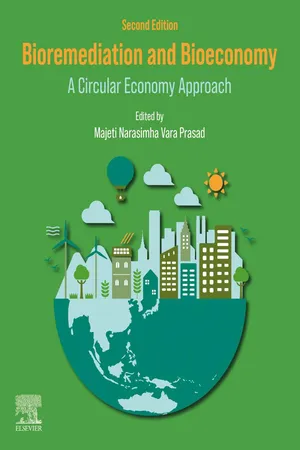
Bioremediation and Bioeconomy: A Circular Economy Approach provides a common platform for scientists from various backgrounds to find sustainable solutions to environmental issues, including remediation of emerging pollutants, usage of contaminated land and wastewater for bioproducts such as natural fibers, biocomposites, and fuels, to boost the economy. The need for transitioning to a sustainable use of natural resources is now more evident than ever as industrialization and pollution are global phenomena.
Biodiversity is being used as raw material for environmental decontamination, and this field has grown phenomenally in recent years, having emerged less than 3 decades ago. On the other hand, the volume of contaminated substrates (water, soil, and air) is increasing due to anthropogenic and technogenic sources of organic and inorganic contaminants. Bioremediation and Bioeconomy: A Circular Economy Approach will address the bottlenecks and solutions to the existing limitations in field scale and the relevant techniques.
- Provides a compilation of new information on bioremediation not found in other books in the present market
- Presents the link between bioremediation, bioeconomy, and the circular economy
- Includes strategies for using contaminated substrates for producing bioresources and co-generation of value chain and value addition products
Information
Topic
Physical SciencesSubtopic
Environmental ScienceTable of contents
- Bioremediation and Bioeconomy
- Cover
- Title Page
- Copyright
- Table of Contents
- Dedication
- Contributors
- Preface
- Acknowledgments
- Chapter 1 Bioremediation, bioeconomy, circular economy, and circular bioeconomy—Strategies for sustainability
- Chapter 2 Holistic approach to bioremediation-derived biomass and biorefineries for accelerating bioeconomy, circular bioeconomy, and carbon neutrality
- Chapter 3 Production of biodiesel feedstock from trace element-contaminated lands in Ukraine
- Chapter 4 Aromatic, medicinal, and energy plantations on metalliferous/contaminated soil—Bioremediation and bioeconomy
- Chapter 5 Prosopis juliflora (Sw) DC: Potential for bioremediation and bio-based economy
- Chapter 6 Giant reed (Arundo donax L.)—A multi-purpose crop bridging phytoremediation with sustainable bioeconomy
- Chapter 7 Phytomass gasification for energy recovery from aquatic plants
- Chapter 8 Jatropha curcas L. cultivation on contaminated and marginal land—Exploring the potential for circular economy, environmental protection, and sustainability
- Chapter 9 Potential of ornamental plants for phytoremediation and income generation
- Chapter 10 Native trees on abandoned mine land: From environmental remediation to bioeconomy
- Chapter 11 Rice plants for cleanup of trace elements—Bioeconomic perspectives
- Chapter 12 Duckweeds: Bioremediation of surface wastewater and biorefinery
- Chapter 13 Cultivation of sweet sorghum on heavy metal-contaminated soils by phytoremediation approach for production of bioethanol
- Chapter 14 Bioremediation and bioeconomy potential of sunflower (Helianthus annuus L.)
- Chapter 15 Chrysopogon zizanioides (vetiver grass) for abandoned mine restoration and phytoremediation: Cogeneration of economical products
- Chapter 16 Mulberry (Morus spp.) for phytostabilization of coal mine overburden: Co-generation of economic products
- Chapter 17 Utilization of contaminated lands for cultivation of dye producing plants for dyestuff
- Chapter 18 Bioeconomy and circular economy approaches for the greening of urban wastelands: Focus on biodiversity to achieve sustainability
- Chapter 19 Biological recultivation of fly ash dumps strengthening bioeconomy and circular economy in the ural region of Russia
- Chapter 20 Phycoremediation and business prospects
- Chapter 21 Algae-based bioremediation bioproducts and biofuels for biobusiness
- Chapter 22 Building circular bio-based economy through sustainable waste management
- Chapter 23 Bioremediation in Brazil: Recent evolutions and remaining challenges to boost up the bioeconomy
- Chapter 24 Phytomanagement of polycyclic aromatic hydrocarbon and heavy metal contaminated sites in Assam, North Eastern India, for boosting the bioeconomy
- Chapter 25 From preservation of aquatic ecosystems to ecocatalysis®
- Chapter 26 Synthetic biology: An emerging field for developing economies
- Index
Trusted by 375,005 students
Access to over 1.5 million titles for a fair monthly price.
Study more efficiently using our study tools.
Frequently asked questions
Yes, you can cancel anytime from the Subscription tab in your account settings on the Perlego website. Your subscription will stay active until the end of your current billing period. Learn how to cancel your subscription
No, books cannot be downloaded as external files, such as PDFs, for use outside of Perlego. However, you can download books within the Perlego app for offline reading on mobile or tablet. Learn how to download books offline
Perlego offers two plans: Essential and Complete
- Essential is ideal for learners and professionals who enjoy exploring a wide range of subjects. Access the Essential Library with 800,000+ trusted titles and best-sellers across business, personal growth, and the humanities. Includes unlimited reading time and Standard Read Aloud voice.
- Complete: Perfect for advanced learners and researchers needing full, unrestricted access. Unlock 1.5M+ books across hundreds of subjects, including academic and specialized titles. The Complete Plan also includes advanced features like Premium Read Aloud and Research Assistant.
We are an online textbook subscription service, where you can get access to an entire online library for less than the price of a single book per month. With over 1.5 million books across 990+ topics, we’ve got you covered! Learn about our mission
Look out for the read-aloud symbol on your next book to see if you can listen to it. The read-aloud tool reads text aloud for you, highlighting the text as it is being read. You can pause it, speed it up and slow it down. Learn more about Read Aloud
Yes! You can use the Perlego app on both iOS and Android devices to read anytime, anywhere — even offline. Perfect for commutes or when you’re on the go.
Please note we cannot support devices running on iOS 13 and Android 7 or earlier. Learn more about using the app
Please note we cannot support devices running on iOS 13 and Android 7 or earlier. Learn more about using the app
Yes, you can access Bioremediation and Bioeconomy by Majeti Narasimha Vara Prasad in PDF and/or ePUB format, as well as other popular books in Physical Sciences & Environmental Science. We have over 1.5 million books available in our catalogue for you to explore.