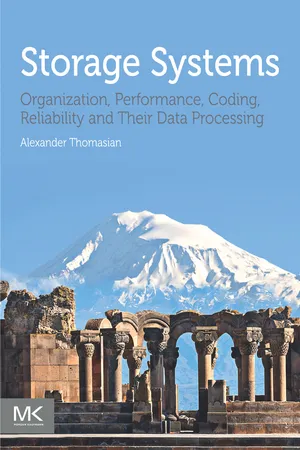
eBook - ePub
Storage Systems
Organization, Performance, Coding, Reliability, and Their Data Processing
- 746 pages
- English
- ePUB (mobile friendly)
- Available on iOS & Android
eBook - ePub
Storage Systems
Organization, Performance, Coding, Reliability, and Their Data Processing
About this book
Storage Systems: Organization, Performance, Coding, Reliability and Their Data Processing was motivated by the 1988 Redundant Array of Inexpensive/Independent Disks proposal to replace large form factor mainframe disks with an array of commodity disks. Disk loads are balanced by striping data into strips—with one strip per disk— and storage reliability is enhanced via replication or erasure coding, which at best dedicates k strips per stripe to tolerate k disk failures. Flash memories have resulted in a paradigm shift with Solid State Drives (SSDs) replacing Hard Disk Drives (HDDs) for high performance applications. RAID and Flash have resulted in the emergence of new storage companies, namely EMC, NetApp, SanDisk, and Purestorage, and a multibillion-dollar storage market. Key new conferences and publications are reviewed in this book.The goal of the book is to expose students, researchers, and IT professionals to the more important developments in storage systems, while covering the evolution of storage technologies, traditional and novel databases, and novel sources of data. We describe several prototypes: FAWN at CMU, RAMCloud at Stanford, and Lightstore at MIT; Oracle's Exadata, AWS' Aurora, Alibaba's PolarDB, Fungible Data Center; and author's paper designs for cloud storage, namely heterogeneous disk arrays and hierarchical RAID.
- Surveys storage technologies and lists sources of data: measurements, text, audio, images, and video
- Familiarizes with paradigms to improve performance: caching, prefetching, log-structured file systems, and merge-trees (LSMs)
- Describes RAID organizations and analyzes their performance and reliability
- Conserves storage via data compression, deduplication, compaction, and secures data via encryption
- Specifies implications of storage technologies on performance and power consumption
- Exemplifies database parallelism for big data, analytics, deep learning via multicore CPUs, GPUs, FPGAs, and ASICs, e.g., Google's Tensor Processing Units
Information
Table of contents
- Storage Systems
- Chapter 1 Introduction
- Chapter 2 Storage technologies and their data
- Chapter 3 Disk drive data placement and scheduling
- Chapter 4 Mirrored & hybrid arrays
- Chapter 5 Redundant Arrays of Independent Disks - RAID
- Chapter 6 Coding for multiple disk failures
- Chapter 7 Saving power in disks, flash memories, and servers
- Chapter 8 Database parallelism, big data and analytics, deep learning
- Chapter 9 Structured, unstructured, and diverse databases
- Chapter 10 Heterogeneous Disk Arrays - HDAs
- Chapter 11 Hierarchical RAID - HRAID
- Chapter 12 Conclusions
- Appendix
- Bibliography
- Index
Trusted by 375,005 students
Access to over 1.5 million titles for a fair monthly price.
Study more efficiently using our study tools.
Frequently asked questions
Yes, you can cancel anytime from the Subscription tab in your account settings on the Perlego website. Your subscription will stay active until the end of your current billing period. Learn how to cancel your subscription
No, books cannot be downloaded as external files, such as PDFs, for use outside of Perlego. However, you can download books within the Perlego app for offline reading on mobile or tablet. Learn how to download books offline
Perlego offers two plans: Essential and Complete
- Essential is ideal for learners and professionals who enjoy exploring a wide range of subjects. Access the Essential Library with 800,000+ trusted titles and best-sellers across business, personal growth, and the humanities. Includes unlimited reading time and Standard Read Aloud voice.
- Complete: Perfect for advanced learners and researchers needing full, unrestricted access. Unlock 1.5M+ books across hundreds of subjects, including academic and specialized titles. The Complete Plan also includes advanced features like Premium Read Aloud and Research Assistant.
We are an online textbook subscription service, where you can get access to an entire online library for less than the price of a single book per month. With over 1.5 million books across 990+ topics, we’ve got you covered! Learn about our mission
Look out for the read-aloud symbol on your next book to see if you can listen to it. The read-aloud tool reads text aloud for you, highlighting the text as it is being read. You can pause it, speed it up and slow it down. Learn more about Read Aloud
Yes! You can use the Perlego app on both iOS and Android devices to read anytime, anywhere — even offline. Perfect for commutes or when you’re on the go.
Please note we cannot support devices running on iOS 13 and Android 7 or earlier. Learn more about using the app
Please note we cannot support devices running on iOS 13 and Android 7 or earlier. Learn more about using the app
Yes, you can access Storage Systems by Alexander Thomasian in PDF and/or ePUB format, as well as other popular books in Biological Sciences & Biotechnology. We have over 1.5 million books available in our catalogue for you to explore.