eBook - ePub
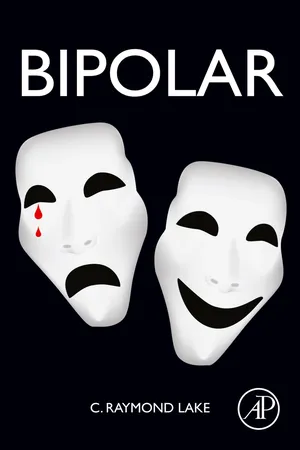
Bipolar
About this book
It is estimated that as many as fifty percent of patients initially diagnosed with major Unipolar depression (UP, MDD) will subsequently incur a manic episode or discover a past subtle episode and will have had Bipolar depression rather than MDD. The average Bipolar individual suffers with episodic symptoms for ten years before receiving an accurate diagnosis. As many as 16 million individuals in the United States will have a Bipolar episode in their lives, diagnosed or not. With the recognition of these growing numbers of patients with a Bipolar Disorder, it is imperative that patients are diagnosed and treated earlier, accurately and efficiently. Untreated Bipolar usually gets worse.
Bipolar aims to improve recognition, acceptance, and compliance. Dr. C. Raymond Lake applies two different approaches , comprehensive research and case studies, to the understanding of Bipolar Disorders, presenting basic, selected Bipolar data including history, diagnostic criteria, definitions of terms, and classifications, as well as management and treatment strategies to help the reader fully comprehend the disorder. In addition, case studies provide the reader with real-life examples to help increase recognition of various Bipolar presentations beyond the stark black-and-white diagnostic criteria of the DSM and ICD.
- Explains differences between Bipolar and Unipolar Disorders
- Provides crucial information on psychotherapy and mood-stabilizing medications as treatment options
- Demonstrates diagnostic interviewing for physicians and patients
- Discusses differential diagnoses for Bipolar
- Includes difficult-to-diagnose case studies of various presentations in Bipolar
Information
Table of contents
- Title of Book
- Cover image
- Title page
- Table of Contents
- Copyright
- Table of Abbreviations
- List of Figures
- List of Tables
- Guide to Clinical Bipolar Case Locations by Chapter (N=111)
- About the Author
- Preface
- Acknowledgments
- Chapter 1 Introduction and Chapter Summaries
- Chapter 2 The Spectrum of Mood Disorders: Bipolar I, Bipolar II, and Unipolar
- Chapter 3 A 2,000-year History of Bipolar
- Chapter 4 Bipolar Is a Neurogenetic Disease of the Brain, Not a Psychological Condition
- Chapter 5 The Disaster of a Missed Diagnosis; How It Happens
- Chapter 6 The Introduction of “Schizophrenia” Deprived Bipolar Patients of Proper care; a History
- Chapter 7 The Diagnosis of Bipolar Recovers from the 1970s to the Present; the Continuum Concept Ends the Kraepelinian Dichotomy and “Schizophrenia”
- Chapter 8 Psychotic Mood Disorders Are Disorders of Thought and Mood; A Damaged Brain Selective-Attention Filter Explains Psychotic Manic Thought
- Chapter 9 Paranoid Delusions Explained by Manic Grandiosity and the Guilt of Depression; There Is No “Schizophrenia”
- Chapter 10 The Differential Diagnoses for Bipolar
- Chapter 11 Difficult-to-diagnose Case Studies Demonstrating Wide Variations in Presentations
- Chapter 12 Psychotic Perpetrators of Violence, Murder, and Mass Murder Are Bipolar
- Chapter 13 The Initial Diagnostic Interview for Physicians and Patients
- Chapter 14 Treatment of Bipolar: What to Expect; How to Manage the Chaos
- Chapter 15 Conclusions and Future Considerations for Bipolar
- References
- Index
Trusted by 375,005 students
Access to over 1.5 million titles for a fair monthly price.
Study more efficiently using our study tools.
Frequently asked questions
Yes, you can cancel anytime from the Subscription tab in your account settings on the Perlego website. Your subscription will stay active until the end of your current billing period. Learn how to cancel your subscription
No, books cannot be downloaded as external files, such as PDFs, for use outside of Perlego. However, you can download books within the Perlego app for offline reading on mobile or tablet. Learn how to download books offline
Perlego offers two plans: Essential and Complete
- Essential is ideal for learners and professionals who enjoy exploring a wide range of subjects. Access the Essential Library with 800,000+ trusted titles and best-sellers across business, personal growth, and the humanities. Includes unlimited reading time and Standard Read Aloud voice.
- Complete: Perfect for advanced learners and researchers needing full, unrestricted access. Unlock 1.5M+ books across hundreds of subjects, including academic and specialized titles. The Complete Plan also includes advanced features like Premium Read Aloud and Research Assistant.
We are an online textbook subscription service, where you can get access to an entire online library for less than the price of a single book per month. With over 1.5 million books across 990+ topics, we’ve got you covered! Learn about our mission
Look out for the read-aloud symbol on your next book to see if you can listen to it. The read-aloud tool reads text aloud for you, highlighting the text as it is being read. You can pause it, speed it up and slow it down. Learn more about Read Aloud
Yes! You can use the Perlego app on both iOS and Android devices to read anytime, anywhere — even offline. Perfect for commutes or when you’re on the go.
Please note we cannot support devices running on iOS 13 and Android 7 or earlier. Learn more about using the app
Please note we cannot support devices running on iOS 13 and Android 7 or earlier. Learn more about using the app
Yes, you can access Bipolar by C. Raymond Lake in PDF and/or ePUB format, as well as other popular books in Psychology & Clinical Psychology. We have over 1.5 million books available in our catalogue for you to explore.