- 700 pages
- English
- ePUB (mobile friendly)
- Available on iOS & Android
eBook - ePub
Viral Diseases of Field and Horticultural Crops
About this book
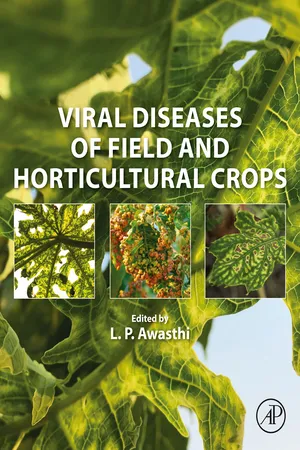
Viral Diseases of Field and Horticultural Crops details the fundamental and applied aspects of the viral diseases of field and horticultural crops. The book opens with a historical introduction to plant virology, important plant virologists, and landmarks. It continues with systematic coverage of viral diseases, their economic significance, disease symptoms, host range, mode of transmission, diagnostic techniques, geographic distribution, epidemiology, yield losses, and control and management of the disease. Contributions from an international group of virologists with a wide range of academic, research, professional, and specialized backgrounds in plant virology makes Viral Diseases of Field and Horticultural Crops a comprehensive and must-have resource for those engaged in the study and research of plant virology, microbiology, and plant pathology particularly viral diseases and their impact on field and horticultural crops.
- Provides virus characterization according to the disease pattern and symptoms they cause
- Covers viral diseases of cereals, oil seeds, legumes, commercial crops, spices and condiments, medicinal and aromatic crops, forage crops, vegetable crops, fruit crops, tree nuts, among others
- Discusses advances like applications in nanotechnology, molecular techniques for the detection and characterization of plant viruses, and the development of technologies for detecting plant viruses
Information
Table of contents
- Viral Diseases of Field and Horticultural Crops
- Title Page
- Copyright
- Table of Contents
- Contributors
- About the author
- Foreword
- Preface
- Acknowledgments
- Chapter 1 Important landmarks in the history of plant virology
- Chapter 2 Viral diseases of field and horticultural crops
- Chapter 3 Economic significance of viruses in field crops
- Chapter 4 Wheat
- Chapter 5 Emerging and re-emerging viruses of wheat: current status and future challenges
- Chapter 6 Barley
- Chapter 7 Oats
- Chapter 8 Viral Diseases of Rice Crops in Colombia - Latin America
- Chapter 9 Rice tungro disease
- Chapter 10 Maize
- Chapter 11 Sorghum
- Chapter 12 Millets
- Chapter 13 Black gram/green gram
- Chapter 14 Chick pea, Lentil
- Chapter 15 Cowpea
- Chapter 16 Faba bean (Broad bean)
- Chapter 17 Pigeon Pea
- Chapter 18 Soybean
- Chapter 19 Mustard
- Chapter 20 Ground nut (Peanut)
- Chapter 21 Sunflower
- Chapter 22 Flax (Linseed)
- Chapter 23 Castor bean
- Chapter 24 Sugarcane
- Chapter 25 Tobacco
- Chapter 26 Commercial bast fibre crops
- Chapter 27 Cotton
- Chapter 28 Opium poppy
- Chapter 29 Hemp
- Chapter 30 Coconut, areca nut
- Chapter 31 Cacao and Kola
- Chapter 32 Vanilla
- Chapter 33 Coffee
- Chapter 34 Tea
- Chapter 35 Olives
- Chapter 36 Rubber
- Chapter 37 Spices and condiments
- Chapter 38 Alfalfa
- Chapter 39 Alsike clover (white, red)
- Chapter 40 Economic significance of viruses in horticultural crops
- Chapter 41 Potato virus Y
- Chapter 42 Potato
- Chapter 43 Tomato
- Chapter 44 Emergence, diversity, and epidemiological prospects of viruses infecting tomato crops
- Chapter 45 Viroid diseases of tomato
- Chapter 46 Brinjal (Eggplant)
- Chapter 47 Chilli
- Chapter 48 Bell pepper
- Chapter 49 Cucurbitaceous vegetables-I
- Chapter 50 Cucurbitaceous vegetables-II
- Chapter 51 Broccoli, Cabbage and Cauliflower
- Chapter 52 Radish and Turnip
- Chapter 53 Parsnip
- Chapter 54 Legume vegetables
- Chapter 55 Poleroviruses in vegetable legumes
- Chapter 56 Okra (Lady's finger)
- Chapter 57 Sugar beet
- Chapter 58 Spinach
- Chapter 59 Carrot
- Chapter 60 Onion and Garlic
- Chapter 61 Artichoke
- Chapter 62 Asparagus
- Chapter 63 Lettuce
- Chapter 64 Tuber crops: Sweet potatoes
- Chapter 65 Cassava
- Chapter 66 Aroids (Colocasia and Xanthosoma)
- Chapter 67 Viral diseases of tropical fruits
- Chapter 68 Papaya—I
- Chapter 69 Papaya—II
- Chapter 70 Banana
- Chapter 71 Banana bunchy top virus (BBTV)
- Chapter 72 Mechanisms of transmission of the Banana streak virus by Paracoccus burnerae
- Chapter 73 Citrus
- Chapter 74 Passion fruit
- Chapter 75 Pomegranate
- Chapter 76 Fig
- Chapter 77 Kiwifruit
- Chapter 78 Mulberry
- Chapter 79 Temperate fruits-I Tree fruits (apple, pear, quince, loquat)
- Chapter 80 Temperate fruits-II Tree fruits (apricot, peach, plum)
- Chapter 81 Temperate fruits-III Nut trees
- Chapter 82 Temperate fruits IV Vine fruits / Grapevine
- Chapter 83 Temperate fruits V Small fruits /soft fruits
- Chapter 84 Viral diseases of vegetables and fruits in Egypt
- Chapter 85 Characterization of viruses infecting rose
- Chapter 86 Rose
- Chapter 87 Common and emerging viral pathogens of annual ornamental plants
- Chapter 88 Viral diseases of ornamental plants-I
- Chapter 89 Viral diseases of ornamental plants-II
- Chapter 90 Viral diseases of ornamental plants-III
- Chapter 91 Medicinal and aromatic plants-I
- Chapter 92 Medicinal and aromatic plants - II
- Chapter 93 Orchids
- Chapter 94 Forest trees
- Chapter 95 The importance of weeds as reservoirs of viruses of field and horticultural crops
- Chapter 96 Application of plant viruses in nanotechnology
- Chapter 97 Foodborne viral disease
- Chapter 98 Molecular tools for the detection of plant viruses
- Chapter 99 Emergence of companies in the development of technology for detecting plant viruses
- Index
- Index - continued
- Index - continued
- Index - continued
- Index - continued
Trusted by 375,005 students
Access to over 1.5 million titles for a fair monthly price.
Study more efficiently using our study tools.
Frequently asked questions
Yes, you can cancel anytime from the Subscription tab in your account settings on the Perlego website. Your subscription will stay active until the end of your current billing period. Learn how to cancel your subscription
No, books cannot be downloaded as external files, such as PDFs, for use outside of Perlego. However, you can download books within the Perlego app for offline reading on mobile or tablet. Learn how to download books offline
Perlego offers two plans: Essential and Complete
- Essential is ideal for learners and professionals who enjoy exploring a wide range of subjects. Access the Essential Library with 800,000+ trusted titles and best-sellers across business, personal growth, and the humanities. Includes unlimited reading time and Standard Read Aloud voice.
- Complete: Perfect for advanced learners and researchers needing full, unrestricted access. Unlock 1.5M+ books across hundreds of subjects, including academic and specialized titles. The Complete Plan also includes advanced features like Premium Read Aloud and Research Assistant.
We are an online textbook subscription service, where you can get access to an entire online library for less than the price of a single book per month. With over 1.5 million books across 990+ topics, we’ve got you covered! Learn about our mission
Look out for the read-aloud symbol on your next book to see if you can listen to it. The read-aloud tool reads text aloud for you, highlighting the text as it is being read. You can pause it, speed it up and slow it down. Learn more about Read Aloud
Yes! You can use the Perlego app on both iOS and Android devices to read anytime, anywhere — even offline. Perfect for commutes or when you’re on the go.
Please note we cannot support devices running on iOS 13 and Android 7 or earlier. Learn more about using the app
Please note we cannot support devices running on iOS 13 and Android 7 or earlier. Learn more about using the app
Yes, you can access Viral Diseases of Field and Horticultural Crops by L. P. Awasthi in PDF and/or ePUB format, as well as other popular books in Biological Sciences & Microbiology. We have over 1.5 million books available in our catalogue for you to explore.