eBook - ePub
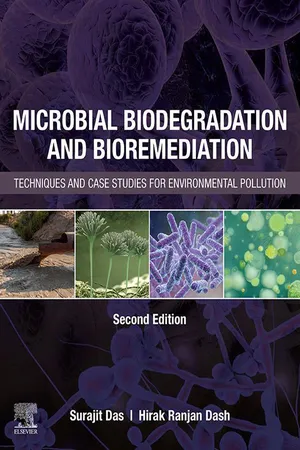
Microbial Biodegradation and Bioremediation
Techniques and Case Studies for Environmental Pollution
- 646 pages
- English
- ePUB (mobile friendly)
- Available on iOS & Android
eBook - ePub
Microbial Biodegradation and Bioremediation
Techniques and Case Studies for Environmental Pollution
About this book
Microbial Biodegradation and Bioremediation: Techniques and Case Studies for Environmental Pollution, Second Edition describes the successful application of microbes and their derivatives for bioremediation of potentially toxic and relatively novel compounds in the environment. Our natural biodiversity and environment is in danger due to the release of continuously emerging potential pollutants by anthropogenic activities. Though many attempts have been made to eradicate and remediate these noxious elements, thousands of xenobiotics of relatively new entities emerge every day, thus worsening the situation. Primitive microorganisms are highly adaptable to toxic environments, and can reduce the load of toxic elements by their successful transformation and remediation.
This completely updated new edition presents many new technologies and techniques and includes theoretical context and case studies in every chapter. Microbial Biodegradation and Bioremediation: Techniques and Case Studies for Environmental Pollution, Second Edition serves as a single-source reference and encompasses all categories of pollutants and their applications in a convenient, comprehensive format for researchers in environmental science and engineering, pollution, environmental microbiology, and biotechnology.
- Describes many novel approaches of microbial bioremediation including genetic engineering, metagenomics, microbial fuel cell technology, biosurfactants and biofilm-based bioremediation
- Introduces relatively new hazardous elements and their bioremediation practices including oil spills, military waste water, greenhouse gases, polythene wastes, and more
- Provides the most advanced techniques in the field of bioremediation, including insilico approach, microbes as pollution indicators, use of bioreactors, techniques of pollution monitoring, and more
- Completely updated and expanded to include topics and techniques such as genetically engineered bacteria, environmental health, nanoremediation, heavy metals, contaminant transport, and in situ and ex situ methods
- Includes theoretical context and case studies within each chapter
Information
Topic
Physical SciencesSubtopic
BiotechnologyTable of contents
- Cover
- Title page
- Table of Contents
- Copyright
- Contents
- List of contributors
- Preface
- List of Illustrations
- List of Tables
- Chapter 1 : Prospects and scope of microbial bioremediation for the restoration of the contaminated sites
- Chapter 2 : Mechanism of toxicity and adverse health effects of environmental pollutants
- Chapter 3 : The use of molecular tools to characterize functional microbial communities in contaminated areas
- Chapter 4 : Fate and consequences of microplastics in the environment and their impact on biological organisms
- Chapter 5 : Metagenomic approaches to study the culture-independent bacterial diversity of a polluted environment—a case study on north-eastern coast of Bay of Bengal, India
- Chapter 6 : Constructing thermodynamic models of toxic metal biosorption
- Chapter 7 : Biodegradation of organophosphates: biology and biotechnology
- Chapter 8 : Pollutants in the coral environment and strategies to lower their impact on the functioning of reef ecosystem
- Chapter 9 : Biology, genetic aspects and oxidative stress response of actinobacteria and strategies for bioremediation of toxic metals
- Chapter 10 : Bacterial and fungal bioremediation strategies
- Chapter 11 : Current trends in algal biotechnology for the generation of sustainable biobased products
- Chapter 12 : A review on microbial potential of toxic azo dyes bioremediation in aquatic system
- Chapter 13 : Role of rhizosphere microbiome during phytoremediation of heavy metals
- Chapter 14 : Recent advancements in microbial bioremediation of industrial effluents: challenges and future outlook
- Chapter 15 : Potential of anaerobic bacteria in bioremediation of metal-contaminated marine and estuarine environment
- Chapter 16 : Plant growth-promoting rhizobacteria-assisted bioremediation of toxic contaminant: recent advancements and applications
- Chapter 17 : Cyanobacterial and microalgal bioremediation: an efficient and eco-friendly approach toward industrial wastewater treatment and value-addition
- Chapter 18 : Microbial degradation of aromatic pollutants: metabolic routes, pathway diversity, and strategies for bioremediation
- Chapter 19 : Microbial bioremediation of Cr(VI)-contaminated soil for sustainable agriculture
- Chapter 20 : Microbial bioremediation of aquaculture effluents
- Chapter 21 : Transport and disposal of radioactive wastes in nuclear industry
- Chapter 22 : Biofilm-mediated biodegradation of hydrophobic organic compounds in the presence of metals as co-contaminants
- Chapter 23 : Factors affecting the bioremediation of industrial and domestic wastewaters
- Chapter 24 : Organophosphate pesticide: usage, environmental exposure, health effects, and microbial bioremediation
- Chapter 25 : Feasibility of using bioelectrochemical systems for bioremediation
- Chapter 26 : Electrochemical biosensors for monitoring of bioorganic and inorganic chemical pollutants in biological and environmental matrices
- Chapter 27 : Bioelectrochemical system for environmental remediation of toxicants
- Chapter 28 : Biofilm-mediated bioremediation of polycyclic aromatic hydrocarbons: current status and future perspectives
- Chapter 29 : Extremophilic nature of microbial ligninolytic enzymes and their role in biodegradation
- Chapter 30 : Marine hydrocarbon-degrading bacteria: their role and application in oil-spill response and enhanced oil recovery
- Chapter 31 : Nanoremediation of toxic contaminants from the environment: challenges and scopes
- Index
- A
Trusted by 375,005 students
Access to over 1.5 million titles for a fair monthly price.
Study more efficiently using our study tools.
Frequently asked questions
Yes, you can cancel anytime from the Subscription tab in your account settings on the Perlego website. Your subscription will stay active until the end of your current billing period. Learn how to cancel your subscription
No, books cannot be downloaded as external files, such as PDFs, for use outside of Perlego. However, you can download books within the Perlego app for offline reading on mobile or tablet. Learn how to download books offline
We are an online textbook subscription service, where you can get access to an entire online library for less than the price of a single book per month. With over 1.5 million books across 990+ topics, we’ve got you covered! Learn about our mission
Look out for the read-aloud symbol on your next book to see if you can listen to it. The read-aloud tool reads text aloud for you, highlighting the text as it is being read. You can pause it, speed it up and slow it down. Learn more about Read Aloud
Yes! You can use the Perlego app on both iOS and Android devices to read anytime, anywhere — even offline. Perfect for commutes or when you’re on the go.
Please note we cannot support devices running on iOS 13 and Android 7 or earlier. Learn more about using the app
Please note we cannot support devices running on iOS 13 and Android 7 or earlier. Learn more about using the app
Yes, you can access Microbial Biodegradation and Bioremediation by Surajit Das,Hirak Ranjan Dash in PDF and/or ePUB format, as well as other popular books in Physical Sciences & Biotechnology. We have over 1.5 million books available in our catalogue for you to explore.