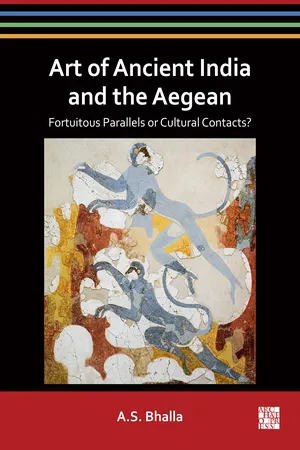
Art in physical forms and shapes (e.g. buildings and paintings) existed in both prehistoric and modern societies. This book examines similarities and differences between art in ancient Indian (Indus) civilizations and that of the Aegean civilizations (i.e. Minoan, Mycenaean and the Cycladic). In prehistoric cultures, art was distinct from the modern, which was defined in terms of utility or practicality rather than aesthetics. It was expressed not in terms of the beauty of an object, but rather its purpose, such as for worship through representations of gods and goddesses (male and female sculptures) or the use of figurines as votive offerings; it was also used for trade and commerce (stamp seals) and for indication of social hierarchy (jewellery and ornaments). Demand for prestige objects in the Minoan and Mycenaean societies grew in response to royal and elite patronage, which was absent in the Indus Valley. The book discusses production and consumption patterns of objects such as pottery, figurines, seals, jewellery and paintings to show striking similarities between the Indian and Aegean civilizations. The comparison raises questions about possible cross-cultural influences, which became much more significant and direct following Alexander's invasion and the subsequent adaptation of Indian art under the Indo-Greek kingdoms.
eBook - PDF
Art of Ancient India and the Aegean
Fortuitous Parallels or Cultural Contacts?
- 166 pages
- English
- PDF
- Available on iOS & Android
eBook - PDF
About this book
Information
Subtopic
ArchaeologyIndex
Social SciencesTable of contents
- Cover
- Title Page
- Copyright Page
- Contents Page
- List of Figures
- List of Tables
- List of Maps
- List of Abbreviations
- Illustration Credits
- Preface
- Introduction
- 1. A Brief Introduction to Ancient Societies
- 2. Egalitarianism, Elitism and Prestige Goods
- 3. The Art of the Indus Valley and the Aegean
- 4. The Indus Valley and Minoan Crete:Fortuitous Parallels or Cultural/Historical Contacts?
- 5. Direct Greek Influences on Indian Gandhara Art
- 6. Conclusion: Patronage, Pomp and Power
- References
- Index
Trusted by 375,005 students
Access to over 1.5 million titles for a fair monthly price.
Study more efficiently using our study tools.
Frequently asked questions
Yes, you can cancel anytime from the Subscription tab in your account settings on the Perlego website. Your subscription will stay active until the end of your current billing period. Learn how to cancel your subscription
No, books cannot be downloaded as external files, such as PDFs, for use outside of Perlego. However, you can download books within the Perlego app for offline reading on mobile or tablet. Learn how to download books offline
Perlego offers two plans: Essential and Complete
- Essential is ideal for learners and professionals who enjoy exploring a wide range of subjects. Access the Essential Library with 800,000+ trusted titles and best-sellers across business, personal growth, and the humanities. Includes unlimited reading time and Standard Read Aloud voice.
- Complete: Perfect for advanced learners and researchers needing full, unrestricted access. Unlock 1.5M+ books across hundreds of subjects, including academic and specialized titles. The Complete Plan also includes advanced features like Premium Read Aloud and Research Assistant.
We are an online textbook subscription service, where you can get access to an entire online library for less than the price of a single book per month. With over 1.5 million books across 990+ topics, we’ve got you covered! Learn about our mission
Look out for the read-aloud symbol on your next book to see if you can listen to it. The read-aloud tool reads text aloud for you, highlighting the text as it is being read. You can pause it, speed it up and slow it down. Learn more about Read Aloud
Yes! You can use the Perlego app on both iOS and Android devices to read anytime, anywhere — even offline. Perfect for commutes or when you’re on the go.
Please note we cannot support devices running on iOS 13 and Android 7 or earlier. Learn more about using the app
Please note we cannot support devices running on iOS 13 and Android 7 or earlier. Learn more about using the app
Yes, you can access Art of Ancient India and the Aegean by A.S. Bhalla in PDF and/or ePUB format, as well as other popular books in Social Sciences & Archaeology. We have over 1.5 million books available in our catalogue for you to explore.