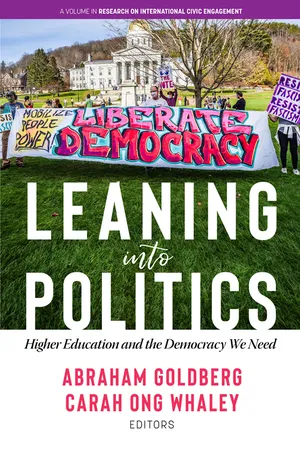
Democratic decline in the United States and globally, a lack of confidence in political institutions and an increasingly violent and divisive political climate raise many questions for the state of political learning and civic engagement. A decade ago, a task force commissioned by the United States Department of Education called on colleges and universities to affirm their missions to educate for democracy. Relatively few have made the investment, though dozens of higher education associations and organizations have publicly committed their support to prepare students to address the persistent public issues they are inheriting.
While there has been a recent upward spike in rote civic knowledge and historically high youth voting rates, the United States has seen a decline in political rights and civil liberties and has been listed as a backsliding democracy. Since 2010, state legislatures have passed laws making it harder to vote, with access to the ballot increasingly dependent on which party controls the state legislature. Meanwhile, substantial dysfunction and hyperpartisanship in Congress, concerns over the impartiality of the judiciary and limited accountability and oversight of the executive branch have contributed to the loss of institutional capacity to address public problems and to declining public confidence in political institutions.
These trends coincide with problematic rhetoric and growing scrutiny from public officials on how colleges and universities educate students on public issues, particularly those centered on class, race, ethnicity and social justice. Issues of free speech and expression have been further nationalized following a high-profile hearing of the House Committee on Education and the Workforce that questioned the presidents of Harvard, Massachusetts Institute of Technology and University of Pennsylvania about antisemitism on their campuses and as campus protests regarding the Israeli-Palestinian conflict have been met with heavy-handed responses. These episodes serve as loud warning shots to colleges and universities across the country. Academic freedom and freedom of speech - core tenets of a liberal education - are at risk. Can higher education step up and meet the moment? Collectively, contributors to this volume - who come from a broad range of institutions, experiences and perspectives - provide critical research and analyses, as well as innovative approaches for how higher education can fulfill its public role and contribute to building the democratic societies we need.