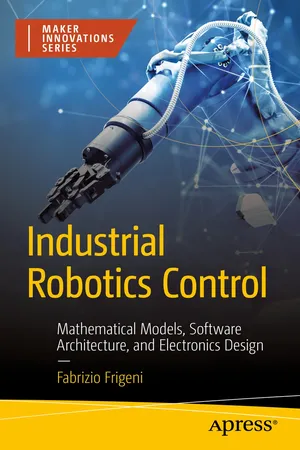
Industrial Robotics Control
Mathematical Models, Software Architecture, and Electronics Design
- English
- ePUB (mobile friendly)
- Available on iOS & Android
Industrial Robotics Control
Mathematical Models, Software Architecture, and Electronics Design
About this book
After covering the theory, readers can put what they've learned in practice by programming a control firmware for the robot. Each software component is described in detail, from the HMI and the interpreter of motion commands, to the servo loop controller at the core of each servo drive. In particular, the author presents the commutation algorithm and the servo loop controller for brushless synchronous motors, which are typically employed in robotics applications. Readers will also learn how to calibrate the robot, commission it to the end-user, and design a digital twin to test and monitor the entire workcell in a safe simulated environment.
Finally, the book delves into hardware, covering how to select and use electric motors and encoders, how to build servo drives and motion controllers, and how to design your own PCBs. Different electronic components and their application circuits are analyzed, showing the advantages and drawbacks of each.
By the end of the book you should be able to design and build electronic boards and write their core firmware to control any kind of industrial robot for all sorts of different practical applications.
What you'll learn
- Solve kinematics models of robots
- Generate safe paths and optimal motion trajectories
- Create a digital twin of your robot to test and monitor its movements
- Master the electronic commutation and closed-loop control of brushless motors
- Design electronics circuit boards for motion applications
Who This Book Is For
Robotics engineers (and students) who want to understand the theory behind the control of robotics arms, from the kinematic models of their axes to the electronic commutation of their motors. Some basic calculus and linear algebra is required for the understanding of the geometrical framework, while some electronics foundations are helpful to grasp the details of the circuits design.Tools to learn more effectively

Saving Books

Keyword Search

Annotating Text

Listen to it instead
Information
Table of contents
- Cover
- Front Matter
- 1. Industrial Robots
- Part I. Robot Geometry
- Part II. Robot Movements
- PART III. Robot Software
- Part IV. Robot Hardware
- Correction to: Industrial Robotics Control
- Back Matter
Frequently asked questions
- Essential is ideal for learners and professionals who enjoy exploring a wide range of subjects. Access the Essential Library with 800,000+ trusted titles and best-sellers across business, personal growth, and the humanities. Includes unlimited reading time and Standard Read Aloud voice.
- Complete: Perfect for advanced learners and researchers needing full, unrestricted access. Unlock 1.4M+ books across hundreds of subjects, including academic and specialized titles. The Complete Plan also includes advanced features like Premium Read Aloud and Research Assistant.
Please note we cannot support devices running on iOS 13 and Android 7 or earlier. Learn more about using the app