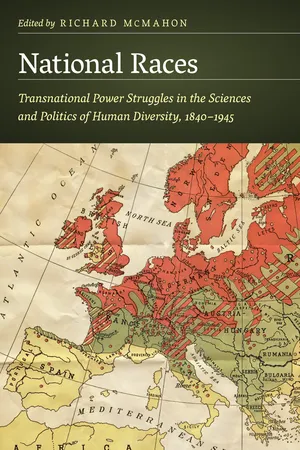
National Races explores how politics interacted with transnational science in the nineteenth and early twentieth centuries. This interaction produced powerful, racialized national identity discourses whose influence continues to resonate in today's culture and politics. Ethnologists, anthropologists, and raciologists compared modern physical types with ancient skeletal finds to unearth the deep prehistoric past and true nature of nations. These scientists understood certain physical types to be what Richard McMahon calls "national races, " or the ageless biological essences of nations. Contributors to this volume address a central tension in anthropological race classification. On one hand, classifiers were nationalists who explicitly or implicitly used race narratives to promote political agendas. Their accounts of prehistoric geopolitics treated "national races" as the proxies of nations in order to legitimize present-day geopolitical positions. On the other hand, the transnational community of race scholars resisted the centrifugal forces of nationalism. Their interdisciplinary project was a vital episode in the development of the social sciences, using biological race classification to explain the history, geography, relationships, and psychologies of nations. National Races goes to the heart of tensions between nationalism and transnationalism, politics and science, by examining transnational science from the perspective of its peripheries. Contributors to the book supplement the traditional focus of historians on France, Britain, and Germany, with myriad case studies and examples of nineteenth- and early twentieth-century racial and national identities in countries such as Russia, Italy, Poland, Greece, and Yugoslavia, and among Jewish anthropologists.
eBook - ePub
National Races
Transnational Power Struggles in the Sciences and Politics of Human Diversity, 1840–1945
- 402 pages
- English
- ePUB (mobile friendly)
- Available on iOS & Android
eBook - ePub
National Races
Transnational Power Struggles in the Sciences and Politics of Human Diversity, 1840–1945
About this book
Information
Table of contents
- Cover
- Series Page
- Title Page
- Copyright Page
- Contents
- List of Figures
- Series Editors’ Introduction
- Introduction
- 1. Transnational Network, Transnational Narratives
- 2. The Destiny of Races “Not Yet Called to Civilization”
- 3. A Matter of Place, Space, and People
- 4. Yet Another Greek Tragedy?
- 5. Jews between Volk and Rasse
- 6. Classifying Hybridity in Nineteenth- and Early Twentieth-Century Russian Imperial Anthropology
- 7. Physical Anthropology in Colonial Korea
- 8. Racial Anthropology on the Eastern Front, 1912 to the mid-1920s
- 9. Racial Politics as a Multiethnic Pavilion
- Conclusion
- Contributors
- Index
- About Richard McMahon
- Series List
Trusted by 375,005 students
Access to over 1.5 million titles for a fair monthly price.
Study more efficiently using our study tools.
Frequently asked questions
Yes, you can cancel anytime from the Subscription tab in your account settings on the Perlego website. Your subscription will stay active until the end of your current billing period. Learn how to cancel your subscription
No, books cannot be downloaded as external files, such as PDFs, for use outside of Perlego. However, you can download books within the Perlego app for offline reading on mobile or tablet. Learn how to download books offline
Perlego offers two plans: Essential and Complete
- Essential is ideal for learners and professionals who enjoy exploring a wide range of subjects. Access the Essential Library with 800,000+ trusted titles and best-sellers across business, personal growth, and the humanities. Includes unlimited reading time and Standard Read Aloud voice.
- Complete: Perfect for advanced learners and researchers needing full, unrestricted access. Unlock 1.5M+ books across hundreds of subjects, including academic and specialized titles. The Complete Plan also includes advanced features like Premium Read Aloud and Research Assistant.
We are an online textbook subscription service, where you can get access to an entire online library for less than the price of a single book per month. With over 1.5 million books across 990+ topics, we’ve got you covered! Learn about our mission
Look out for the read-aloud symbol on your next book to see if you can listen to it. The read-aloud tool reads text aloud for you, highlighting the text as it is being read. You can pause it, speed it up and slow it down. Learn more about Read Aloud
Yes! You can use the Perlego app on both iOS and Android devices to read anytime, anywhere — even offline. Perfect for commutes or when you’re on the go.
Please note we cannot support devices running on iOS 13 and Android 7 or earlier. Learn more about using the app
Please note we cannot support devices running on iOS 13 and Android 7 or earlier. Learn more about using the app
Yes, you can access National Races by Richard McMahon in PDF and/or ePUB format, as well as other popular books in Social Sciences & Nationalism & Patriotism. We have over 1.5 million books available in our catalogue for you to explore.