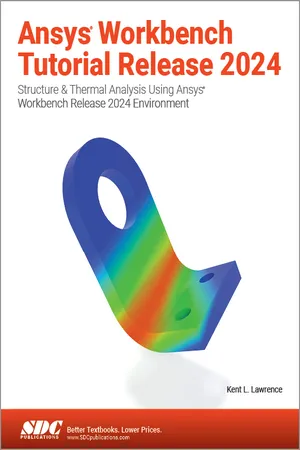
- Step-by-step tutorials teach you to use Ansys Workbench 2024
- Covers stress analysis, conduction/convection heat transfer, thermal stress, vibration, buckling and nonlinear problems
- Includes an introduction to composites, design optimization, and electro-thermal-deflection coupling
- Designed for both practicing and student engineers
- End of chapter problems reinforce and develop the skills learned in each tutorial
To understand Ansys Workbench quickly and well, you need to learn from an expert, study in short bursts of time, and complete hands-on exercises. Ansys Workbench Tutorial: Structural & Thermal Analysis Using Ansys Workbench Release 2024 checks all those boxes. Ansys Workbench is a powerful and widely used solid modeling, simulation and optimization software program. This textbook uses tutorials to cover key features of the software: stress analysis, conduction/convection heat transfer, thermal stress, vibration, buckling, nonlinear problems with an introduction to composites, design optimization, and electro-thermal-deflection coupling.
To use Ansys Workbench Tutorial effectively, you should understand the fundamentals of engineering. It is designed for practicing and student engineers alike and is suitable for use with an organized course of instruction or for self-study. If you are just starting with Ansys Workbench, read the introduction and chapters one and two first. Experienced Workbench users can read the material in any order desired. Since each tutorial can be mastered in a short period of time, the entire book quickly provides a complete, basic introduction to the concepts and capabilities of Ansys Workbench.
Engineers routinely use solid modelers together with the Finite Element Method (FEM) to solve everyday problems of modeling for form/fit/function, stress, deformation, heat transfer, fluid flow, electromagnetics, etc. using commercial as well as special purpose computer codes. FEM tools like the ones found in Ansys Workbench are important components in the skill set of today's engineers. In Ansys Workbench Tutorial, the reader practices these skills by creating the models for the tutorials with DesignModeler, which comes with Ansys Workbench, or the solid modeler (parametric modeling system) of their choice. Chapter one reviews a variety of ways to create and access geometry for each project you complete.
In each tutorial, the author completes analyses with you, explains the results, and touches on alternative ways to accomplish tasks. The author's straightforward and focused style shows you how an expert in Ansys Workbench thinks and works, helping cement your proficiency with the software and increasing your productivity in class and in your career.
End-of-Chapter Problems
Apply what you learned in the tutorials to solve end-of-chapter problems. Problems advance in difficulty as the tutorials do. Some problems challenge learners to create a new model and find stresses, strains, deflections, factor of safety, natural frequencies, pressure, buckling load, and more, using methods discussed in the tutorials. Other problems start with a model and a task and then ask you to consider that same model using different materials, after changing the size or conditions, or by comparing two results. Tackling the problems from different angles covers all aspects of each topic, prepares you for real-life modeling challenges, and helps you learn Ansys Workbench more thoroughly.