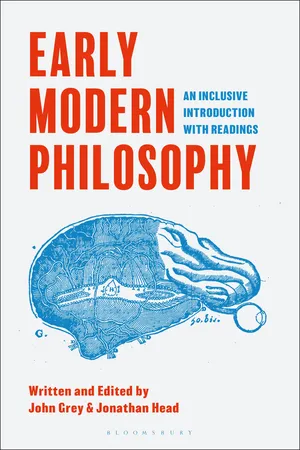
For anyone in search of the philosophers who influenced one of the richest moments in Western intellectual history, this inclusive reader is the place to start. Early Modern Philosophy showcases an unrivalled range of thinkers. Through them, you are introduced to a selection of their texts that return important philosophical ideas and debates to our understanding of modern philosophy. Addressing a one-sided view of intellectual history that has persisted for centuries, this reader goes beyond the usual focus on rationalism and empiricism with readings organised into three parts:
- Dualistic theories of human nature as the union of a mind and a body
- Debates concerning social relations and education
- The nature of reality and the way in which the mind reveals or constructs
our understanding of the world
The thematic approach puts women philosophers and understudied figures in direct conversation with canonical thinkers. Extracts from primary sources are accompanied by biographical details, questions for reflection, further reading and summaries that place philosophers in their historical contexts.
- 392 pages
- English
- ePUB (mobile friendly)
- Available on iOS & Android
eBook - ePub
About this book
Information
Topic
PhilosophySubtopic
Modern PhilosophyTable of contents
- Cover
- Half Title
- Series Page
- Title Page
- Copyright Page
- Dedication
- Contents
- Preface
- Acknowledgments
- Introduction
- Part I Understanding Human Nature
- 1 Early Modern Dualism: René Descartes, Henry More, and Anton Wilhelm Amo
- 2 The Mind-Body Problem: René Descartes and Elisabeth of Bohemia
- 3 Idealist Responses: Anne Conway and Gottfried Leibniz
- 4 Materialist Responses: Thomas Hobbes and Margaret Cavendish
- Part II Sociability and Education
- 5 The Nature of Love: John Norris, Mary Astell, and Damaris Masham
- 6 The Nature of Morality: John Locke and Catharine Trotter Cockburn
- 7 The Nature of Education: Anna van Schurman and Mary Astell
- 8 Sympathy and Morality: Sophie de Grouchy and David Hume
- 9 The Debate about Slavery: Jacobus Capitein and Ottobah Cugoano
- Part III Mind and Reality
- 10 God and World: Baruch Spinoza and George Berkeley
- 11 The Nature of Space: Samuel Clarke and Émilie du Châtelet
- 12 The Nature of Causation: David Hume and Thomas Reid
- 13 A Transcendental Approach: Mary Shepherd and Immanuel Kant
- Conclusion
- Notes
- Glossary
- Index
Trusted by 375,005 students
Access to over 1.5 million titles for a fair monthly price.
Study more efficiently using our study tools.
Frequently asked questions
Yes, you can cancel anytime from the Subscription tab in your account settings on the Perlego website. Your subscription will stay active until the end of your current billing period. Learn how to cancel your subscription
No, books cannot be downloaded as external files, such as PDFs, for use outside of Perlego. However, you can download books within the Perlego app for offline reading on mobile or tablet. Learn how to download books offline
Perlego offers two plans: Essential and Complete
- Essential is ideal for learners and professionals who enjoy exploring a wide range of subjects. Access the Essential Library with 800,000+ trusted titles and best-sellers across business, personal growth, and the humanities. Includes unlimited reading time and Standard Read Aloud voice.
- Complete: Perfect for advanced learners and researchers needing full, unrestricted access. Unlock 1.5M+ books across hundreds of subjects, including academic and specialized titles. The Complete Plan also includes advanced features like Premium Read Aloud and Research Assistant.
We are an online textbook subscription service, where you can get access to an entire online library for less than the price of a single book per month. With over 1.5 million books across 990+ topics, we’ve got you covered! Learn about our mission
Look out for the read-aloud symbol on your next book to see if you can listen to it. The read-aloud tool reads text aloud for you, highlighting the text as it is being read. You can pause it, speed it up and slow it down. Learn more about Read Aloud
Yes! You can use the Perlego app on both iOS and Android devices to read anytime, anywhere — even offline. Perfect for commutes or when you’re on the go.
Please note we cannot support devices running on iOS 13 and Android 7 or earlier. Learn more about using the app
Please note we cannot support devices running on iOS 13 and Android 7 or earlier. Learn more about using the app
Yes, you can access Early Modern Philosophy by Jonathan Head,John Grey in PDF and/or ePUB format, as well as other popular books in Philosophy & Modern Philosophy. We have over 1.5 million books available in our catalogue for you to explore.