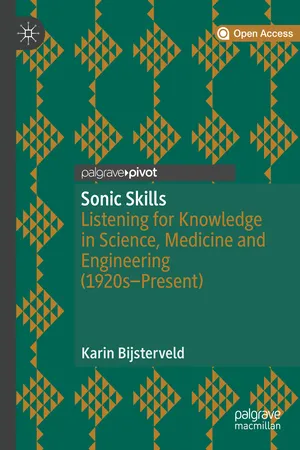
It is common for us today to associate the practice of science primarily with the act of seeing—with staring at computer screens, analyzing graphs, and presenting images. We may notice that physicians use stethoscopes to listen for disease, that biologists tune into sound recordings to understand birds, or that engineers have created Geiger tellers warning us for radiation through sound. But in the sciences overall, we think, seeing is believing. This open access book explains why, indeed, listening for knowledge plays an ambiguous, if fascinating, role in the sciences. For what purposes have scientists, engineers and physicians listened to the objects of their interest? How did they listen exactly? And why has listening often been contested as a legitimate form of access to scientific knowledge? This concise monograph combines historical and ethnographic evidence about the practices of listening on shop floors, in laboratories, field stations, hospitals, and conference halls, between the 1920s and today. It shows how scientists have used sonic skills—skills required for making, recording, storing, retrieving, and listening to sound—in ensembles: sets of instruments and techniques for particular situations of knowledge making. Yet rather than pleading for the emancipation of hearing at the expense of seeing, this essay investigates when, how, and under which conditions the ear has contributed to science dynamics, either in tandem with or without the eye.
eBook - ePub
Sonic Skills
Listening for Knowledge in Science, Medicine and Engineering (1920s-Present)
- English
- ePUB (mobile friendly)
- Available on iOS & Android
eBook - ePub
Sonic Skills
Listening for Knowledge in Science, Medicine and Engineering (1920s-Present)
About this book
Information
Table of contents
- Cover
- Front Matter
- 1. Listening for Knowledge: Introduction
- 2. Sonic Signs: Turning to, Talking About, and Transcribing Sound
- 3. Modes of Listening: Why, How and to What?
- 4. Resounding Contestation: The Ambiguous Status of Sonic Skills
- 5. Popping Up: The Continual Return of Sound and Listening
- 6. Ensembles of Sonic Skills: Conclusions
- Back Matter
Trusted by 375,005 students
Access to over 1.5 million titles for a fair monthly price.
Study more efficiently using our study tools.
Frequently asked questions
Yes, you can cancel anytime from the Subscription tab in your account settings on the Perlego website. Your subscription will stay active until the end of your current billing period. Learn how to cancel your subscription
No, books cannot be downloaded as external files, such as PDFs, for use outside of Perlego. However, you can download books within the Perlego app for offline reading on mobile or tablet. Learn how to download books offline
Perlego offers two plans: Essential and Complete
- Essential is ideal for learners and professionals who enjoy exploring a wide range of subjects. Access the Essential Library with 800,000+ trusted titles and best-sellers across business, personal growth, and the humanities. Includes unlimited reading time and Standard Read Aloud voice.
- Complete: Perfect for advanced learners and researchers needing full, unrestricted access. Unlock 1.5M+ books across hundreds of subjects, including academic and specialized titles. The Complete Plan also includes advanced features like Premium Read Aloud and Research Assistant.
We are an online textbook subscription service, where you can get access to an entire online library for less than the price of a single book per month. With over 1.5 million books across 990+ topics, we’ve got you covered! Learn about our mission
Look out for the read-aloud symbol on your next book to see if you can listen to it. The read-aloud tool reads text aloud for you, highlighting the text as it is being read. You can pause it, speed it up and slow it down. Learn more about Read Aloud
Yes! You can use the Perlego app on both iOS and Android devices to read anytime, anywhere — even offline. Perfect for commutes or when you’re on the go.
Please note we cannot support devices running on iOS 13 and Android 7 or earlier. Learn more about using the app
Please note we cannot support devices running on iOS 13 and Android 7 or earlier. Learn more about using the app
Yes, you can access Sonic Skills by Karin Bijsterveld in PDF and/or ePUB format, as well as other popular books in Technology & Engineering & Acoustical Engineering. We have over 1.5 million books available in our catalogue for you to explore.