- 96 pages
- English
- ePUB (mobile friendly)
- Available on iOS & Android
eBook - ePub
About this book
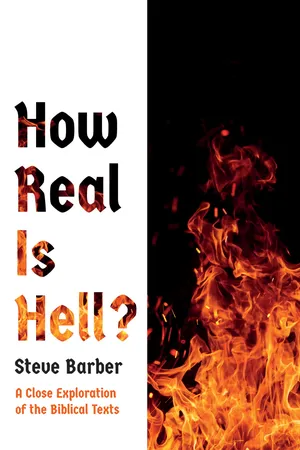
How Real Is Hell? offers guidance for those in pastoral ministry as to what the Bible teaches concerning the eternal fate of the unrighteous. How can the hell-fire language of Jesus be reconciled with Paul's teachings about death and destruction and passages that appear to offer universal hope? What did people understand at the time when Jesus talked about hell, weeping and gnashing of teeth, and worms that will never die? What does the story of the rich man and Lazarus teach us about future judgment? What possibilities are valid for interpreting Jesus' phrase "eternal punishment"?
Through an examination of the biblical texts, How Real Is Hell? offers arguments for and against the three main positions on the eternal fate of the unrighteous: traditional, conditional, and universal. At a time when evangelicals remain divided on the issue, this book will provide helpful insights to enable ministers and others to further reflect on the issue.
The book arose following a pastoral conversation with a person who was deeply disturbed by her traditional understanding of hell as a place of everlasting conscious suffering. How Real Is Hell? aims to better equip those in pastoral ministry to offer help and support to such a person.
Information
Topic
Theology & ReligionSubtopic
Biblical StudiesTable of contents
- Title Page
- Introduction
- Chapter 1: Understanding Géenna (Hell) Imagery
- Chapter 2: Eternal Punishment and the Age to Come
- Chapter 3: The Language of Destruction, Perishing, and Death
- Chapter 4: The Relevance of the Story of the Rich Man and Lazarus
- Chapter 5: Sulfur, Smoke, Torment, and Second Death
- Chapter 6: All Things Reconciled
- Chapter 7: Conclusion to the Descriptive and Synthetic Tasks
- Chapter 8: So What?
- Appendix: Survey
- Bibliography
Trusted by 375,005 students
Access to over 1.5 million titles for a fair monthly price.
Study more efficiently using our study tools.
Frequently asked questions
Yes, you can cancel anytime from the Subscription tab in your account settings on the Perlego website. Your subscription will stay active until the end of your current billing period. Learn how to cancel your subscription
No, books cannot be downloaded as external files, such as PDFs, for use outside of Perlego. However, you can download books within the Perlego app for offline reading on mobile or tablet. Learn how to download books offline
Perlego offers two plans: Essential and Complete
- Essential is ideal for learners and professionals who enjoy exploring a wide range of subjects. Access the Essential Library with 800,000+ trusted titles and best-sellers across business, personal growth, and the humanities. Includes unlimited reading time and Standard Read Aloud voice.
- Complete: Perfect for advanced learners and researchers needing full, unrestricted access. Unlock 1.5M+ books across hundreds of subjects, including academic and specialized titles. The Complete Plan also includes advanced features like Premium Read Aloud and Research Assistant.
We are an online textbook subscription service, where you can get access to an entire online library for less than the price of a single book per month. With over 1.5 million books across 990+ topics, we’ve got you covered! Learn about our mission
Look out for the read-aloud symbol on your next book to see if you can listen to it. The read-aloud tool reads text aloud for you, highlighting the text as it is being read. You can pause it, speed it up and slow it down. Learn more about Read Aloud
Yes! You can use the Perlego app on both iOS and Android devices to read anytime, anywhere — even offline. Perfect for commutes or when you’re on the go.
Please note we cannot support devices running on iOS 13 and Android 7 or earlier. Learn more about using the app
Please note we cannot support devices running on iOS 13 and Android 7 or earlier. Learn more about using the app
Yes, you can access How Real Is Hell? by Steve Barber in PDF and/or ePUB format, as well as other popular books in Theology & Religion & Biblical Studies. We have over 1.5 million books available in our catalogue for you to explore.