Inspired by Mary Anderson's influential work Do No Harm (1999), this book encourages critical reflection on the development and contemporary relevance of conflict sensitivity approaches in international development, humanitarian action and peacebuilding.
Despite the widespread acceptance of conflict sensitivity, particularly in the context of worsening crises, there has been a surprising lack of critical discussion and evaluation of the framework and its application. This book fills this gap by bringing together a diverse collection of articles, practice notes and reflections from academics and practitioners in the field of conflict sensitivity. It provides a comprehensive platform for valuable debate, highlighting strengths, areas for improvement and practical guidance for real- world application, based on 25 years of conflict sensitivity/ do no harm practice and innovation. By integrating insights from practitioners, the book aims to bridge the gap between theory and practice. Advocating the systematic integration of conflict sensitivity into humanitarian, development and peacebuilding efforts, the book offers practical guidance for implementation and adaptation in different contexts and programmes.
As a valuable resource, it deepens understanding and promotes accountability to the populations that humanitarian, development and peacebuilding actors seek to support, including actors advancing conflict sensitivity in their own contexts. It serves as a springboard for further academic research on conflict sensitivity. This book was originally published as a special issue of Development in Practice.
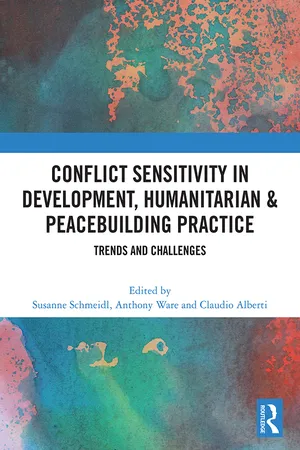
eBook - ePub
Conflict Sensitivity in Development, Humanitarian & Peacebuilding Practice
Trends and Challenges
- 160 pages
- English
- ePUB (mobile friendly)
- Available on iOS & Android
eBook - ePub
Conflict Sensitivity in Development, Humanitarian & Peacebuilding Practice
Trends and Challenges
About this book
Trusted by 375,005 students
Access to over 1.5 million titles for a fair monthly price.
Study more efficiently using our study tools.
Information
Subtopic
Global Development StudiesIndex
Social SciencesTable of contents
- Cover
- Half Title
- Title Page
- Copyright Page
- Contents
- Citation Information
- Notes on Contributors
- Introduction – conflict sensitivity/Do No Harm (DNH) in development, humanitarian, and peacebuilding practice: reflections and emerging trends
- 1 Looking back to look forward
- 2 Necessary complexity in the Anthropocene: new approaches in socio-ecological systems thinking, Do No Harm, and fragility integration
- 3 Conflict sensitivity/Do No Harm (DNH) through an everyday peace lens: analysing a Rohingya–Rakhine program in Myanmar
- 4 Humanitarian cash assistance: risks and opportunities for local peace
- 5 Depoliticised humanitarianism: critiquing the effectiveness of international aid for the Bedouin communities in the Jerusalem periphery
- 6 Peace responsiveness: a paradigm shift to deliver on conflict sensitivity and sustaining peace
- 7 A conflict-sensitivity dilemma: how conflict denialism constrains spaces for conflict-sensitive actions for peacebuilding
- 8 Far beyond a tool: Do No Harm as spiritual (trans)formation for interfaith cooperation and action
- 9 The reform of freetown port: lessons from Political Economy Analysis (PEA) to make conflict sensitivity more efficient
- 10 Conflict sensitivity and activism: insights from Cambodia’s resource conflicts
- 11 Beyond box-ticking: how conflict sensitivity can help bring about a more equitable aid system
- 12 Building a culture of conflict sensitivity within a consortium
- 13 The localisation discourse in post-2021 Myanmar: implications for conflict sensitivity
- 14 Conflict-sensitive research: bringing research ethics into practice
- Index
Frequently asked questions
Yes, you can cancel anytime from the Subscription tab in your account settings on the Perlego website. Your subscription will stay active until the end of your current billing period. Learn how to cancel your subscription
No, books cannot be downloaded as external files, such as PDFs, for use outside of Perlego. However, you can download books within the Perlego app for offline reading on mobile or tablet. Learn how to download books offline
Perlego offers two plans: Essential and Complete
- Essential is ideal for learners and professionals who enjoy exploring a wide range of subjects. Access the Essential Library with 800,000+ trusted titles and best-sellers across business, personal growth, and the humanities. Includes unlimited reading time and Standard Read Aloud voice.
- Complete: Perfect for advanced learners and researchers needing full, unrestricted access. Unlock 1.5M+ books across hundreds of subjects, including academic and specialized titles. The Complete Plan also includes advanced features like Premium Read Aloud and Research Assistant.
We are an online textbook subscription service, where you can get access to an entire online library for less than the price of a single book per month. With over 1.5 million books across 990+ topics, we’ve got you covered! Learn about our mission
Look out for the read-aloud symbol on your next book to see if you can listen to it. The read-aloud tool reads text aloud for you, highlighting the text as it is being read. You can pause it, speed it up and slow it down. Learn more about Read Aloud
Yes! You can use the Perlego app on both iOS and Android devices to read anytime, anywhere — even offline. Perfect for commutes or when you’re on the go.
Please note we cannot support devices running on iOS 13 and Android 7 or earlier. Learn more about using the app
Please note we cannot support devices running on iOS 13 and Android 7 or earlier. Learn more about using the app
Yes, you can access Conflict Sensitivity in Development, Humanitarian & Peacebuilding Practice by Susanne Schmeidl,Anthony Ware,Claudio Alberti in PDF and/or ePUB format, as well as other popular books in Social Sciences & Global Development Studies. We have over 1.5 million books available in our catalogue for you to explore.