Humans, being visually oriented, are well versed in camouflage and how animals hide from predators that use vision to locate prey. However, many predators do not hunt by sight; they hunt by scent. This raises the question: do survival mechanisms and behaviors exist which allow animals to hide from these olfactory predators? If so, what are they, and how do they work?
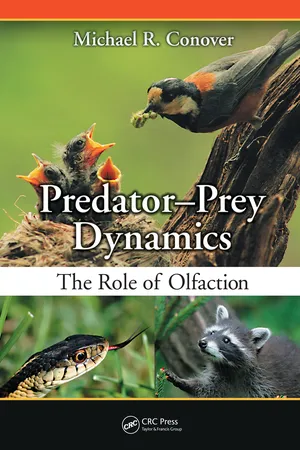
Predator-Prey Dynamics: The Role of Olfaction examines environmental as well as biological and behavioral elements of both predators and prey to answer gaps in our current knowledge of the survival dynamics of species. Beginning with a thorough look at the mechanics of olfaction, the author explains how predators detect, locate, and track their prey using odor trails on the ground or odor plumes in the air. Understanding the physics of airflow is the next step to understanding the potential for manipulating and masking scent. While a bush may conceal an animal visually from a predator, it will not protect an animal from a predator using olfaction. To hide from the latter, an animal needs to hide in locations where turbulence and updrafts will disperse its scent.
The book addresses tradeoffs that animals must make given their dual needs to hide from predators and to procure food and water. Studies of mammalian and avian behavior provide examples on the actual use and efficacy of olfactory camouflage tactics. The book concludes with a redefinition of ecological terms based on the physics of airflow and a summary of the theory and implications of olfactory predator--prey dynamics.
Introducing the mechanics of olfaction and its influence on the behavior of both predators and prey, Predator-Prey Dynamics: The Role of Olfaction presents a new perception of the world and enables us to understand and more effectively manage the delicate survival dynamics of animals in the wild.
- 264 pages
- English
- ePUB (mobile friendly)
- Available on iOS & Android
eBook - ePub
About this book
Information
Table of contents
- Cover
- Half Title
- Title Page
- Copyright Page
- Dedication
- Table of Contents
- Preface
- Acknowledgments
- Chapter 1 Olfactory predators and odorants
- Chapter 2 Detecting and locating prey through depositional odor trails
- Chapter 3 Using airborne odorants to detect the presence of prey
- Chapter 4 Using odor plumes to locate prey and the impact of convection
- Chapter 5 Experimental evidence that updrafts and turbulence hinder the ability of predators to find prey using olfaction
- Chapter 6 Turbulence caused by isolated surface features
- Chapter 7 Turbulence over rough surfaces
- Chapter 8 Turbulence within and below plant canopies
- Chapter 9 Trade-offs required to achieve optimal hiding strategies
- Chapter 10 Impact of olfactory predators on the behavior of female ungulates during parturition and on the behavior of their young
- Chapter 11 Do nest site characteristics influence nest predation rates by olfactory predators?
- Chapter 12 Do weather, convection, isolated surface features, or shelterbelts influence nest predation rates of olfactory predators?
- Chapter 13 Do prairies, savannas, forests, or edge habitats influence nest predation rates of olfactory predators?
- Chapter 14 Using the physics of airflow to redefine common ecological terms
- Chapter 15 Epilogue
- References
- Appendix 1 Latin names of species mentioned in this book
- Appendix 2 Symbols used in this book
- Appendix 3 Forces controlling wind speed and direction
- Appendix 4 Pasquill’s system for measuring atmospheric stability
- Author Index
- Species Index
- Subject Index
Trusted by 375,005 students
Access to over 1.5 million titles for a fair monthly price.
Study more efficiently using our study tools.
Frequently asked questions
Yes, you can cancel anytime from the Subscription tab in your account settings on the Perlego website. Your subscription will stay active until the end of your current billing period. Learn how to cancel your subscription
No, books cannot be downloaded as external files, such as PDFs, for use outside of Perlego. However, you can download books within the Perlego app for offline reading on mobile or tablet. Learn how to download books offline
Perlego offers two plans: Essential and Complete
- Essential is ideal for learners and professionals who enjoy exploring a wide range of subjects. Access the Essential Library with 800,000+ trusted titles and best-sellers across business, personal growth, and the humanities. Includes unlimited reading time and Standard Read Aloud voice.
- Complete: Perfect for advanced learners and researchers needing full, unrestricted access. Unlock 1.5M+ books across hundreds of subjects, including academic and specialized titles. The Complete Plan also includes advanced features like Premium Read Aloud and Research Assistant.
We are an online textbook subscription service, where you can get access to an entire online library for less than the price of a single book per month. With over 1.5 million books across 990+ topics, we’ve got you covered! Learn about our mission
Look out for the read-aloud symbol on your next book to see if you can listen to it. The read-aloud tool reads text aloud for you, highlighting the text as it is being read. You can pause it, speed it up and slow it down. Learn more about Read Aloud
Yes! You can use the Perlego app on both iOS and Android devices to read anytime, anywhere — even offline. Perfect for commutes or when you’re on the go.
Please note we cannot support devices running on iOS 13 and Android 7 or earlier. Learn more about using the app
Please note we cannot support devices running on iOS 13 and Android 7 or earlier. Learn more about using the app
Yes, you can access Predator-Prey Dynamics by Michael R. Conover in PDF and/or ePUB format, as well as other popular books in Biological Sciences & Ecology. We have over 1.5 million books available in our catalogue for you to explore.