- 804 pages
- English
- PDF
- Available on iOS & Android
eBook - PDF
Oil Spill Science and Technology
About this book
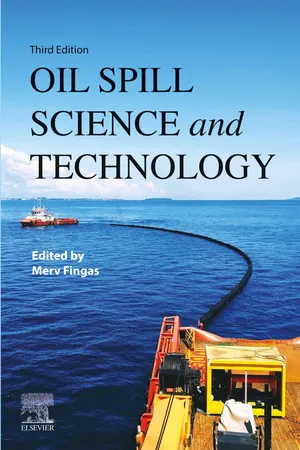
Oil Spill Science and Technology, Third Edition delivers a multi-contributed view on the entire chain of oil-spill related topics from oil properties and behaviors to remote sensing through the management side of contingency planning and communicating oil spill risk perceptions. This new edition compiles information on oil spills from a scientific point of view and with new case studies and examples. This book aims to serve both as an authoritative reference for individuals new to the field who need to understand the depth of science going into the fields of oil spill, recovery, assessment, and analysis, as well as those who have years of experience.Written by over 24 experts in the field, this updated edition combines technology with case studies to identify the current state of knowledge surrounding oil spills that will encourage additional areas of research that are left to uncover in this critical sector of the energy industry.
- Updated with new chapters on: The Deepwater Horizon Spill; Oil Seeps; Processes: MOSSFA, Marine Snow, Tar Ball formation, and more
- Supported with technological advances evolved from the Deepwater Horizon/BP oil tragedy and events in the Arctic/Antarctic
- Multi-contributed from various industry experts to provide an extensive background in technical equipment and worldwide procedures used today
- Presents accurate, peer-reviewed topics with thorough literature review
Information
Table of contents
- Front Cover
- Oil Spill Science and Technology
- Copyright
- Contents
- Contributors
- About the editor
- Author biography
- Preface
- Chapter 1: Introduction to the history of oil spills
- Chapter 2: Photooxidation of oil at sea-Historical perspective, current state of the science and future dire
- Chapter 3: How to model evaporation
- Chapter 4: Water-in-oil emulsions
- Chapter 5: Introduction to spill modeling
- Chapter 6: Review of oil spill remote sensing: The current state of the art
- Chapter 7: In situ burning: A summary
- Chapter 8: Laser fluorosensors for oil spill detection
- Chapter 9: Shoreline countermeasures
- Chapter 10: Remediation of oiled mangroves: Lessons from the Niger Delta
- Chapter 11: Rapid forensic oil identification by direct analysis in real time (DART) with time-of-flight mass spectrometr ...
- Chapter 12: Fates of petroleum compounds from the Deepwater Horizon oil spill
- Chapter 13: Bioremediation strategies for diesel-contaminated Antarctic soils
- Index
- Back Cover
Trusted by 375,005 students
Access to over 1.5 million titles for a fair monthly price.
Study more efficiently using our study tools.
Frequently asked questions
Yes, you can cancel anytime from the Subscription tab in your account settings on the Perlego website. Your subscription will stay active until the end of your current billing period. Learn how to cancel your subscription
No, books cannot be downloaded as external files, such as PDFs, for use outside of Perlego. However, you can download books within the Perlego app for offline reading on mobile or tablet. Learn how to download books offline
Perlego offers two plans: Essential and Complete
- Essential is ideal for learners and professionals who enjoy exploring a wide range of subjects. Access the Essential Library with 800,000+ trusted titles and best-sellers across business, personal growth, and the humanities. Includes unlimited reading time and Standard Read Aloud voice.
- Complete: Perfect for advanced learners and researchers needing full, unrestricted access. Unlock 1.5M+ books across hundreds of subjects, including academic and specialized titles. The Complete Plan also includes advanced features like Premium Read Aloud and Research Assistant.
We are an online textbook subscription service, where you can get access to an entire online library for less than the price of a single book per month. With over 1.5 million books across 990+ topics, we’ve got you covered! Learn about our mission
Look out for the read-aloud symbol on your next book to see if you can listen to it. The read-aloud tool reads text aloud for you, highlighting the text as it is being read. You can pause it, speed it up and slow it down. Learn more about Read Aloud
Yes! You can use the Perlego app on both iOS and Android devices to read anytime, anywhere — even offline. Perfect for commutes or when you’re on the go.
Please note we cannot support devices running on iOS 13 and Android 7 or earlier. Learn more about using the app
Please note we cannot support devices running on iOS 13 and Android 7 or earlier. Learn more about using the app
Yes, you can access Oil Spill Science and Technology by Merv Fingas in PDF and/or ePUB format, as well as other popular books in Biological Sciences & Environmental Science. We have over 1.5 million books available in our catalogue for you to explore.