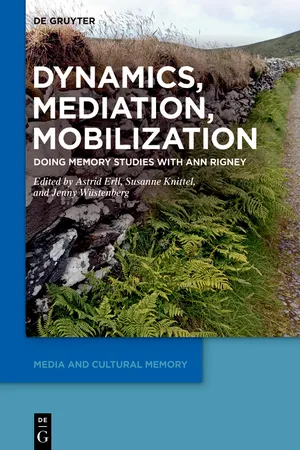
Dynamics, Mediation, Mobilization
eBook - PDF

Dynamics, Mediation, Mobilization

Doing Memory Studies With Ann Rigney

  1. 450 pages
  2. English
  3. PDF
  4. Available on iOS & Android
eBook - PDF

Dynamics, Mediation, Mobilization

Doing Memory Studies With Ann Rigney

About this book

Im Kontext der kulturwissenschaftlichen GedĂ€chtnisforschung widmet sich diese interdisziplinĂ€r ausgerichtete Reihe dem VerhĂ€ltnis von Medien und kultureller Erinnerung. Die hier vorgestellten Studien behandeln die ganze Bandbreite der durch Medien konstruierten, tradierten und verbreiteten Erinnerung. Schrift und Bild, das Kino und die 'neuen' digitalen Medien, IntermedialitĂ€t, TransmedialitĂ€t und Remediation sowie die sozialen, zunehmend transnationalen und transkulturellen, Kontexte der mediatisierten Erinnerung gehören zu den Forschungsinteressen der Reihe. Ziel ist es, eine internationale Plattform fĂŒr die interdisziplinĂ€re Medien- und GedĂ€chtnisforschung zu schaffen. Eingereichte Manuskripte werden im peer review Verfahren durch externe Experten begutachtet.

Den Herausgebern, Astrid Erll (Goethe-UniversitĂ€t Frankfurt am Main) und Ansgar NĂŒnning (Justus-Liebig-UniversitĂ€t Gießen) ist ein internationaler Beirat aus renommierten Wissenschaftlern assoziiert:

  • Aleida Assmann (UniversitĂ€t Konstanz)
  • Mieke Bal (University of Amsterdam)
  • Vita Fortunati (University of Bologna)
  • Richard Grusin (University of Wisconsin-Milwaukee)
  • Udo Hebel (UniversitĂ€t Regensburg)
  • Andrew Hoskins (University of Glasgow)
  • Wulf Kansteiner (Binghamton University)
  • Alison Landsberg (George Mason University)
  • Claus Leggewie (Kulturwissenschaftliches Institut Essen)
  • Jeffrey Olick (University of Virginia)
  • Susannah Radstone (University of South Australia)
  • Ann Rigney (Utrecht University)
  • Michael Rothberg (University of Illinois)
  • Werner Sollors (Harvard University)
  • Frederic Tygstrup (University of Copenhagen)
  • Harald Welzer (Kulturwissenschaftliches Institut Essen)

Trusted by 375,005 students

Access to over 1.5 million titles for a fair monthly price.

Study more efficiently using our study tools.

Information

Publisher
De Gruyter
Year
2024
eBook ISBN
9783111439273

Table of contents

  1. Acknowledgements
  2. Contents
  3. Introduction: Doing Memory Studies with Ann Rigney
  4. 1 History, Narrative, Memory
  5. History, Memory, and Historical Theory: Five Ideas for Good Memory Management
  6. Stories We Remember By: Narrativity and Memory-Making
  7. Narratives at my Doorstep: Researching Memory as an “Improper Historian”
  8. The Nation Facing Its Memories
  9. Orating Prememory from the Dock
  10. Divided Narratives and the Crisis of National Solidarity
  11. 2 The Dynamics of Memory
  12. Memory in Motion: The Dynamic Turn
  13. The Dynamics of Postmemory
  14. The Political Economy of Memory
  15. Digging Up Mnemonic Fossils
  16. Flashbulb Memories as Sites for Collective Memories
  17. Eccentric Agency: Women ‘Remembering’ Chattel Slavery
  18. Transmutations of an Argentine Site of Traumatic Memory
  19. Citrus: An Experiment in Memory Work
  20. 3 Mediation and Remediation
  21. Mediation and Prosthetic Memory
  22. The Platformization of Scholarly Legacy
  23. Memory and Platformization
  24. Memory and Artificial Intelligence
  25. Cultural Memory and Cultural Analytics
  26. The Media Amnesia of Capital Accumulation
  27. 4 Life and Afterlives of Memory
  28. Afterlives of Literature: Five Lessons from Odyssean Mnemohistory
  29. The Afterlives of a National Apology: From Reconciliation to Self-Determination
  30. The Cultural Memory of Protest Slogans
  31. Musical After/Lives: Cultural Remembrance and Distributed Creativity
  32. Posthumanist Dreams of Imperfect Memories
  33. How a Footnote Remembers
  34. A Portable Fatherland: Afterlives of the St. George’s Night Uprising (1343) in Estonian Cultural Memory
  35. 5 National and Transnational Memory
  36. Transnational Memory Reconsidered
  37. How (Post) Memory Matters to Justice
  38. Flags, Hearts, and Stamps: The Transnational Memory of COVID-19
  39. Remembering the Female Partisan: Sanja Iveković’s Transnational Memory Work
  40. Articulation, Politics and the Aesthetic: Yeats’s Nobel Prize, 1923–2023
  41. Memory Translation and Minor Transnationalism
  42. 6 The Matter of Memory
  43. Remembering Things: The Materiality of Memory and the Memory of Materials
  44. Accidental Archives and Diffractive Reading: Gladys Mgudlandlu and the Resistant Periodical Memory Object
  45. The Transcultural Mnemonic Agency of “Post-German” Things in Poland
  46. Provocative Objects and the Remaking of Cultural Memory
  47. Bones of Contention: Necrotoxicity in the Francoist Underworld
  48. Ecologies of the Discarded: Cartographic Collage as Mnemonic Recovery
  49. Who and What Matters in Literary Memory
  50. 7 The Agency of the Aesthetic
  51. Multidirectional Memory and the Agency of the Aesthetic
  52. Scales of Memory: Family Chronicles and the Agency of the Aesthetic
  53. Remembering Earth: Countering Planetary Amnesia through the Creative Ar
  54. Post-Religious Memory and the Agency of the Aesthetic: ‘Small acts of repair’ in Lucas Rijneveld’s The Discomfort of Evening
  55. Writing for the Birds: Early Irish Lyrics and the Unravelling of Cultural Memory
  56. Affiliation and Mediation: Memory in Performance in An Old Song Half Forgotten by Deirdre Kinahan
  57. Aesthetic Autonomy after Adorno
  58. 8 The Memory-Activism Nexus
  59. Memories, Social Movements and Activism from Below
  60. “Activist Memory” and Trade Unionism ‘Splintering’ the Memory-Activism Nexus: State and Market Forces in the Vortex of Civic Memory
  61. ‘Splintering’ the Memory-Activism Nexus: State and Market Forces in the Vortex of Civic Memory
  62. Visual Memory of Protest in the Age of Generative Artificial Intelligence
  63. Remembering Autism in the Memory-Activism Nexus
  64. Monuments as Actants of Mnemonic Change
  65. Activist Afterlives
  66. Bibliography
  67. The Authors
  68. Index

Frequently asked questions

Yes, you can cancel anytime from the Subscription tab in your account settings on the Perlego website. Your subscription will stay active until the end of your current billing period. Learn how to cancel your subscription
No, books cannot be downloaded as external files, such as PDFs, for use outside of Perlego. However, you can download books within the Perlego app for offline reading on mobile or tablet. Learn how to download books offline
Perlego offers two plans: Essential and Complete
  • Essential is ideal for learners and professionals who enjoy exploring a wide range of subjects. Access the Essential Library with 800,000+ trusted titles and best-sellers across business, personal growth, and the humanities. Includes unlimited reading time and Standard Read Aloud voice.
  • Complete: Perfect for advanced learners and researchers needing full, unrestricted access. Unlock 1.5M+ books across hundreds of subjects, including academic and specialized titles. The Complete Plan also includes advanced features like Premium Read Aloud and Research Assistant.
Both plans are available with monthly, semester, or annual billing cycles.
We are an online textbook subscription service, where you can get access to an entire online library for less than the price of a single book per month. With over 1.5 million books across 990+ topics, we’ve got you covered! Learn about our mission
Look out for the read-aloud symbol on your next book to see if you can listen to it. The read-aloud tool reads text aloud for you, highlighting the text as it is being read. You can pause it, speed it up and slow it down. Learn more about Read Aloud
Yes! You can use the Perlego app on both iOS and Android devices to read anytime, anywhere — even offline. Perfect for commutes or when you’re on the go.
Please note we cannot support devices running on iOS 13 and Android 7 or earlier. Learn more about using the app
Yes, you can access Dynamics, Mediation, Mobilization by Astrid Erll,Susanne Knittel,Jenny WĂŒstenberg in PDF and/or ePUB format, as well as other popular books in Social Sciences & Literary Criticism. We have over 1.5 million books available in our catalogue for you to explore.